

9.2 Generalization to Many-Nucleon Projectiles
443
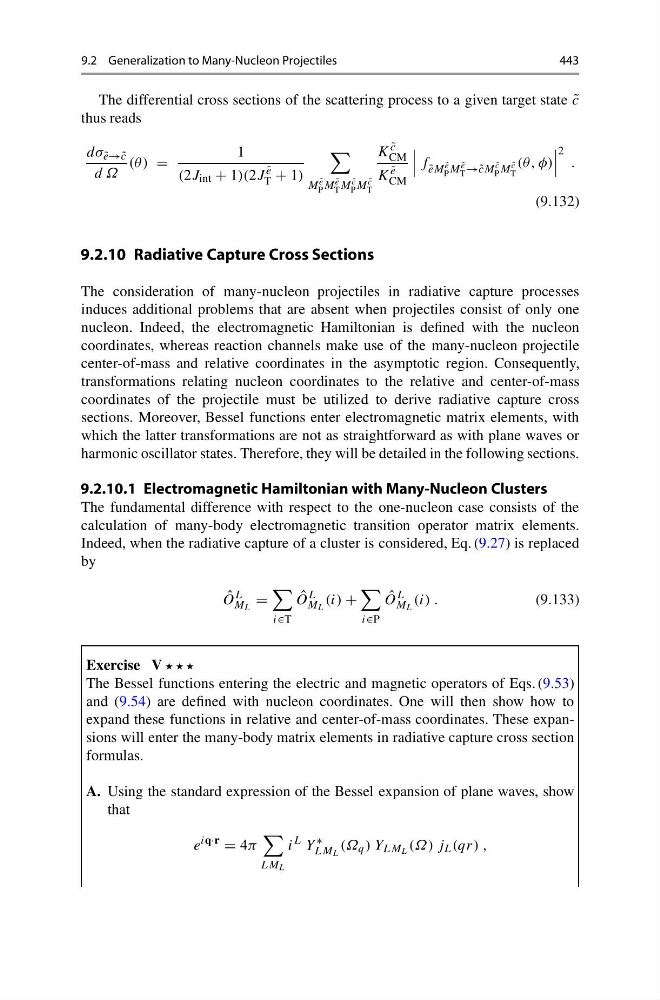
The differential cross sections of the scattering process to a given target state ˜
c
thus reads
dσ ˜
e→˜ c
d Ω
(θ ) =
1
(2J int + 1)(2J
˜
e
T + 1)
M ˜
e
P M ˜
e
T M ˜
c
P M ˜
c
T
K
˜
c
CM
K
˜
e
CM
f ˜
eM ˜
e
P M ˜
e
T →˜ cM ˜
c
P M ˜
c
T
(θ, φ)
2
.
(9.132)
9.2.10 Radiative Capture Cross Sections
The consideration of many-nucleon projectiles in radiative capture processes
induces additional problems that are absent when projectiles consist of only one
nucleon. Indeed, the electromagnetic Hamiltonian is defined with the nucleon
coordinates, whereas reaction channels make use of the many-nucleon projectile
center-of-mass and relative coordinates in the asymptotic region. Consequently,
transformations relating nucleon coordinates to the relative and center-of-mass
coordinates of the projectile must be utilized to derive radiative capture cross
sections. Moreover, Bessel functions enter electromagnetic matrix elements, with
which the latter transformations are not as straightforward as with plane waves or
harmonic oscillator states. Therefore, they will be detailed in the following sections.
9.2.10.1 Electromagnetic Hamiltonian with Many-Nucleon Clusters
The fundamental difference with respect to the one-nucleon case consists of the
calculation of many-body electromagnetic transition operator matrix elements.
Indeed, when the radiative capture of a cluster is considered, Eq. (9.27) is replaced
by
ˆ
O
L
M L
=
i∈T
ˆ
O
L
M L
(i) +
i∈P
ˆ
O
L
M L
(i) .
(9.133)
Exercise V
The Bessel functions entering the electric and magnetic operators of Eqs. (9.53)
and (9.54) are defined with nucleon coordinates. One will then show how to
expand these functions in relative and center-of-mass coordinates. These expansions will enter the many-body matrix elements in radiative capture cross section
formulas.
A. Using the standard expression of the Bessel expansion of plane waves, show
that
e
iq·r
= 4π
LM L
i
L Y
∗
LM L
(Ω q ) Y LM L (Ω) j L (qr) ,
443
The differential cross sections of the scattering process to a given target state ˜
c
thus reads
dσ ˜
e→˜ c
d Ω
(θ ) =
1
(2J int + 1)(2J
˜
e
T + 1)
M ˜
e
P M ˜
e
T M ˜
c
P M ˜
c
T
K
˜
c
CM
K
˜
e
CM
f ˜
eM ˜
e
P M ˜
e
T →˜ cM ˜
c
P M ˜
c
T
(θ, φ)
2
.
(9.132)
9.2.10 Radiative Capture Cross Sections
The consideration of many-nucleon projectiles in radiative capture processes
induces additional problems that are absent when projectiles consist of only one
nucleon. Indeed, the electromagnetic Hamiltonian is defined with the nucleon
coordinates, whereas reaction channels make use of the many-nucleon projectile
center-of-mass and relative coordinates in the asymptotic region. Consequently,
transformations relating nucleon coordinates to the relative and center-of-mass
coordinates of the projectile must be utilized to derive radiative capture cross
sections. Moreover, Bessel functions enter electromagnetic matrix elements, with
which the latter transformations are not as straightforward as with plane waves or
harmonic oscillator states. Therefore, they will be detailed in the following sections.
9.2.10.1 Electromagnetic Hamiltonian with Many-Nucleon Clusters
The fundamental difference with respect to the one-nucleon case consists of the
calculation of many-body electromagnetic transition operator matrix elements.
Indeed, when the radiative capture of a cluster is considered, Eq. (9.27) is replaced
by
ˆ
O
L
M L
=
i∈T
ˆ
O
L
M L
(i) +
i∈P
ˆ
O
L
M L
(i) .
(9.133)
Exercise V
The Bessel functions entering the electric and magnetic operators of Eqs. (9.53)
and (9.54) are defined with nucleon coordinates. One will then show how to
expand these functions in relative and center-of-mass coordinates. These expansions will enter the many-body matrix elements in radiative capture cross section
formulas.
A. Using the standard expression of the Bessel expansion of plane waves, show
that
e
iq·r
= 4π
LM L
i
L Y
∗
LM L
(Ω q ) Y LM L (Ω) j L (qr) ,