

444
9 The Unification of Structure and Reaction Frameworks
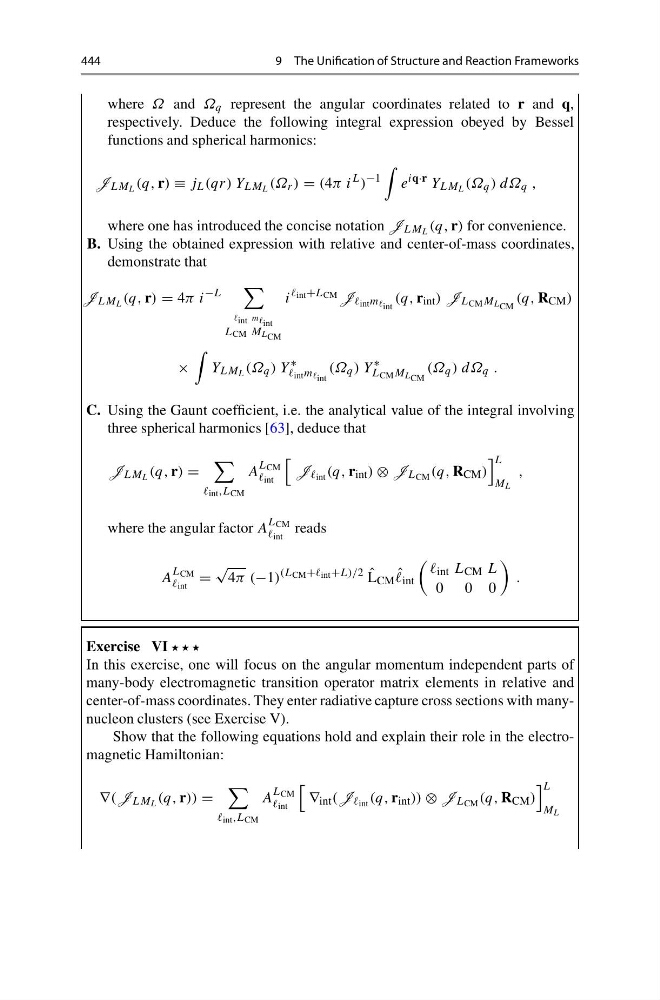
where Ω and Ω q represent the angular coordinates related to r and q,
respectively. Deduce the following integral expression obeyed by Bessel
functions and spherical harmonics:
J LM L (q, r) ≡ j L (qr) Y LM L (Ω r ) = (4π i
L )
−1
e
iq·r Y LM L (Ω q ) dΩ q ,
where one has introduced the concise notation J LM L (q, r) for convenience.
B. Using the obtained expression with relative and center-of-mass coordinates,
demonstrate that
J LM L (q, r) = 4π i
−L
int m int
L CM M L CM
i
int +L CM J int m int (q, r int ) J L CM M L CM (q, R CM )
×
Y LM L (Ω q ) Y
∗
int m int
(Ω q ) Y
∗
L CM M L CM
(Ω q ) dΩ q .
C. Using the Gaunt coefficient, i.e. the analytical value of the integral involving
three spherical harmonics [63], deduce that
J LM L (q, r) =
int ,L CM
A
L CM
int
J int (q, r int ) ⊗ J L CM (q, R CM )
L
M L
,
where the angular factor A
L CM
int
reads
A
L CM
int
=
√
4π (−1)
(L CM + int +L)/2 ˆ
L CM ˆ
int
int L CM L
0 0 0
.
Exercise VI
In this exercise, one will focus on the angular momentum independent parts of
many-body electromagnetic transition operator matrix elements in relative and
center-of-mass coordinates. They enter radiative capture cross sections with manynucleon clusters (see Exercise V).
Show that the following equations hold and explain their role in the electromagnetic Hamiltonian:
∇(J LM L (q, r)) =
int ,L CM
A
L CM
int
∇ int (J int (q, r int )) ⊗ J L CM (q, R CM )
L
M L
9 The Unification of Structure and Reaction Frameworks
where Ω and Ω q represent the angular coordinates related to r and q,
respectively. Deduce the following integral expression obeyed by Bessel
functions and spherical harmonics:
J LM L (q, r) ≡ j L (qr) Y LM L (Ω r ) = (4π i
L )
−1
e
iq·r Y LM L (Ω q ) dΩ q ,
where one has introduced the concise notation J LM L (q, r) for convenience.
B. Using the obtained expression with relative and center-of-mass coordinates,
demonstrate that
J LM L (q, r) = 4π i
−L
int m int
L CM M L CM
i
int +L CM J int m int (q, r int ) J L CM M L CM (q, R CM )
×
Y LM L (Ω q ) Y
∗
int m int
(Ω q ) Y
∗
L CM M L CM
(Ω q ) dΩ q .
C. Using the Gaunt coefficient, i.e. the analytical value of the integral involving
three spherical harmonics [63], deduce that
J LM L (q, r) =
int ,L CM
A
L CM
int
J int (q, r int ) ⊗ J L CM (q, R CM )
L
M L
,
where the angular factor A
L CM
int
reads
A
L CM
int
=
√
4π (−1)
(L CM + int +L)/2 ˆ
L CM ˆ
int
int L CM L
0 0 0
.
Exercise VI
In this exercise, one will focus on the angular momentum independent parts of
many-body electromagnetic transition operator matrix elements in relative and
center-of-mass coordinates. They enter radiative capture cross sections with manynucleon clusters (see Exercise V).
Show that the following equations hold and explain their role in the electromagnetic Hamiltonian:
∇(J LM L (q, r)) =
int ,L CM
A
L CM
int
∇ int (J int (q, r int )) ⊗ J L CM (q, R CM )
L
M L