

442
9 The Unification of Structure and Reaction Frameworks
It is possible to generalize Eq. (9.128) to the use of projectiles bearing
more than one internal degree of freedom. For this, one replaces V (T) (r, R) by
V (T) (r 1 , . . . , r a , R), where r 1 , . . . , r a are the relative radii associated to the a + 1
subsystems of the projectile. Consequently, Eq. (9.124) now depends on r 1 , . . . , r a ,
so that it is now a multidimensional equation, to be solved with, e.g., Gamow
shell model. However, the numerical cost of solving Eq. (9.124) and calculating the
matrix elements of Eq. (9.128) increases quickly with a, so due to computational
limitations one can expect this method to be practical only if a = 2, 3.
9.2.9 Elastic and Inelastic Scattering Cross Sections
The cross section expression for direct reaction is very close to that presented in
Sect. 9.1.3, where r must be substituted by R CM and where the internal angular
momentum of the projectile, equal to 1/2 for one-nucleon projectiles, is now equal to
J int . Therefore, one will restate cross sections formulas in the case of many-nucleon
projectiles for clarity, insisting only on the differences with the one-nucleon case.
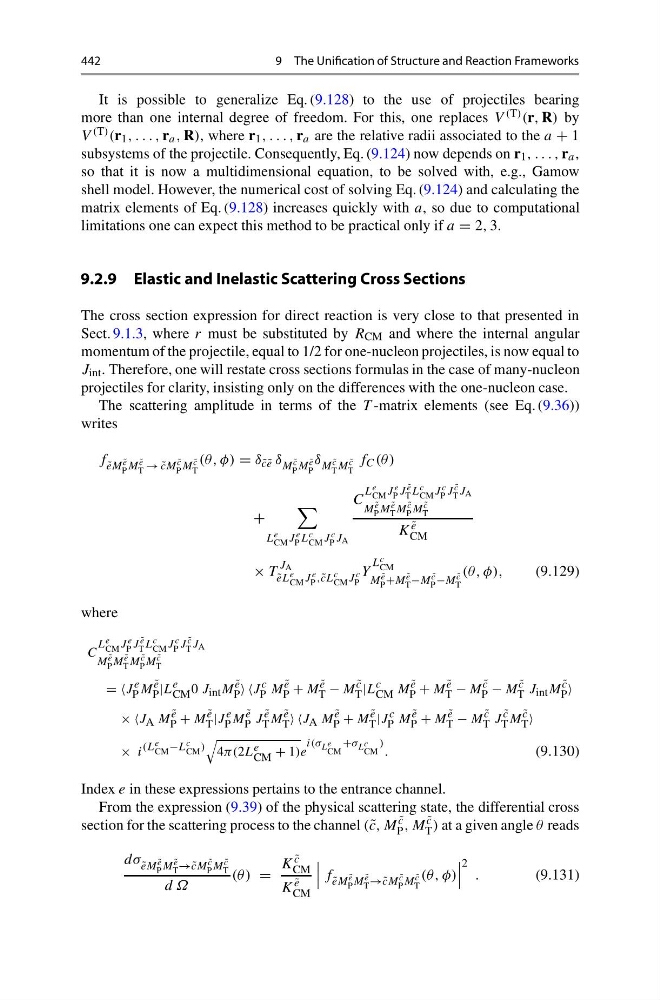
The scattering amplitude in terms of the T -matrix elements (see Eq. (9.36))
writes
f ˜
eM ˜
e
P M ˜
e
T → ˜
cM ˜
c
P M ˜
c
T
(θ, φ) = δ ˜
c ˜
e δ M ˜
c
P M ˜
e
P
δ M ˜
c
T M ˜
c
T
f C (θ )
+
L e
CM J e
P L c
CM J c
P J A
C
L e
CM J e
P J ˜
e
T L c
CM J c
P J ˜
c
T J A
M ˜
e
P M ˜
e
T M ˜
c
P M ˜
c
T
K
˜
e
CM
× T
J A
˜
eL e
CM J e
P , ˜
cL c
CM J c
P
Y
L c
CM
M ˜
e
P +M ˜
e
T −M ˜
c
P −M ˜
c
T
(θ, φ),
(9.129)
where
C
L e
CM J e
P J ˜
e
T L c
CM J c
P J ˜
c
T J A
M ˜
e
P M ˜
e
T M ˜
c
P M ˜
c
T
= =J e
P M ˜
e
P |L e
CM 0 J int M ˜
e
P c
P M ˜
e
P + M ˜
e
T − M ˜
c
T |L c
CM M ˜
e
P + M ˜
e
T − M ˜
c
P − M ˜
c
T J int M ˜
c
P
× ×J A M ˜
e
P + M ˜
e
T |J e
P M ˜
e
P J ˜
e
T M ˜
e
T A M ˜
e
P + M ˜
e
T |J c
P M ˜
e
P + M ˜
e
T − M ˜
c
T J ˜
c
T M ˜
c
T
× i (L e
CM −L c
CM )
4π(2L e
CM + 1)e
i(σ L e
CM
+σ L c
CM
)
.
(9.130)
Index e in these expressions pertains to the entrance channel.
From the expression (9.39) of the physical scattering state, the differential cross
section for the scattering process to the channel ( ˜
c, M
˜
c
P , M
˜
c
T ) at a given angle θ reads
dσ ˜
eM ˜
e
P M ˜
e
T →˜ cM ˜
c
P M ˜
c
T
d Ω
(θ ) =
K
˜
c
CM
K
˜
e
CM
f ˜
eM ˜
e
P M ˜
e
T →˜ cM ˜
c
P M ˜
c
T
(θ, φ)
2
.
(9.131)
9 The Unification of Structure and Reaction Frameworks
It is possible to generalize Eq. (9.128) to the use of projectiles bearing
more than one internal degree of freedom. For this, one replaces V (T) (r, R) by
V (T) (r 1 , . . . , r a , R), where r 1 , . . . , r a are the relative radii associated to the a + 1
subsystems of the projectile. Consequently, Eq. (9.124) now depends on r 1 , . . . , r a ,
so that it is now a multidimensional equation, to be solved with, e.g., Gamow
shell model. However, the numerical cost of solving Eq. (9.124) and calculating the
matrix elements of Eq. (9.128) increases quickly with a, so due to computational
limitations one can expect this method to be practical only if a = 2, 3.
9.2.9 Elastic and Inelastic Scattering Cross Sections
The cross section expression for direct reaction is very close to that presented in
Sect. 9.1.3, where r must be substituted by R CM and where the internal angular
momentum of the projectile, equal to 1/2 for one-nucleon projectiles, is now equal to
J int . Therefore, one will restate cross sections formulas in the case of many-nucleon
projectiles for clarity, insisting only on the differences with the one-nucleon case.
The scattering amplitude in terms of the T -matrix elements (see Eq. (9.36))
writes
f ˜
eM ˜
e
P M ˜
e
T → ˜
cM ˜
c
P M ˜
c
T
(θ, φ) = δ ˜
c ˜
e δ M ˜
c
P M ˜
e
P
δ M ˜
c
T M ˜
c
T
f C (θ )
+
L e
CM J e
P L c
CM J c
P J A
C
L e
CM J e
P J ˜
e
T L c
CM J c
P J ˜
c
T J A
M ˜
e
P M ˜
e
T M ˜
c
P M ˜
c
T
K
˜
e
CM
× T
J A
˜
eL e
CM J e
P , ˜
cL c
CM J c
P
Y
L c
CM
M ˜
e
P +M ˜
e
T −M ˜
c
P −M ˜
c
T
(θ, φ),
(9.129)
where
C
L e
CM J e
P J ˜
e
T L c
CM J c
P J ˜
c
T J A
M ˜
e
P M ˜
e
T M ˜
c
P M ˜
c
T
= =J e
P M ˜
e
P |L e
CM 0 J int M ˜
e
P c
P M ˜
e
P + M ˜
e
T − M ˜
c
T |L c
CM M ˜
e
P + M ˜
e
T − M ˜
c
P − M ˜
c
T J int M ˜
c
P
× ×J A M ˜
e
P + M ˜
e
T |J e
P M ˜
e
P J ˜
e
T M ˜
e
T A M ˜
e
P + M ˜
e
T |J c
P M ˜
e
P + M ˜
e
T − M ˜
c
T J ˜
c
T M ˜
c
T
× i (L e
CM −L c
CM )
4π(2L e
CM + 1)e
i(σ L e
CM
+σ L c
CM
)
.
(9.130)
Index e in these expressions pertains to the entrance channel.
From the expression (9.39) of the physical scattering state, the differential cross
section for the scattering process to the channel ( ˜
c, M
˜
c
P , M
˜
c
T ) at a given angle θ reads
dσ ˜
eM ˜
e
P M ˜
e
T →˜ cM ˜
c
P M ˜
c
T
d Ω
(θ ) =
K
˜
c
CM
K
˜
e
CM
f ˜
eM ˜
e
P M ˜
e
T →˜ cM ˜
c
P M ˜
c
T
(θ, φ)
2
.
(9.131)