

2.3 Coulomb Potential and Coulomb Wave Functions
29
The asymptotic forms of Coulomb wave functions for r fixed and k → 0 in
the complex plane can be expressed from their analytical formulas, function of
confluent hypergeometric functions (see Eqs. (2.29), (2.32), and (2.34) and Ref. [8]).
Contrary to real k values, these equivalents are complex functions of k and and
possess branch cuts in the complex plane. However, one can derive useful equalities
using the analytical properties of Coulomb wave functions:
F η (kr) = k
+1 C (η) f B ((, k, r) ,
(2.60)
H
+
η (kr) = k
− C (η)
−1 h
+
B ((, k, r) ,
(2.61)
where f B ((, k, r) and h
+
B ((, k, r) are bounded when k → 0 if v c ≥ 0 and
(k) ≥ 0 in Eq. (2.61). It is straightforward to obtain Eq. (2.60) using the power
series expansion of F η (kr) (see Eq. (2.37)). If 2 is not an integer, Eq. (2.61) can
be then derived using Eqs. (2.39) and (2.60). Conversely, when 2 is an integer, it is
preferable to use the analytical expression of the 2 F 0 function based on power series
[8, 13] in Eq. (2.32) for that matter. Note that Eqs. (2.60) and (2.61) are also correct
if v c < 0 provided that one avoids the close vicinity of the poles associated to bound
states in the k-plane [13].
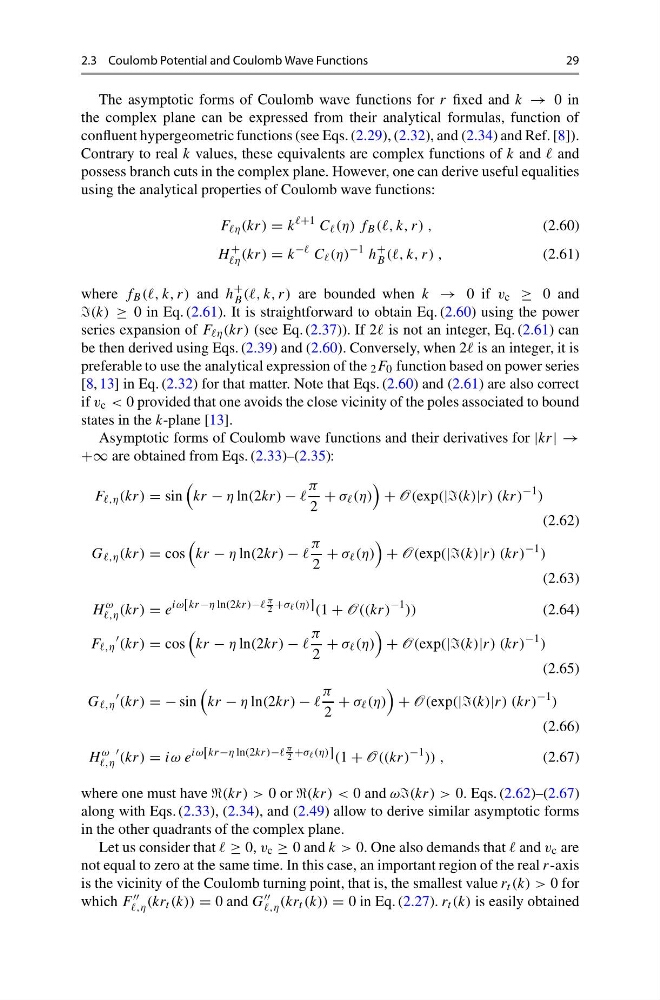
Asymptotic forms of Coulomb wave functions and their derivatives for |kr| →
+∞ are obtained from Eqs. (2.33)–(2.35):
F ,η (kr) = sin
kr − η ln(2kr) −
π
2
+ σ (η)
+ O(exp(||(k)|r) (kr)
−1 )
(2.62)
G ,η (kr) = cos
kr − η ln(2kr) −
π
2
+ σ (η)
+ O(exp(||(k)|r) (kr)
−1 )
(2.63)
H
ω
,η (kr) = e
iω[kr−η ln(2kr)−
π
2 +σ (η)] (1 + O((kr)
−1 ))
(2.64)
F ,η
(kr) = cos
kr − η ln(2kr) −
π
2
+ σ (η)
+ O(exp(||(k)|r) (kr)
−1 )
(2.65)
G ,η
(kr) = − sin
kr − η ln(2kr) −
π
2
+ σ (η)
+ O(exp(||(k)|r) (kr)
−1 )
(2.66)
H
ω
,η
(kr) = iω e
iω[kr−η ln(2kr)−
π
2 +σ (η)] (1 + O((kr)
−1 )) ,
(2.67)
where one must have (kr) > 0 or (kr) < 0 and ω(kr) > 0. Eqs. (2.62)–(2.67)
along with Eqs. (2.33), (2.34), and (2.49) allow to derive similar asymptotic forms
in the other quadrants of the complex plane.
Let us consider that ≥ 0, v c ≥ 0 and k > 0. One also demands that and v c are
not equal to zero at the same time. In this case, an important region of the real r-axis
is the vicinity of the Coulomb turning point, that is, the smallest value r t (k) > 0 for
which F
,η (kr t (k)) = 0 and G
,η (kr t (k)) = 0 in Eq. (2.27). r t (k) is easily obtained
29
The asymptotic forms of Coulomb wave functions for r fixed and k → 0 in
the complex plane can be expressed from their analytical formulas, function of
confluent hypergeometric functions (see Eqs. (2.29), (2.32), and (2.34) and Ref. [8]).
Contrary to real k values, these equivalents are complex functions of k and and
possess branch cuts in the complex plane. However, one can derive useful equalities
using the analytical properties of Coulomb wave functions:
F η (kr) = k
+1 C (η) f B ((, k, r) ,
(2.60)
H
+
η (kr) = k
− C (η)
−1 h
+
B ((, k, r) ,
(2.61)
where f B ((, k, r) and h
+
B ((, k, r) are bounded when k → 0 if v c ≥ 0 and
(k) ≥ 0 in Eq. (2.61). It is straightforward to obtain Eq. (2.60) using the power
series expansion of F η (kr) (see Eq. (2.37)). If 2 is not an integer, Eq. (2.61) can
be then derived using Eqs. (2.39) and (2.60). Conversely, when 2 is an integer, it is
preferable to use the analytical expression of the 2 F 0 function based on power series
[8, 13] in Eq. (2.32) for that matter. Note that Eqs. (2.60) and (2.61) are also correct
if v c < 0 provided that one avoids the close vicinity of the poles associated to bound
states in the k-plane [13].
Asymptotic forms of Coulomb wave functions and their derivatives for |kr| →
+∞ are obtained from Eqs. (2.33)–(2.35):
F ,η (kr) = sin
kr − η ln(2kr) −
π
2
+ σ (η)
+ O(exp(||(k)|r) (kr)
−1 )
(2.62)
G ,η (kr) = cos
kr − η ln(2kr) −
π
2
+ σ (η)
+ O(exp(||(k)|r) (kr)
−1 )
(2.63)
H
ω
,η (kr) = e
iω[kr−η ln(2kr)−
π
2 +σ (η)] (1 + O((kr)
−1 ))
(2.64)
F ,η
(kr) = cos
kr − η ln(2kr) −
π
2
+ σ (η)
+ O(exp(||(k)|r) (kr)
−1 )
(2.65)
G ,η
(kr) = − sin
kr − η ln(2kr) −
π
2
+ σ (η)
+ O(exp(||(k)|r) (kr)
−1 )
(2.66)
H
ω
,η
(kr) = iω e
iω[kr−η ln(2kr)−
π
2 +σ (η)] (1 + O((kr)
−1 )) ,
(2.67)
where one must have (kr) > 0 or (kr) < 0 and ω(kr) > 0. Eqs. (2.62)–(2.67)
along with Eqs. (2.33), (2.34), and (2.49) allow to derive similar asymptotic forms
in the other quadrants of the complex plane.
Let us consider that ≥ 0, v c ≥ 0 and k > 0. One also demands that and v c are
not equal to zero at the same time. In this case, an important region of the real r-axis
is the vicinity of the Coulomb turning point, that is, the smallest value r t (k) > 0 for
which F
,η (kr t (k)) = 0 and G
,η (kr t (k)) = 0 in Eq. (2.27). r t (k) is easily obtained