

28
2 The Discrete Spectrum and the Continuum
2.3.3 Asymptotic Forms of Coulomb Wave Functions for Small
and Large Arguments
Coulomb wave functions appear as a function of z = kr in radial wave functions
(see Eq. (2.7)). Therefore, it is convenient to have asymptotic forms of Coulomb
wave functions for k → 0 and r > 0 fixed.
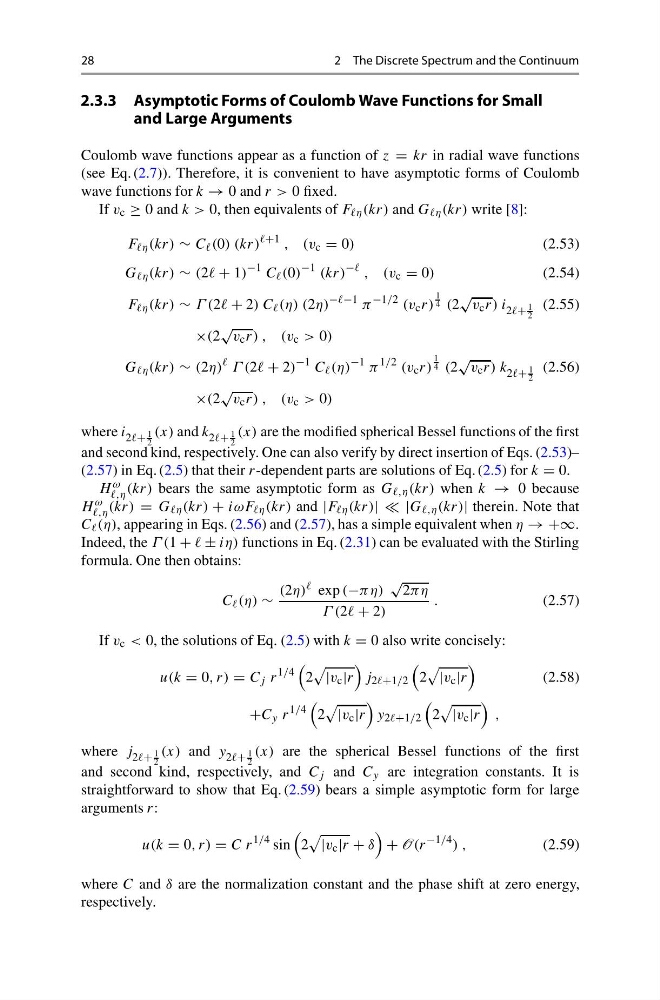
If v c ≥ 0 and k > 0, then equivalents of F η (kr) and G η (kr) write [8]:
F η (kr) ∼ C (0) (kr)
, (v c = 0)
(2.53)
G η (kr) ∼ (2 + 1)
−1 C (0)
−1 (kr)
− , (v c = 0)
(2.54)
F η (kr) ∼ Γ (2 + 2) C (η) (2η)
− π
−1/2 (v c r)
1
4 (2
√
v c r) i 2
1
2
(2.55)
×(2
√
v c r) , (v c > 0)
G η (kr) ∼ (2η)
Γ (2 + 2)
−1 C (η)
−1 π
1/2 (v c r)
1
4 (2
√
v c r) k 2
1
2
(2.56)
×(2
√
v c r) , (v c > 0)
where i 2
1
2
(x) and k 2
1
2
(x) are the modified spherical Bessel functions of the first
and second kind, respectively. One can also verify by direct insertion of Eqs. (2.53)–
(2.57) in Eq. (2.5) that their r-dependent parts are solutions of Eq. (2.5) for k = 0.
H ω
,η (kr) bears the same asymptotic form as G ,η (kr) when k → 0 because
H ω
,η (kr) = G η (kr) + iωF η (kr) and |F η (kr)| | |G ,η (kr)| therein. Note that
C (η), appearing in Eqs. (2.56) and (2.57), has a simple equivalent when η → +∞.
Indeed, the Γ (1 + ± iη) functions in Eq. (2.31) can be evaluated with the Stirling
formula. One then obtains:
C (η) ∼
(2η) exp (−πη)
√
2πη
Γ (2 + 2)
.
(2.57)
If v c < 0, the solutions of Eq. (2.5) with k = 0 also write concisely:
u(k = 0, r) = C j r
1/4
2
|v c |r
j 2
2
|v c |r
(2.58)
+C y r
1/4
2
|v c |r
y 2
2
|v c |r
,
where j 2
1
2
(x) and y 2
1
2
(x) are the spherical Bessel functions of the first
and second kind, respectively, and C j and C y are integration constants. It is
straightforward to show that Eq. (2.59) bears a simple asymptotic form for large
arguments r:
u(k = 0, r) = C r
1/4 sin
2
|v c |r + δ
+ O(r
−1/4 ) ,
(2.59)
where C and δ are the normalization constant and the phase shift at zero energy,
respectively.
2 The Discrete Spectrum and the Continuum
2.3.3 Asymptotic Forms of Coulomb Wave Functions for Small
and Large Arguments
Coulomb wave functions appear as a function of z = kr in radial wave functions
(see Eq. (2.7)). Therefore, it is convenient to have asymptotic forms of Coulomb
wave functions for k → 0 and r > 0 fixed.
If v c ≥ 0 and k > 0, then equivalents of F η (kr) and G η (kr) write [8]:
F η (kr) ∼ C (0) (kr)
, (v c = 0)
(2.53)
G η (kr) ∼ (2 + 1)
−1 C (0)
−1 (kr)
− , (v c = 0)
(2.54)
F η (kr) ∼ Γ (2 + 2) C (η) (2η)
− π
−1/2 (v c r)
1
4 (2
√
v c r) i 2
1
2
(2.55)
×(2
√
v c r) , (v c > 0)
G η (kr) ∼ (2η)
Γ (2 + 2)
−1 C (η)
−1 π
1/2 (v c r)
1
4 (2
√
v c r) k 2
1
2
(2.56)
×(2
√
v c r) , (v c > 0)
where i 2
1
2
(x) and k 2
1
2
(x) are the modified spherical Bessel functions of the first
and second kind, respectively. One can also verify by direct insertion of Eqs. (2.53)–
(2.57) in Eq. (2.5) that their r-dependent parts are solutions of Eq. (2.5) for k = 0.
H ω
,η (kr) bears the same asymptotic form as G ,η (kr) when k → 0 because
H ω
,η (kr) = G η (kr) + iωF η (kr) and |F η (kr)| | |G ,η (kr)| therein. Note that
C (η), appearing in Eqs. (2.56) and (2.57), has a simple equivalent when η → +∞.
Indeed, the Γ (1 + ± iη) functions in Eq. (2.31) can be evaluated with the Stirling
formula. One then obtains:
C (η) ∼
(2η) exp (−πη)
√
2πη
Γ (2 + 2)
.
(2.57)
If v c < 0, the solutions of Eq. (2.5) with k = 0 also write concisely:
u(k = 0, r) = C j r
1/4
2
|v c |r
j 2
2
|v c |r
(2.58)
+C y r
1/4
2
|v c |r
y 2
2
|v c |r
,
where j 2
1
2
(x) and y 2
1
2
(x) are the spherical Bessel functions of the first
and second kind, respectively, and C j and C y are integration constants. It is
straightforward to show that Eq. (2.59) bears a simple asymptotic form for large
arguments r:
u(k = 0, r) = C r
1/4 sin
2
|v c |r + δ
+ O(r
−1/4 ) ,
(2.59)
where C and δ are the normalization constant and the phase shift at zero energy,
respectively.