

428
9 The Unification of Structure and Reaction Frameworks
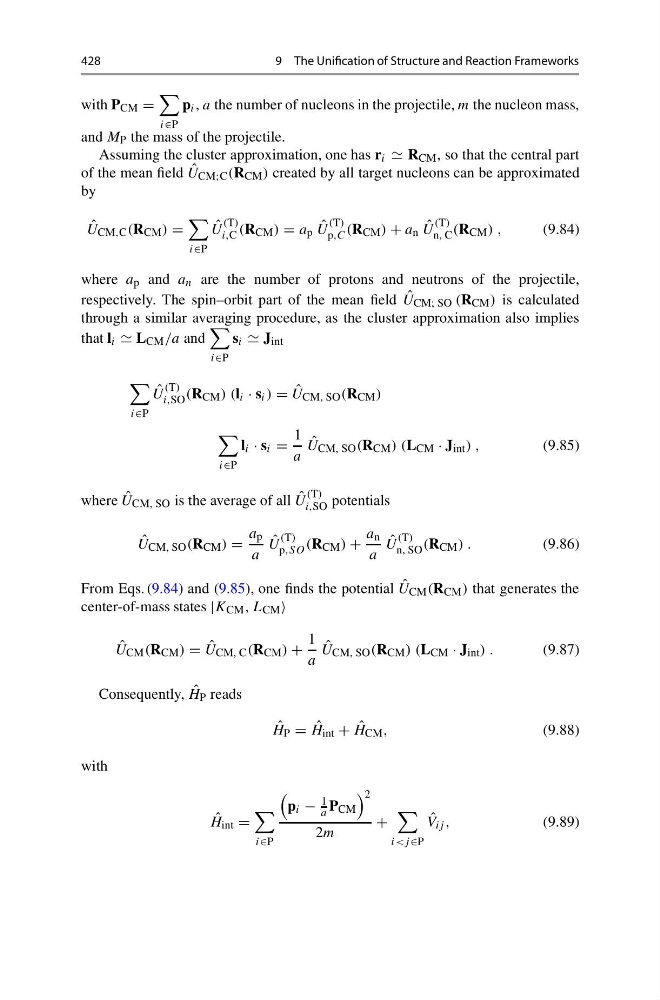
with P CM =
i∈P
p i , a the number of nucleons in the projectile, m the nucleon mass,
and M P the mass of the projectile.
Assuming the cluster approximation, one has r i R CM , so that the central part
of the mean field ˆ
U CM;C (R CM ) created by all target nucleons can be approximated
by
ˆ
U CM,C (R CM ) =
i∈P
ˆ
U
(T)
i,C (R CM ) = a p ˆ
U
(T)
p,C (R CM ) + a n ˆ
U
(T)
n, C (R CM ) ,
(9.84)
where a p and a n are the number of protons and neutrons of the projectile,
respectively. The spin–orbit part of the mean field ˆ
U CM; SO (R CM ) is calculated
through a similar averaging procedure, as the cluster approximation also implies
that l i L CM /a and
i∈P
s i J int
i∈P
ˆ
U
(T)
i,SO (R CM ) (l i · s i ) = ˆ
U CM, SO (R CM )
i∈P
l i · s i =
1
a
ˆ
U CM, SO (R CM ) (L CM · J int ) ,
(9.85)
where ˆ
U CM, SO is the average of all ˆ
U
(T)
i,SO potentials
ˆ
U CM, SO (R CM ) =
a p
a
ˆ
U
(T)
p,SO (R CM ) +
a n
a
ˆ
U
(T)
n, SO (R CM ) .
(9.86)
From Eqs. (9.84) and (9.85), one finds the potential ˆ
U CM (R CM ) that generates the
center-of-mass states |K CM , L CM
ˆ
U CM (R CM ) = ˆ
U CM, C (R CM ) +
1
a
ˆ
U CM, SO (R CM ) (L CM · J int ) .
(9.87)
Consequently, ˆ
H P reads
ˆ
H P = ˆ
H int + ˆ
H CM ,
(9.88)
with
ˆ
H int =
i∈P
p i −
1
a P CM
2
2m
+
i
V ij ,
(9.89)
9 The Unification of Structure and Reaction Frameworks
with P CM =
i∈P
p i , a the number of nucleons in the projectile, m the nucleon mass,
and M P the mass of the projectile.
Assuming the cluster approximation, one has r i R CM , so that the central part
of the mean field ˆ
U CM;C (R CM ) created by all target nucleons can be approximated
by
ˆ
U CM,C (R CM ) =
i∈P
ˆ
U
(T)
i,C (R CM ) = a p ˆ
U
(T)
p,C (R CM ) + a n ˆ
U
(T)
n, C (R CM ) ,
(9.84)
where a p and a n are the number of protons and neutrons of the projectile,
respectively. The spin–orbit part of the mean field ˆ
U CM; SO (R CM ) is calculated
through a similar averaging procedure, as the cluster approximation also implies
that l i L CM /a and
i∈P
s i J int
i∈P
ˆ
U
(T)
i,SO (R CM ) (l i · s i ) = ˆ
U CM, SO (R CM )
i∈P
l i · s i =
1
a
ˆ
U CM, SO (R CM ) (L CM · J int ) ,
(9.85)
where ˆ
U CM, SO is the average of all ˆ
U
(T)
i,SO potentials
ˆ
U CM, SO (R CM ) =
a p
a
ˆ
U
(T)
p,SO (R CM ) +
a n
a
ˆ
U
(T)
n, SO (R CM ) .
(9.86)
From Eqs. (9.84) and (9.85), one finds the potential ˆ
U CM (R CM ) that generates the
center-of-mass states |K CM , L CM
ˆ
U CM (R CM ) = ˆ
U CM, C (R CM ) +
1
a
ˆ
U CM, SO (R CM ) (L CM · J int ) .
(9.87)
Consequently, ˆ
H P reads
ˆ
H P = ˆ
H int + ˆ
H CM ,
(9.88)
with
ˆ
H int =
i∈P
p i −
1
a P CM
2
2m
+
i
V ij ,
(9.89)