

9.2 Generalization to Many-Nucleon Projectiles
429
and
ˆ
H CM =
P CM
2
2M P
+ ˆ
U CM .
(9.90)
The mean-field approximation described in Eqs. (9.84) and (9.85) insures
that ˆ
U CM (R CM ) recaptures the features of the Hamiltonian of Eq. (9.82) for the
|K CM , L CM center-of-mass states at the level of cluster approximation. It is thus
possible to calculate a Berggren basis of center-of-mass |K CM , L CM states, as
these states are formally identical to one-body states. Moreover, even though cluster
approximation is no longer valid in break-up reactions, the latter potential can still
be used therein as it provides with a complete set of |K CM , L CM center-of-mass
states.
9.2.5 Orthogonalization of Composites with Respect to the Core
In the case of a one-nucleon projectile, all calculated wave functions must be
orthogonal to the occupied states in the core, as demanded by the orthogonalization
condition model (see Sect. 5.2). Both target and projectile wave functions of the
composite state in this case could be in principle diagonalized using the same
Berggren basis, from which the occupied core one-body states are removed. Consequently, the basis configurations expanding target and projectile wave functions
are all orthogonal to the occupied states in the core, so that the orthogonalization
condition model would be a priori exactly verified.
However, we have seen that projectile wave functions, describing a cluster of a
few nucleons, must be written as the product of center-of-mass and relative parts
(see Eq. (9.63)). As the occupied states in the core are written in cluster orbital
shell model coordinates, the orthogonalization condition model would become very
cumbersome to apply. Indeed, as said before, the transformation from cluster orbital
shell model coordinates to center-of-mass and relative coordinates is conveniently
treated only through the use of a basis of harmonic oscillator states or Jacobi
coordinates. This would a priori preclude the inclusion of the Berggren basis to
describe cluster wave functions.
Thus, one has to introduce an alternative procedure to impose the orthogonalization condition model for composite eigenstates whose projectile is a cluster and
whose wave function is a product of center-of-mass and relative wave functions (see
Eq. (9.63)). In order to avoid the problems related to the transformation from cluster
orbital shell model coordinates to center-of-mass and relative coordinates, one will
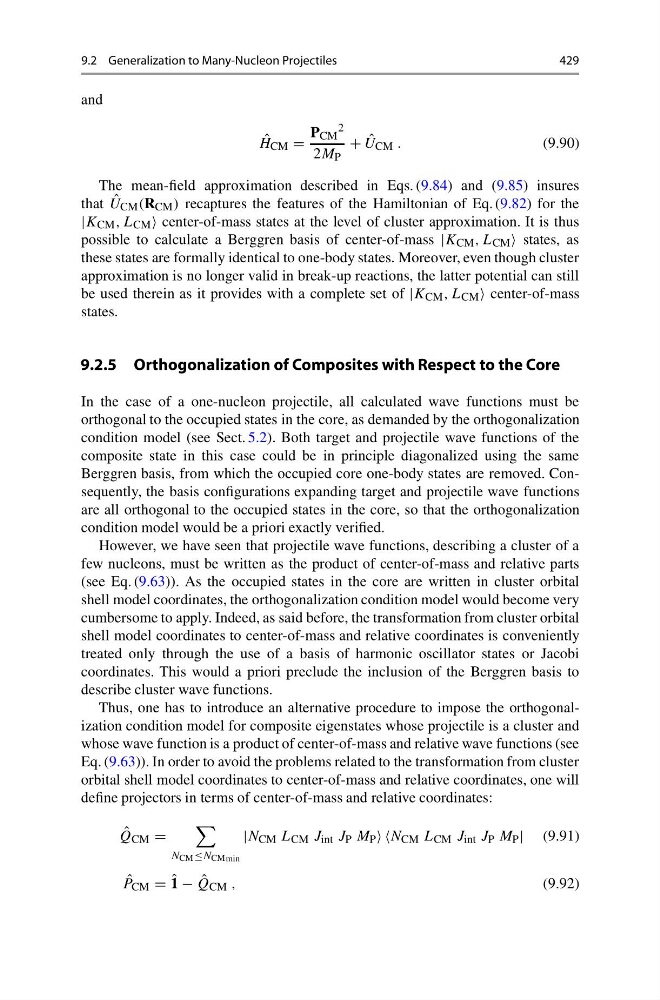
define projectors in terms of center-of-mass and relative coordinates:
ˆ
Q CM =
N CM ≤N CMmin
|N CM L CM J int J P M P CM L CM J int J P M P | (9.91)
ˆ
P CM = ˆ
1 − ˆ
Q CM ,
(9.92)
429
and
ˆ
H CM =
P CM
2
2M P
+ ˆ
U CM .
(9.90)
The mean-field approximation described in Eqs. (9.84) and (9.85) insures
that ˆ
U CM (R CM ) recaptures the features of the Hamiltonian of Eq. (9.82) for the
|K CM , L CM center-of-mass states at the level of cluster approximation. It is thus
possible to calculate a Berggren basis of center-of-mass |K CM , L CM states, as
these states are formally identical to one-body states. Moreover, even though cluster
approximation is no longer valid in break-up reactions, the latter potential can still
be used therein as it provides with a complete set of |K CM , L CM center-of-mass
states.
9.2.5 Orthogonalization of Composites with Respect to the Core
In the case of a one-nucleon projectile, all calculated wave functions must be
orthogonal to the occupied states in the core, as demanded by the orthogonalization
condition model (see Sect. 5.2). Both target and projectile wave functions of the
composite state in this case could be in principle diagonalized using the same
Berggren basis, from which the occupied core one-body states are removed. Consequently, the basis configurations expanding target and projectile wave functions
are all orthogonal to the occupied states in the core, so that the orthogonalization
condition model would be a priori exactly verified.
However, we have seen that projectile wave functions, describing a cluster of a
few nucleons, must be written as the product of center-of-mass and relative parts
(see Eq. (9.63)). As the occupied states in the core are written in cluster orbital
shell model coordinates, the orthogonalization condition model would become very
cumbersome to apply. Indeed, as said before, the transformation from cluster orbital
shell model coordinates to center-of-mass and relative coordinates is conveniently
treated only through the use of a basis of harmonic oscillator states or Jacobi
coordinates. This would a priori preclude the inclusion of the Berggren basis to
describe cluster wave functions.
Thus, one has to introduce an alternative procedure to impose the orthogonalization condition model for composite eigenstates whose projectile is a cluster and
whose wave function is a product of center-of-mass and relative wave functions (see
Eq. (9.63)). In order to avoid the problems related to the transformation from cluster
orbital shell model coordinates to center-of-mass and relative coordinates, one will
define projectors in terms of center-of-mass and relative coordinates:
ˆ
Q CM =
N CM ≤N CMmin
|N CM L CM J int J P M P CM L CM J int J P M P | (9.91)
ˆ
P CM = ˆ
1 − ˆ
Q CM ,
(9.92)