

426
9 The Unification of Structure and Reaction Frameworks
generated by H int in the relative Berggren basis. They are projected on a basis of
harmonic oscillator states in order to provide with the |K int J int HO states.
The |Ψ
J P
P
HO
states of Eq. (9.65) have to be expressed in cluster orbital shell
model coordinates to be able to use them in a shell model formalism. For this,
one can apply the Talmi–Brody–Moshinsky transformation (see Ref.[53, 54] and
Sect. 2.2) to the relative + center-of-mass two-body wave functions formed by
the deuteron states of Eq. (9.65). Consequently, the coefficients of the Slater
determinant expansion of |Ψ
J P
P
HO in Eq. (9.65) are straightforward to obtain
|Ψ
J P
P
HO =
N
c
HO
N |SD N
HO .
(9.76)
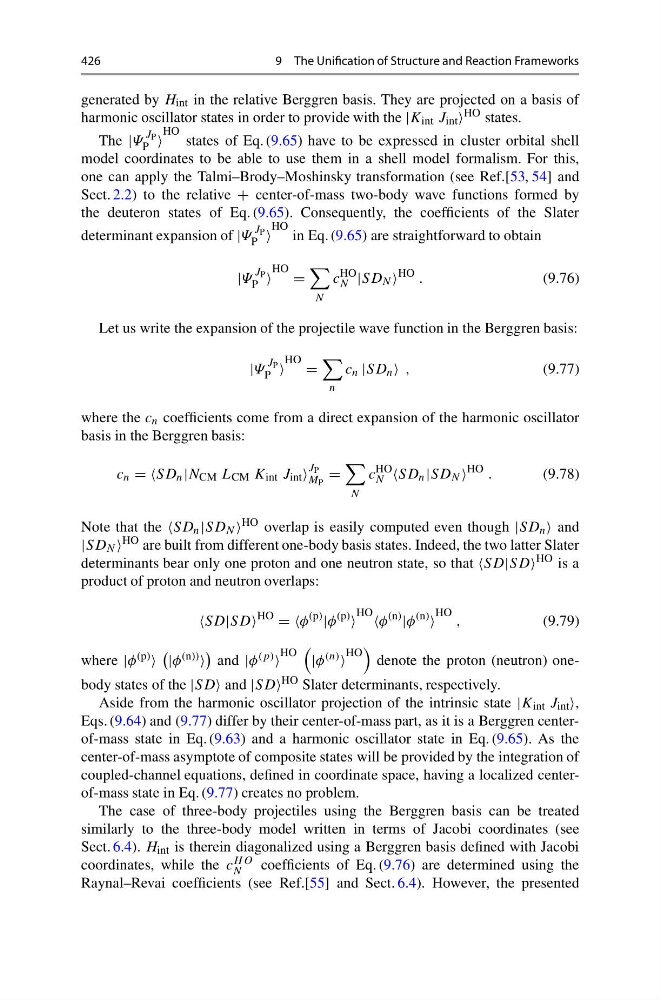
Let us write the expansion of the projectile wave function in the Berggren basis:
|Ψ
J P
P
HO =
n
c n |SD n ,
(9.77)
where the c n coefficients come from a direct expansion of the harmonic oscillator
basis in the Berggren basis:
c n = =SD n |N CM L CM K int J int
J P
M P
=
N
c
HO
N SD n |SD N
HO .
(9.78)
Note that the SD n |SD N
HO overlap is easily computed even though |SD n and
|SD N
HO are built from different one-body basis states. Indeed, the two latter Slater
determinants bear only one proton and one neutron state, so that SD|SD
HO is a
product of proton and neutron overlaps:
SD|SD
HO
= =φ
(p)
|φ
(p)
HO
(n)
|φ
(n)
HO ,
(9.79)
where |φ (p)
|φ (n))
and |φ (p)
HO
|φ (n)
HO
denote the proton (neutron) onebody states of the |SD and |SD HO Slater determinants, respectively.
Aside from the harmonic oscillator projection of the intrinsic state |K int J int
Eqs. (9.64) and (9.77) differ by their center-of-mass part, as it is a Berggren centerof-mass state in Eq. (9.63) and a harmonic oscillator state in Eq. (9.65). As the
center-of-mass asymptote of composite states will be provided by the integration of
coupled-channel equations, defined in coordinate space, having a localized centerof-mass state in Eq. (9.77) creates no problem.
The case of three-body projectiles using the Berggren basis can be treated
similarly to the three-body model written in terms of Jacobi coordinates (see
Sect. 6.4). H int is therein diagonalized using a Berggren basis defined with Jacobi
coordinates, while the c H O
N
coefficients of Eq. (9.76) are determined using the
Raynal–Revai coefficients (see Ref.[55] and Sect. 6.4). However, the presented
9 The Unification of Structure and Reaction Frameworks
generated by H int in the relative Berggren basis. They are projected on a basis of
harmonic oscillator states in order to provide with the |K int J int HO states.
The |Ψ
J P
P
HO
states of Eq. (9.65) have to be expressed in cluster orbital shell
model coordinates to be able to use them in a shell model formalism. For this,
one can apply the Talmi–Brody–Moshinsky transformation (see Ref.[53, 54] and
Sect. 2.2) to the relative + center-of-mass two-body wave functions formed by
the deuteron states of Eq. (9.65). Consequently, the coefficients of the Slater
determinant expansion of |Ψ
J P
P
HO in Eq. (9.65) are straightforward to obtain
|Ψ
J P
P
HO =
N
c
HO
N |SD N
HO .
(9.76)
Let us write the expansion of the projectile wave function in the Berggren basis:
|Ψ
J P
P
HO =
n
c n |SD n ,
(9.77)
where the c n coefficients come from a direct expansion of the harmonic oscillator
basis in the Berggren basis:
c n = =SD n |N CM L CM K int J int
J P
M P
=
N
c
HO
N SD n |SD N
HO .
(9.78)
Note that the SD n |SD N
HO overlap is easily computed even though |SD n and
|SD N
HO are built from different one-body basis states. Indeed, the two latter Slater
determinants bear only one proton and one neutron state, so that SD|SD
HO is a
product of proton and neutron overlaps:
SD|SD
HO
= =φ
(p)
|φ
(p)
HO
(n)
|φ
(n)
HO ,
(9.79)
where |φ (p)
|φ (n))
and |φ (p)
HO
|φ (n)
HO
denote the proton (neutron) onebody states of the |SD and |SD HO Slater determinants, respectively.
Aside from the harmonic oscillator projection of the intrinsic state |K int J int
Eqs. (9.64) and (9.77) differ by their center-of-mass part, as it is a Berggren centerof-mass state in Eq. (9.63) and a harmonic oscillator state in Eq. (9.65). As the
center-of-mass asymptote of composite states will be provided by the integration of
coupled-channel equations, defined in coordinate space, having a localized centerof-mass state in Eq. (9.77) creates no problem.
The case of three-body projectiles using the Berggren basis can be treated
similarly to the three-body model written in terms of Jacobi coordinates (see
Sect. 6.4). H int is therein diagonalized using a Berggren basis defined with Jacobi
coordinates, while the c H O
N
coefficients of Eq. (9.76) are determined using the
Raynal–Revai coefficients (see Ref.[55] and Sect. 6.4). However, the presented