

9.2 Generalization to Many-Nucleon Projectiles
425
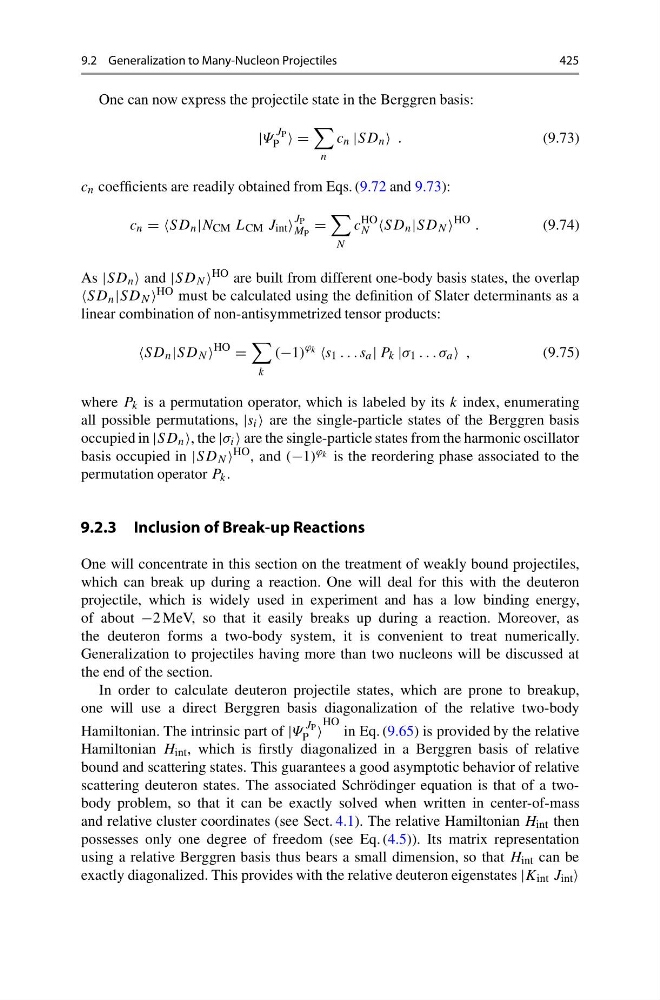
One can now express the projectile state in the Berggren basis:
|Ψ
J P
P =
n
c n |SD n .
(9.73)
c n coefficients are readily obtained from Eqs. (9.72 and 9.73):
c n = =SD n |N CM L CM J int
J P
M P
=
N
c
HO
N SD n |SD N
HO .
(9.74)
As |SD n and |SD N HO are built from different one-body basis states, the overlap
SD n |SD N HO must be calculated using the definition of Slater determinants as a
linear combination of non-antisymmetrized tensor products:
SD n |SD N
HO
=
k
(−1)
ϕ k 1 . . . s a | P k |σ 1 . . . σ a ,
(9.75)
where P k is a permutation operator, which is labeled by its k index, enumerating
all possible permutations, |s i are the single-particle states of the Berggren basis
occupied in |SD n , the |σ i are the single-particle states from the harmonic oscillator
basis occupied in |SD N HO , and (−1) ϕ k is the reordering phase associated to the
permutation operator P k .
9.2.3 Inclusion of Break-up Reactions
One will concentrate in this section on the treatment of weakly bound projectiles,
which can break up during a reaction. One will deal for this with the deuteron
projectile, which is widely used in experiment and has a low binding energy,
of about −2 MeV, so that it easily breaks up during a reaction. Moreover, as
the deuteron forms a two-body system, it is convenient to treat numerically.
Generalization to projectiles having more than two nucleons will be discussed at
the end of the section.
In order to calculate deuteron projectile states, which are prone to breakup,
one will use a direct Berggren basis diagonalization of the relative two-body
Hamiltonian. The intrinsic part of |Ψ
J P
P
HO
in Eq. (9.65) is provided by the relative
Hamiltonian H int , which is firstly diagonalized in a Berggren basis of relative
bound and scattering states. This guarantees a good asymptotic behavior of relative
scattering deuteron states. The associated Schrödinger equation is that of a twobody problem, so that it can be exactly solved when written in center-of-mass
and relative cluster coordinates (see Sect. 4.1). The relative Hamiltonian H int then
possesses only one degree of freedom (see Eq. (4.5)). Its matrix representation
using a relative Berggren basis thus bears a small dimension, so that H int can be
exactly diagonalized. This provides with the relative deuteron eigenstates |K int J int
425
One can now express the projectile state in the Berggren basis:
|Ψ
J P
P =
n
c n |SD n .
(9.73)
c n coefficients are readily obtained from Eqs. (9.72 and 9.73):
c n = =SD n |N CM L CM J int
J P
M P
=
N
c
HO
N SD n |SD N
HO .
(9.74)
As |SD n and |SD N HO are built from different one-body basis states, the overlap
SD n |SD N HO must be calculated using the definition of Slater determinants as a
linear combination of non-antisymmetrized tensor products:
SD n |SD N
HO
=
k
(−1)
ϕ k 1 . . . s a | P k |σ 1 . . . σ a ,
(9.75)
where P k is a permutation operator, which is labeled by its k index, enumerating
all possible permutations, |s i are the single-particle states of the Berggren basis
occupied in |SD n , the |σ i are the single-particle states from the harmonic oscillator
basis occupied in |SD N HO , and (−1) ϕ k is the reordering phase associated to the
permutation operator P k .
9.2.3 Inclusion of Break-up Reactions
One will concentrate in this section on the treatment of weakly bound projectiles,
which can break up during a reaction. One will deal for this with the deuteron
projectile, which is widely used in experiment and has a low binding energy,
of about −2 MeV, so that it easily breaks up during a reaction. Moreover, as
the deuteron forms a two-body system, it is convenient to treat numerically.
Generalization to projectiles having more than two nucleons will be discussed at
the end of the section.
In order to calculate deuteron projectile states, which are prone to breakup,
one will use a direct Berggren basis diagonalization of the relative two-body
Hamiltonian. The intrinsic part of |Ψ
J P
P
HO
in Eq. (9.65) is provided by the relative
Hamiltonian H int , which is firstly diagonalized in a Berggren basis of relative
bound and scattering states. This guarantees a good asymptotic behavior of relative
scattering deuteron states. The associated Schrödinger equation is that of a twobody problem, so that it can be exactly solved when written in center-of-mass
and relative cluster coordinates (see Sect. 4.1). The relative Hamiltonian H int then
possesses only one degree of freedom (see Eq. (4.5)). Its matrix representation
using a relative Berggren basis thus bears a small dimension, so that H int can be
exactly diagonalized. This provides with the relative deuteron eigenstates |K int J int