

382
8 No-Core Gamow Shell Model
matrix elements providing with Coulomb wave functions coefficients are not correct
[105, 106]
The calculation of the asymptotic normalization coefficient is based on the tail
of radial overlap integral (see Eq. (7.33) and Sect. 7.3 for a general definition of
the asymptotic normalization coefficient). In the case of reaction: 4 He 0 + + n →
5 He 3/2 − , the operator a
†
(B) creates a neutron in any p 3/2 single-particle state of
the Berggren basis and rrj |u B is the p 3/2 radial wave function. The radial overlap
integral then reads
I =3/2 (r) =
1
2
i
5 He 3/2 − ||a
†
i,=1,j =3/2 ||
4 He 0 + u i,,=1,j =3/2 (r) .
(8.7)
The model space and V low-k momentum cutoff used in this calculation are the same
as the one at the end of Sect. 8.2.2. One uses a p 3/2 Berggren basis partial wave,
where 0p 3/2 is a resonance, while the s 1/2 and p 1/2 neutron partial waves consist
of real-energy Berggren basis contours. Partial waves with ≤ 2 are generated by
harmonic oscillator basis functions. The no-core Gamow shell model calculation is
performed for chiral N 3 LO interaction (see Ref. [4]) with a cutoff parameter Λ =
1.9 fm −1 .
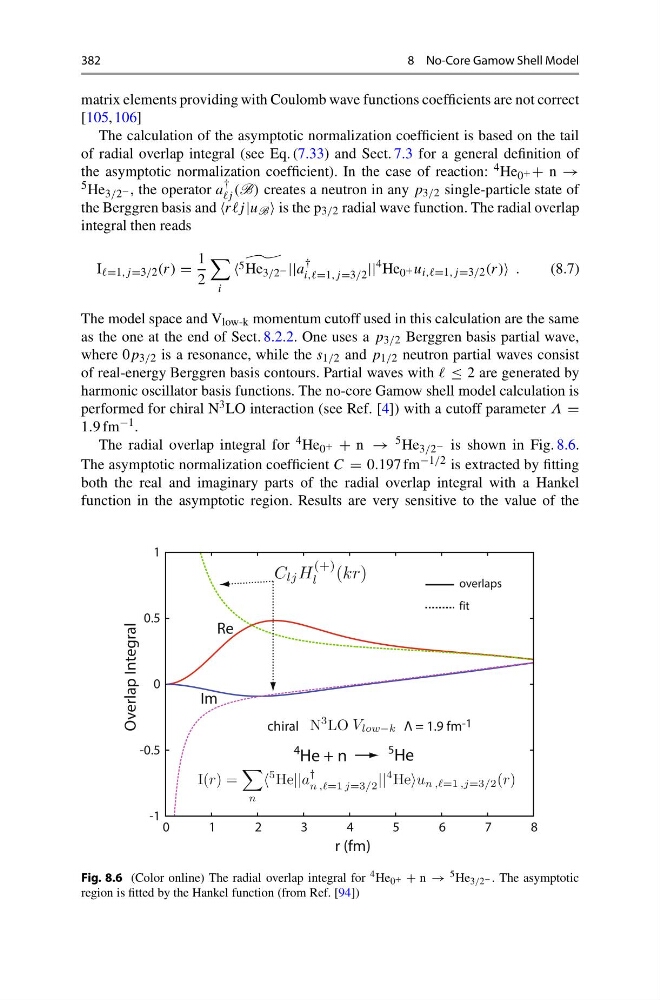
The radial overlap integral for 4 He 0 + + n → 5 He 3/2 − is shown in Fig. 8.6.
The asymptotic normalization coefficient C = 0.197 fm −1/2 is extracted by fitting
both the real and imaginary parts of the radial overlap integral with a Hankel
function in the asymptotic region. Results are very sensitive to the value of the
-1
-0.5
0
0.5
1
0
1
2
3
4
5
6
7
8
4
He + n
5
He
Overlap Integral
r (fm)
Re
Im
overlaps
fit
chiral
Λ = 1.9 fm -1
Fig. 8.6 (Color online) The radial overlap integral for 4 He 0 + + n → 5 He 3/2 − . The asymptotic
region is fitted by the Hankel function (from Ref. [94])
8 No-Core Gamow Shell Model
matrix elements providing with Coulomb wave functions coefficients are not correct
[105, 106]
The calculation of the asymptotic normalization coefficient is based on the tail
of radial overlap integral (see Eq. (7.33) and Sect. 7.3 for a general definition of
the asymptotic normalization coefficient). In the case of reaction: 4 He 0 + + n →
5 He 3/2 − , the operator a
†
(B) creates a neutron in any p 3/2 single-particle state of
the Berggren basis and rrj |u B is the p 3/2 radial wave function. The radial overlap
integral then reads
I =3/2 (r) =
1
2
i
5 He 3/2 − ||a
†
i,=1,j =3/2 ||
4 He 0 + u i,,=1,j =3/2 (r) .
(8.7)
The model space and V low-k momentum cutoff used in this calculation are the same
as the one at the end of Sect. 8.2.2. One uses a p 3/2 Berggren basis partial wave,
where 0p 3/2 is a resonance, while the s 1/2 and p 1/2 neutron partial waves consist
of real-energy Berggren basis contours. Partial waves with ≤ 2 are generated by
harmonic oscillator basis functions. The no-core Gamow shell model calculation is
performed for chiral N 3 LO interaction (see Ref. [4]) with a cutoff parameter Λ =
1.9 fm −1 .
The radial overlap integral for 4 He 0 + + n → 5 He 3/2 − is shown in Fig. 8.6.
The asymptotic normalization coefficient C = 0.197 fm −1/2 is extracted by fitting
both the real and imaginary parts of the radial overlap integral with a Hankel
function in the asymptotic region. Results are very sensitive to the value of the
-1
-0.5
0
0.5
1
0
1
2
3
4
5
6
7
8
4
He + n
5
He
Overlap Integral
r (fm)
Re
Im
overlaps
fit
chiral
Λ = 1.9 fm -1
Fig. 8.6 (Color online) The radial overlap integral for 4 He 0 + + n → 5 He 3/2 − . The asymptotic
region is fitted by the Hankel function (from Ref. [94])