

8.2 Benchmarking of No-Core Gamow Shell Model Against Other Methods
381
Table 8.1 Density matrix renormalization group result of the no-core Gamow shell model is
compared to experimental energy and width of the 5 He ground state deduced by various R-matrix
procedures. Energies are given with respect to the α+ n threshold (adapted from Ref. [94])
Method
Energy (MeV)
Γ (MeV)
Density Matrix Renormalization Group
1.17
0.400
Extended R-matrix [97]
0.798
0.648
R-matrix [97]
0.963
0.985
R-matrix [102]
0.771
0.644
NUBASE evaluation [103]
0.890
0.651
3 He + t [104]
0.79
0.525
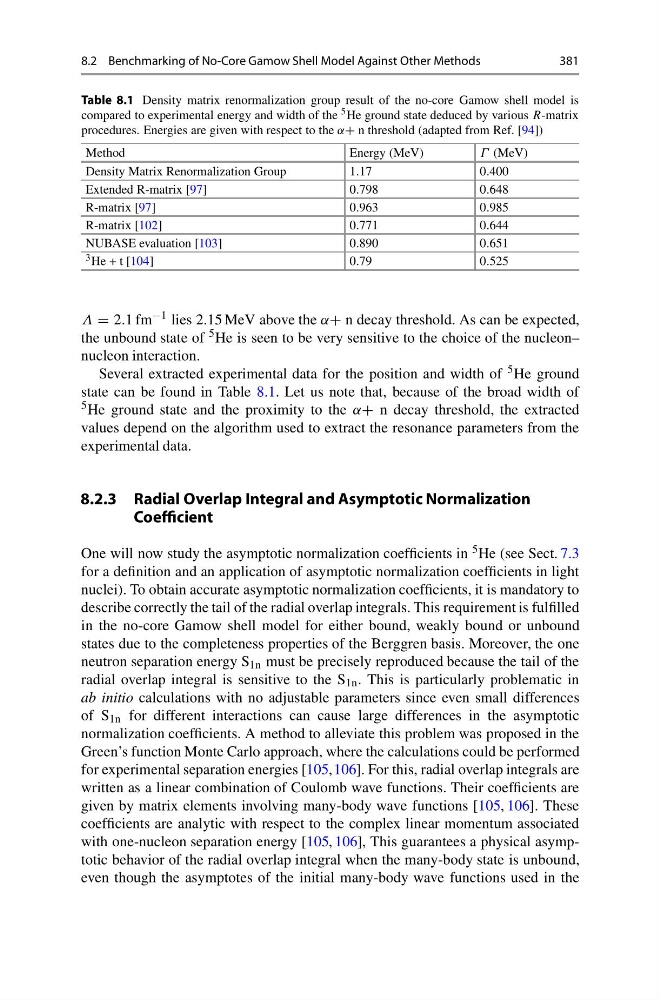
Λ = 2.1 fm −1 lies 2.15 MeV above the α+ n decay threshold. As can be expected,
the unbound state of 5 He is seen to be very sensitive to the choice of the nucleon–
nucleon interaction.
Several extracted experimental data for the position and width of 5 He ground
state can be found in Table 8.1. Let us note that, because of the broad width of
5 He ground state and the proximity to the α+ n decay threshold, the extracted
values depend on the algorithm used to extract the resonance parameters from the
experimental data.
8.2.3 Radial Overlap Integral and Asymptotic Normalization
Coefficient
One will now study the asymptotic normalization coefficients in 5 He (see Sect. 7.3
for a definition and an application of asymptotic normalization coefficients in light
nuclei). To obtain accurate asymptotic normalization coefficients, it is mandatory to
describe correctly the tail of the radial overlap integrals. This requirement is fulfilled
in the no-core Gamow shell model for either bound, weakly bound or unbound
states due to the completeness properties of the Berggren basis. Moreover, the one
neutron separation energy S 1n must be precisely reproduced because the tail of the
radial overlap integral is sensitive to the S 1n . This is particularly problematic in
ab initio calculations with no adjustable parameters since even small differences
of S 1n for different interactions can cause large differences in the asymptotic
normalization coefficients. A method to alleviate this problem was proposed in the
Green’s function Monte Carlo approach, where the calculations could be performed
for experimental separation energies [105,106]. For this, radial overlap integrals are
written as a linear combination of Coulomb wave functions. Their coefficients are
given by matrix elements involving many-body wave functions [105, 106]. These
coefficients are analytic with respect to the complex linear momentum associated
with one-nucleon separation energy [105, 106], This guarantees a physical asymptotic behavior of the radial overlap integral when the many-body state is unbound,
even though the asymptotes of the initial many-body wave functions used in the
381
Table 8.1 Density matrix renormalization group result of the no-core Gamow shell model is
compared to experimental energy and width of the 5 He ground state deduced by various R-matrix
procedures. Energies are given with respect to the α+ n threshold (adapted from Ref. [94])
Method
Energy (MeV)
Γ (MeV)
Density Matrix Renormalization Group
1.17
0.400
Extended R-matrix [97]
0.798
0.648
R-matrix [97]
0.963
0.985
R-matrix [102]
0.771
0.644
NUBASE evaluation [103]
0.890
0.651
3 He + t [104]
0.79
0.525
Λ = 2.1 fm −1 lies 2.15 MeV above the α+ n decay threshold. As can be expected,
the unbound state of 5 He is seen to be very sensitive to the choice of the nucleon–
nucleon interaction.
Several extracted experimental data for the position and width of 5 He ground
state can be found in Table 8.1. Let us note that, because of the broad width of
5 He ground state and the proximity to the α+ n decay threshold, the extracted
values depend on the algorithm used to extract the resonance parameters from the
experimental data.
8.2.3 Radial Overlap Integral and Asymptotic Normalization
Coefficient
One will now study the asymptotic normalization coefficients in 5 He (see Sect. 7.3
for a definition and an application of asymptotic normalization coefficients in light
nuclei). To obtain accurate asymptotic normalization coefficients, it is mandatory to
describe correctly the tail of the radial overlap integrals. This requirement is fulfilled
in the no-core Gamow shell model for either bound, weakly bound or unbound
states due to the completeness properties of the Berggren basis. Moreover, the one
neutron separation energy S 1n must be precisely reproduced because the tail of the
radial overlap integral is sensitive to the S 1n . This is particularly problematic in
ab initio calculations with no adjustable parameters since even small differences
of S 1n for different interactions can cause large differences in the asymptotic
normalization coefficients. A method to alleviate this problem was proposed in the
Green’s function Monte Carlo approach, where the calculations could be performed
for experimental separation energies [105,106]. For this, radial overlap integrals are
written as a linear combination of Coulomb wave functions. Their coefficients are
given by matrix elements involving many-body wave functions [105, 106]. These
coefficients are analytic with respect to the complex linear momentum associated
with one-nucleon separation energy [105, 106], This guarantees a physical asymptotic behavior of the radial overlap integral when the many-body state is unbound,
even though the asymptotes of the initial many-body wave functions used in the