

380
8 No-Core Gamow Shell Model
-0.4
-0.3
-0.2
-0.1
0
0.1
0.2
0.3
0.4
50
100
150
200
250
300
350
400
5 He with chiral
Λ = 1.9 fm -1
ab-initio GSM/DMRG
Experiment
sweep =1
sweep =2
sweep =3
Im(E) (MeV)
N step
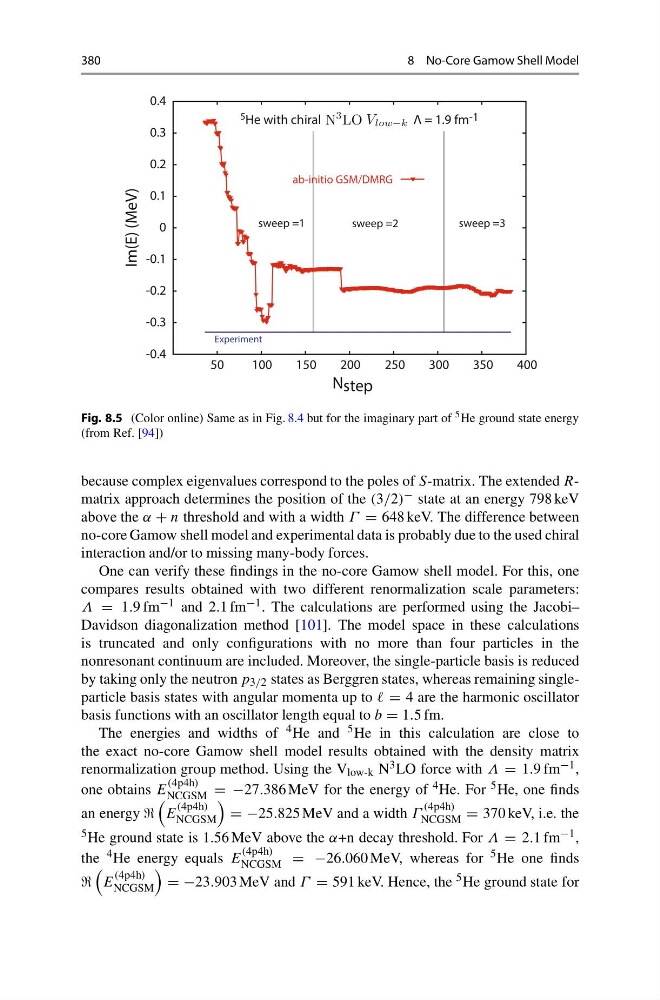
Fig. 8.5 (Color online) Same as in Fig. 8.4 but for the imaginary part of 5 He ground state energy
(from Ref. [94])
because complex eigenvalues correspond to the poles of S-matrix. The extended Rmatrix approach determines the position of the (3/2) − state at an energy 798 keV
above the α + n threshold and with a width Γ = 648 keV. The difference between
no-core Gamow shell model and experimental data is probably due to the used chiral
interaction and/or to missing many-body forces.
One can verify these findings in the no-core Gamow shell model. For this, one
compares results obtained with two different renormalization scale parameters:
Λ = 1.9 fm −1 and 2.1 fm −1 . The calculations are performed using the Jacobi–
Davidson diagonalization method [101]. The model space in these calculations
is truncated and only configurations with no more than four particles in the
nonresonant continuum are included. Moreover, the single-particle basis is reduced
by taking only the neutron p 3/2 states as Berggren states, whereas remaining singleparticle basis states with angular momenta up to = 4 are the harmonic oscillator
basis functions with an oscillator length equal to b = 1.5 fm.
The energies and widths of 4 He and 5 He in this calculation are close to
the exact no-core Gamow shell model results obtained with the density matrix
renormalization group method. Using the V low-k N 3 LO force with Λ = 1.9 fm −1 ,
one obtains E
(4p4h)
NCGSM = −27.386 MeV for the energy of 4 He. For 5 He, one finds
an energy
E
(4p4h)
NCGSM
= −25.825 MeV and a width Γ
(4p4h)
NCGSM = 370 keV, i.e. the
5 He ground state is 1.56 MeV above the α+n decay threshold. For Λ = 2.1 fm −1 ,
the 4 He energy equals E
(4p4h)
NCGSM = −26.060 MeV, whereas for 5 He one finds
E
(4p4h)
NCGSM
= −23.903 MeV and Γ = 591 keV. Hence, the 5 He ground state for
8 No-Core Gamow Shell Model
-0.4
-0.3
-0.2
-0.1
0
0.1
0.2
0.3
0.4
50
100
150
200
250
300
350
400
5 He with chiral
Λ = 1.9 fm -1
ab-initio GSM/DMRG
Experiment
sweep =1
sweep =2
sweep =3
Im(E) (MeV)
N step
Fig. 8.5 (Color online) Same as in Fig. 8.4 but for the imaginary part of 5 He ground state energy
(from Ref. [94])
because complex eigenvalues correspond to the poles of S-matrix. The extended Rmatrix approach determines the position of the (3/2) − state at an energy 798 keV
above the α + n threshold and with a width Γ = 648 keV. The difference between
no-core Gamow shell model and experimental data is probably due to the used chiral
interaction and/or to missing many-body forces.
One can verify these findings in the no-core Gamow shell model. For this, one
compares results obtained with two different renormalization scale parameters:
Λ = 1.9 fm −1 and 2.1 fm −1 . The calculations are performed using the Jacobi–
Davidson diagonalization method [101]. The model space in these calculations
is truncated and only configurations with no more than four particles in the
nonresonant continuum are included. Moreover, the single-particle basis is reduced
by taking only the neutron p 3/2 states as Berggren states, whereas remaining singleparticle basis states with angular momenta up to = 4 are the harmonic oscillator
basis functions with an oscillator length equal to b = 1.5 fm.
The energies and widths of 4 He and 5 He in this calculation are close to
the exact no-core Gamow shell model results obtained with the density matrix
renormalization group method. Using the V low-k N 3 LO force with Λ = 1.9 fm −1 ,
one obtains E
(4p4h)
NCGSM = −27.386 MeV for the energy of 4 He. For 5 He, one finds
an energy
E
(4p4h)
NCGSM
= −25.825 MeV and a width Γ
(4p4h)
NCGSM = 370 keV, i.e. the
5 He ground state is 1.56 MeV above the α+n decay threshold. For Λ = 2.1 fm −1 ,
the 4 He energy equals E
(4p4h)
NCGSM = −26.060 MeV, whereas for 5 He one finds
E
(4p4h)
NCGSM
= −23.903 MeV and Γ = 591 keV. Hence, the 5 He ground state for