

8.2 Benchmarking of No-Core Gamow Shell Model Against Other Methods
379
-27.6
-27.3
-27
-26.7
-26.4
-26.1
-25.8
-25.5
-25.2
-24.9
-24.6
-24.3
-24
50
100
150
200
250
300
350
400
ab-initio GSM/DMRG
Experiment
Re(E) (MeV)
5 He with chiral
Λ = 1.9 fm -1
sweep =1
sweep = 2
sweep = 3
N step
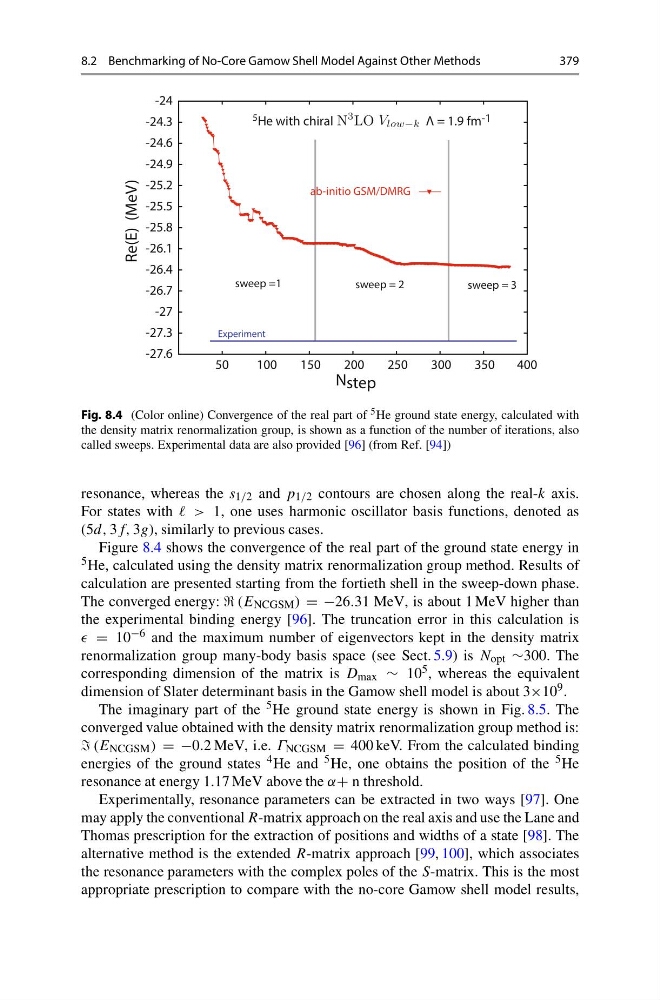
Fig. 8.4 (Color online) Convergence of the real part of 5 He ground state energy, calculated with
the density matrix renormalization group, is shown as a function of the number of iterations, also
called sweeps. Experimental data are also provided [96] (from Ref. [94])
resonance, whereas the s 1/2 and p 1/2 contours are chosen along the real-k axis.
For states with > 1, one uses harmonic oscillator basis functions, denoted as
(5d, 3f, 3g), similarly to previous cases.
Figure 8.4 shows the convergence of the real part of the ground state energy in
5 He, calculated using the density matrix renormalization group method. Results of
calculation are presented starting from the fortieth shell in the sweep-down phase.
The converged energy: (E NCGSM ) = −26.31 MeV, is about 1 MeV higher than
the experimental binding energy [96]. The truncation error in this calculation is
= 10 −6 and the maximum number of eigenvectors kept in the density matrix
renormalization group many-body basis space (see Sect. 5.9) is N opt ∼300. The
corresponding dimension of the matrix is D max ∼ 10 5 , whereas the equivalent
dimension of Slater determinant basis in the Gamow shell model is about 3×10 9 .
The imaginary part of the 5 He ground state energy is shown in Fig. 8.5. The
converged value obtained with the density matrix renormalization group method is:
(E NCGSM ) = −0.2 MeV, i.e. Γ NCGSM = 400 keV. From the calculated binding
energies of the ground states 4 He and 5 He, one obtains the position of the 5 He
resonance at energy 1.17 MeV above the α+ n threshold.
Experimentally, resonance parameters can be extracted in two ways [97]. One
may apply the conventional R-matrix approach on the real axis and use the Lane and
Thomas prescription for the extraction of positions and widths of a state [98]. The
alternative method is the extended R-matrix approach [99, 100], which associates
the resonance parameters with the complex poles of the S-matrix. This is the most
appropriate prescription to compare with the no-core Gamow shell model results,
379
-27.6
-27.3
-27
-26.7
-26.4
-26.1
-25.8
-25.5
-25.2
-24.9
-24.6
-24.3
-24
50
100
150
200
250
300
350
400
ab-initio GSM/DMRG
Experiment
Re(E) (MeV)
5 He with chiral
Λ = 1.9 fm -1
sweep =1
sweep = 2
sweep = 3
N step
Fig. 8.4 (Color online) Convergence of the real part of 5 He ground state energy, calculated with
the density matrix renormalization group, is shown as a function of the number of iterations, also
called sweeps. Experimental data are also provided [96] (from Ref. [94])
resonance, whereas the s 1/2 and p 1/2 contours are chosen along the real-k axis.
For states with > 1, one uses harmonic oscillator basis functions, denoted as
(5d, 3f, 3g), similarly to previous cases.
Figure 8.4 shows the convergence of the real part of the ground state energy in
5 He, calculated using the density matrix renormalization group method. Results of
calculation are presented starting from the fortieth shell in the sweep-down phase.
The converged energy: (E NCGSM ) = −26.31 MeV, is about 1 MeV higher than
the experimental binding energy [96]. The truncation error in this calculation is
= 10 −6 and the maximum number of eigenvectors kept in the density matrix
renormalization group many-body basis space (see Sect. 5.9) is N opt ∼300. The
corresponding dimension of the matrix is D max ∼ 10 5 , whereas the equivalent
dimension of Slater determinant basis in the Gamow shell model is about 3×10 9 .
The imaginary part of the 5 He ground state energy is shown in Fig. 8.5. The
converged value obtained with the density matrix renormalization group method is:
(E NCGSM ) = −0.2 MeV, i.e. Γ NCGSM = 400 keV. From the calculated binding
energies of the ground states 4 He and 5 He, one obtains the position of the 5 He
resonance at energy 1.17 MeV above the α+ n threshold.
Experimentally, resonance parameters can be extracted in two ways [97]. One
may apply the conventional R-matrix approach on the real axis and use the Lane and
Thomas prescription for the extraction of positions and widths of a state [98]. The
alternative method is the extended R-matrix approach [99, 100], which associates
the resonance parameters with the complex poles of the S-matrix. This is the most
appropriate prescription to compare with the no-core Gamow shell model results,