

8.2 Benchmarking of No-Core Gamow Shell Model Against Other Methods
383
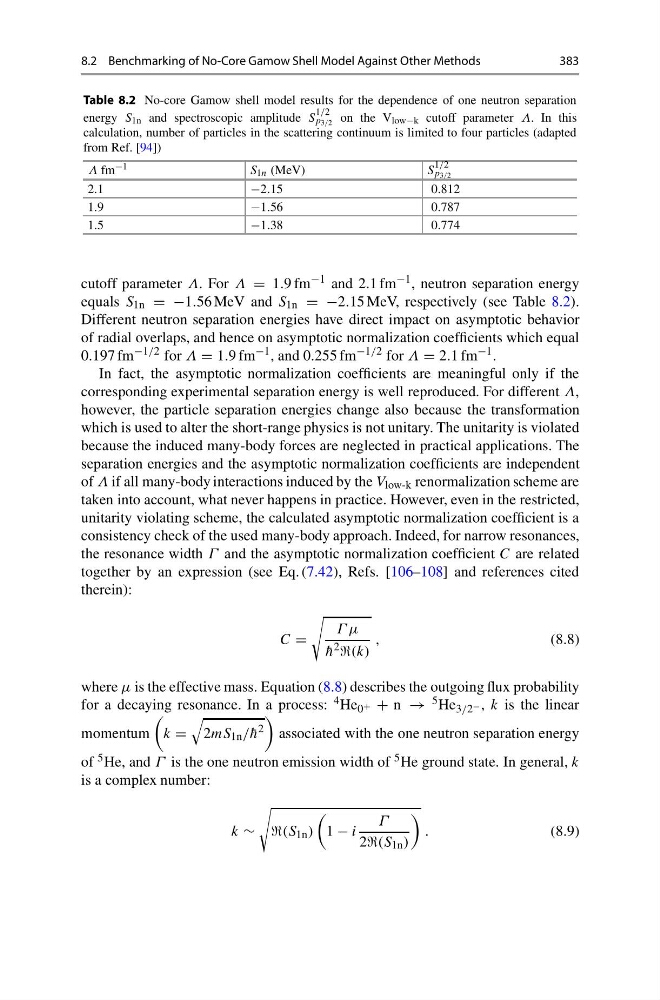
Table 8.2 No-core Gamow shell model results for the dependence of one neutron separation
energy S 1n and spectroscopic amplitude S
1/2
p 3/2 on the V low−k cutoff parameter Λ. In this
calculation, number of particles in the scattering continuum is limited to four particles (adapted
from Ref. [94])
Λ fm −1
S 1n (MeV)
S
1/2
p 3/2
2.1
−2.15
0.812
1.9
−1.56
0.787
1.5
−1.38
0.774
cutoff parameter Λ. For Λ = 1.9 fm −1 and 2.1 fm −1 , neutron separation energy
equals S 1n = −1.56 MeV and S 1n = −2.15 MeV, respectively (see Table 8.2).
Different neutron separation energies have direct impact on asymptotic behavior
of radial overlaps, and hence on asymptotic normalization coefficients which equal
0.197 fm −1/2 for Λ = 1.9 fm −1 , and 0.255 fm −1/2 for Λ = 2.1 fm −1 .
In fact, the asymptotic normalization coefficients are meaningful only if the
corresponding experimental separation energy is well reproduced. For different Λ,
however, the particle separation energies change also because the transformation
which is used to alter the short-range physics is not unitary. The unitarity is violated
because the induced many-body forces are neglected in practical applications. The
separation energies and the asymptotic normalization coefficients are independent
of Λ if all many-body interactions induced by the V low-k renormalization scheme are
taken into account, what never happens in practice. However, even in the restricted,
unitarity violating scheme, the calculated asymptotic normalization coefficient is a
consistency check of the used many-body approach. Indeed, for narrow resonances,
the resonance width Γ and the asymptotic normalization coefficient C are related
together by an expression (see Eq. (7.42), Refs. [106–108] and references cited
therein):
C =
Γ μ
¯
h 2 (k)
,
(8.8)
where μ is the effective mass. Equation (8.8) describes the outgoing flux probability
for a decaying resonance. In a process: 4 He 0 + + n → 5 He 3/2 − , k is the linear
momentum
k =
2mS 1n / ¯
h 2
associated with the one neutron separation energy
of 5 He, and Γ is the one neutron emission width of 5 He ground state. In general, k
is a complex number:
k ∼
(S 1n )
1 − i
Γ
2(S 1n )
.
(8.9)
383
Table 8.2 No-core Gamow shell model results for the dependence of one neutron separation
energy S 1n and spectroscopic amplitude S
1/2
p 3/2 on the V low−k cutoff parameter Λ. In this
calculation, number of particles in the scattering continuum is limited to four particles (adapted
from Ref. [94])
Λ fm −1
S 1n (MeV)
S
1/2
p 3/2
2.1
−2.15
0.812
1.9
−1.56
0.787
1.5
−1.38
0.774
cutoff parameter Λ. For Λ = 1.9 fm −1 and 2.1 fm −1 , neutron separation energy
equals S 1n = −1.56 MeV and S 1n = −2.15 MeV, respectively (see Table 8.2).
Different neutron separation energies have direct impact on asymptotic behavior
of radial overlaps, and hence on asymptotic normalization coefficients which equal
0.197 fm −1/2 for Λ = 1.9 fm −1 , and 0.255 fm −1/2 for Λ = 2.1 fm −1 .
In fact, the asymptotic normalization coefficients are meaningful only if the
corresponding experimental separation energy is well reproduced. For different Λ,
however, the particle separation energies change also because the transformation
which is used to alter the short-range physics is not unitary. The unitarity is violated
because the induced many-body forces are neglected in practical applications. The
separation energies and the asymptotic normalization coefficients are independent
of Λ if all many-body interactions induced by the V low-k renormalization scheme are
taken into account, what never happens in practice. However, even in the restricted,
unitarity violating scheme, the calculated asymptotic normalization coefficient is a
consistency check of the used many-body approach. Indeed, for narrow resonances,
the resonance width Γ and the asymptotic normalization coefficient C are related
together by an expression (see Eq. (7.42), Refs. [106–108] and references cited
therein):
C =
Γ μ
¯
h 2 (k)
,
(8.8)
where μ is the effective mass. Equation (8.8) describes the outgoing flux probability
for a decaying resonance. In a process: 4 He 0 + + n → 5 He 3/2 − , k is the linear
momentum
k =
2mS 1n / ¯
h 2
associated with the one neutron separation energy
of 5 He, and Γ is the one neutron emission width of 5 He ground state. In general, k
is a complex number:
k ∼
(S 1n )
1 − i
Γ
2(S 1n )
.
(8.9)