

24
2 The Discrete Spectrum and the Continuum
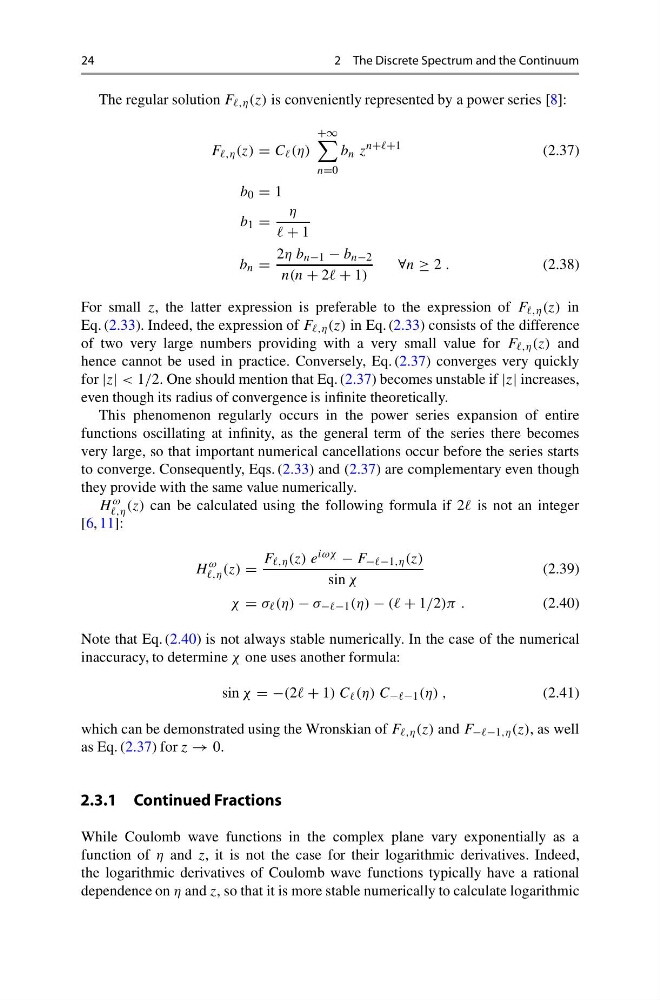
The regular solution F ,η (z) is conveniently represented by a power series [8]:
F ,η (z) = C (η)
+∞
n=0
b n z
n+
(2.37)
b 0 = 1
b 1 =
η
+ 1
b n =
2η b n−1 − b n−2
n(n + 2 + 1)
∀n ≥ 2 .
(2.38)
For small z, the latter expression is preferable to the expression of F ,η (z) in
Eq. (2.33). Indeed, the expression of F ,η (z) in Eq. (2.33) consists of the difference
of two very large numbers providing with a very small value for F ,η (z) and
hence cannot be used in practice. Conversely, Eq. (2.37) converges very quickly
for |z| < 1/2. One should mention that Eq. (2.37) becomes unstable if |z| increases,
even though its radius of convergence is infinite theoretically.
This phenomenon regularly occurs in the power series expansion of entire
functions oscillating at infinity, as the general term of the series there becomes
very large, so that important numerical cancellations occur before the series starts
to converge. Consequently, Eqs. (2.33) and (2.37) are complementary even though
they provide with the same value numerically.
H ω
,η (z) can be calculated using the following formula if 2 is not an integer
[6, 11]:
H
ω
,η (z) =
F ,η (z) e iωχ − F − (z)
sin χ
(2.39)
χ = σ (η) − σ − (η) − (( + 1/2)π .
(2.40)
Note that Eq. (2.40) is not always stable numerically. In the case of the numerical
inaccuracy, to determine χ one uses another formula:
sin χ = −(2 + 1) C (η) C − (η) ,
(2.41)
which can be demonstrated using the Wronskian of F ,η (z) and F − (z), as well
as Eq. (2.37) for z → 0.
2.3.1 Continued Fractions
While Coulomb wave functions in the complex plane vary exponentially as a
function of η and z, it is not the case for their logarithmic derivatives. Indeed,
the logarithmic derivatives of Coulomb wave functions typically have a rational
dependence on η and z, so that it is more stable numerically to calculate logarithmic
2 The Discrete Spectrum and the Continuum
The regular solution F ,η (z) is conveniently represented by a power series [8]:
F ,η (z) = C (η)
+∞
n=0
b n z
n+
(2.37)
b 0 = 1
b 1 =
η
+ 1
b n =
2η b n−1 − b n−2
n(n + 2 + 1)
∀n ≥ 2 .
(2.38)
For small z, the latter expression is preferable to the expression of F ,η (z) in
Eq. (2.33). Indeed, the expression of F ,η (z) in Eq. (2.33) consists of the difference
of two very large numbers providing with a very small value for F ,η (z) and
hence cannot be used in practice. Conversely, Eq. (2.37) converges very quickly
for |z| < 1/2. One should mention that Eq. (2.37) becomes unstable if |z| increases,
even though its radius of convergence is infinite theoretically.
This phenomenon regularly occurs in the power series expansion of entire
functions oscillating at infinity, as the general term of the series there becomes
very large, so that important numerical cancellations occur before the series starts
to converge. Consequently, Eqs. (2.33) and (2.37) are complementary even though
they provide with the same value numerically.
H ω
,η (z) can be calculated using the following formula if 2 is not an integer
[6, 11]:
H
ω
,η (z) =
F ,η (z) e iωχ − F − (z)
sin χ
(2.39)
χ = σ (η) − σ − (η) − (( + 1/2)π .
(2.40)
Note that Eq. (2.40) is not always stable numerically. In the case of the numerical
inaccuracy, to determine χ one uses another formula:
sin χ = −(2 + 1) C (η) C − (η) ,
(2.41)
which can be demonstrated using the Wronskian of F ,η (z) and F − (z), as well
as Eq. (2.37) for z → 0.
2.3.1 Continued Fractions
While Coulomb wave functions in the complex plane vary exponentially as a
function of η and z, it is not the case for their logarithmic derivatives. Indeed,
the logarithmic derivatives of Coulomb wave functions typically have a rational
dependence on η and z, so that it is more stable numerically to calculate logarithmic