

7.2 Halo Nuclei
323
0
5
10
15
1
10
100
η
1s 1/2
0p 1/2
0d 5/2
β
lj
/
β
lj
~
17
F
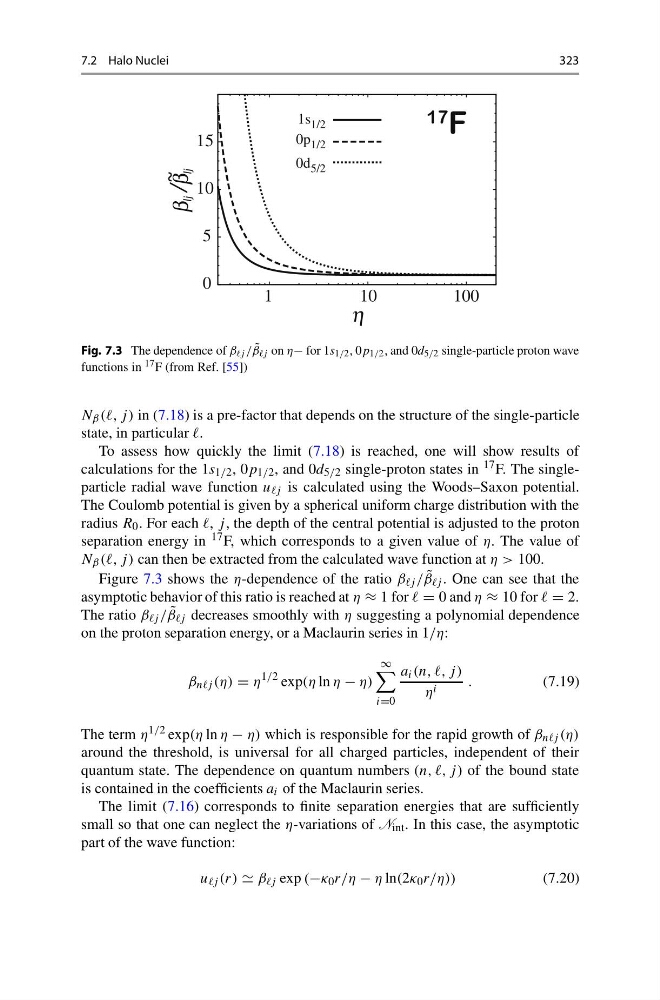
Fig. 7.3 The dependence of β / ˜
β j on η− for 1s 1/2 , 0p 1/2 , and 0d 5/2 single-particle proton wave
functions in 17 F (from Ref. [55])
N β ((, j ) in (7.18) is a pre-factor that depends on the structure of the single-particle
state, in particular
To assess how quickly the limit (7.18) is reached, one will show results of
calculations for the 1s 1/2 , 0p 1/2 , and 0d 5/2 single-proton states in 17 F. The singleparticle radial wave function u j is calculated using the Woods–Saxon potential.
The Coulomb potential is given by a spherical uniform charge distribution with the
radius R 0 . For each j , the depth of the central potential is adjusted to the proton
separation energy in 17 F, which corresponds to a given value of η. The value of
N β ((, j ) can then be extracted from the calculated wave function at η > 100.
Figure 7.3 shows the η-dependence of the ratio β / ˜
β j . One can see that the
asymptotic behavior of this ratio is reached at η ≈ 1 for = 0 and η ≈ 10 for = 2.
The ratio β / ˜
β j decreases smoothly with η suggesting a polynomial dependence
on the proton separation energy, or a Maclaurin series in 1/η:
β nnj (η) = η
1/2 exp(η ln η − η)
∞
i=0
a i (n, ,, j )
η i
.
(7.19)
The term η 1/2 exp(η ln η − η) which is responsible for the rapid growth of β nnj (η)
around the threshold, is universal for all charged particles, independent of their
quantum state. The dependence on quantum numbers (n, ,, j ) of the bound state
is contained in the coefficients a i of the Maclaurin series.
The limit (7.16) corresponds to finite separation energies that are sufficiently
small so that one can neglect the η-variations of N int . In this case, the asymptotic
part of the wave function:
u j (r) β j exp (−κ 0 r/η − η ln(2κ 0 r/η))
(7.20)
323
0
5
10
15
1
10
100
η
1s 1/2
0p 1/2
0d 5/2
β
lj
/
β
lj
~
17
F
Fig. 7.3 The dependence of β / ˜
β j on η− for 1s 1/2 , 0p 1/2 , and 0d 5/2 single-particle proton wave
functions in 17 F (from Ref. [55])
N β ((, j ) in (7.18) is a pre-factor that depends on the structure of the single-particle
state, in particular
To assess how quickly the limit (7.18) is reached, one will show results of
calculations for the 1s 1/2 , 0p 1/2 , and 0d 5/2 single-proton states in 17 F. The singleparticle radial wave function u j is calculated using the Woods–Saxon potential.
The Coulomb potential is given by a spherical uniform charge distribution with the
radius R 0 . For each j , the depth of the central potential is adjusted to the proton
separation energy in 17 F, which corresponds to a given value of η. The value of
N β ((, j ) can then be extracted from the calculated wave function at η > 100.
Figure 7.3 shows the η-dependence of the ratio β / ˜
β j . One can see that the
asymptotic behavior of this ratio is reached at η ≈ 1 for = 0 and η ≈ 10 for = 2.
The ratio β / ˜
β j decreases smoothly with η suggesting a polynomial dependence
on the proton separation energy, or a Maclaurin series in 1/η:
β nnj (η) = η
1/2 exp(η ln η − η)
∞
i=0
a i (n, ,, j )
η i
.
(7.19)
The term η 1/2 exp(η ln η − η) which is responsible for the rapid growth of β nnj (η)
around the threshold, is universal for all charged particles, independent of their
quantum state. The dependence on quantum numbers (n, ,, j ) of the bound state
is contained in the coefficients a i of the Maclaurin series.
The limit (7.16) corresponds to finite separation energies that are sufficiently
small so that one can neglect the η-variations of N int . In this case, the asymptotic
part of the wave function:
u j (r) β j exp (−κ 0 r/η − η ln(2κ 0 r/η))
(7.20)