

324
7 Wave Functions in the Vicinity of Particle-Emission Threshold
shows the usual exponential decay. In order to keep N ext finite when η decreases,
β j has to increase. Consequently, one can expect a minimum of β j as a function
of η going from small values of η toward the threshold (η = +∞).
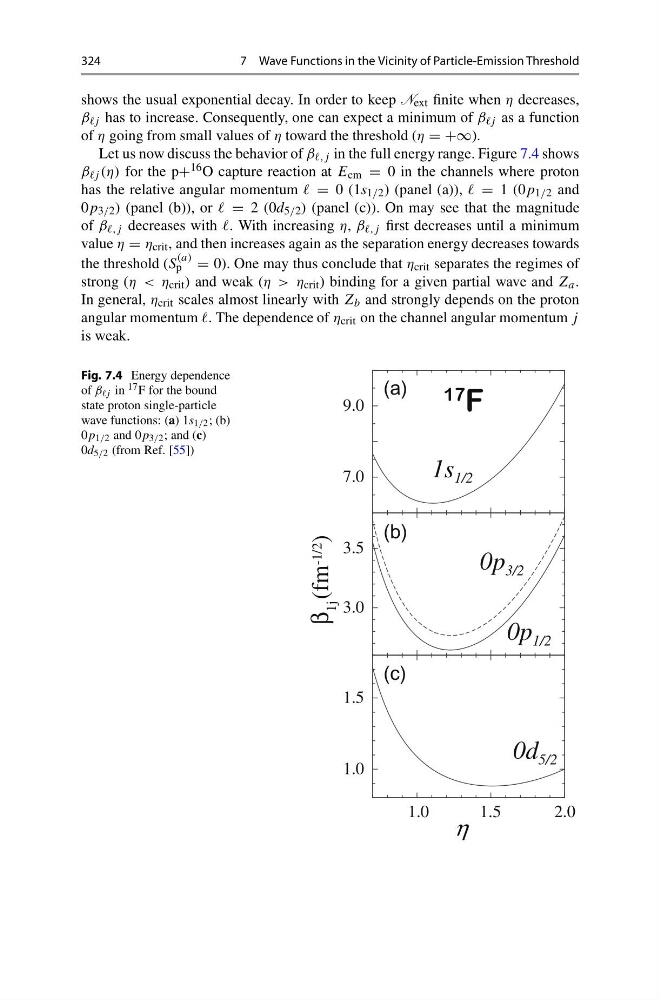
Let us now discuss the behavior of β ,j in the full energy range. Figure 7.4 shows
β j (η) for the p+ 16 O capture reaction at E cm = 0 in the channels where proton
has the relative angular momentum = 0 (1s 1/2 ) (panel (a)), = 1 (0p 1/2 and
0p 3/2 ) (panel (b)), or = 2 (0d 5/2 ) (panel (c)). On may see that the magnitude
of β ,j decreases with . With increasing η, β ,j first decreases until a minimum
value η = η crit , and then increases again as the separation energy decreases towards
the threshold (S
(a)
p = 0). One may thus conclude that η crit separates the regimes of
strong (η < η crit ) and weak (η > η crit ) binding for a given partial wave and Z a .
In general, η crit scales almost linearly with Z b and strongly depends on the proton
angular momentum . The dependence of η crit on the channel angular momentum j
is weak.
Fig. 7.4 Energy dependence
of β j in 17 F for the bound
state proton single-particle
wave functions: (a) 1s 1/2 ; (b)
0p 1/2 and 0p 3/2 ; and (c)
0d 5/2 (from Ref. [55])
1.0
1.5
1.0
1.5
2.0
3.0
3.5
β
1j
(fm -1/2
)
7.0
9.0
(a)
(b)
(c)
1s 1/2
0p 3/2
0p 1/2
0d 5/2
η
17
F
7 Wave Functions in the Vicinity of Particle-Emission Threshold
shows the usual exponential decay. In order to keep N ext finite when η decreases,
β j has to increase. Consequently, one can expect a minimum of β j as a function
of η going from small values of η toward the threshold (η = +∞).
Let us now discuss the behavior of β ,j in the full energy range. Figure 7.4 shows
β j (η) for the p+ 16 O capture reaction at E cm = 0 in the channels where proton
has the relative angular momentum = 0 (1s 1/2 ) (panel (a)), = 1 (0p 1/2 and
0p 3/2 ) (panel (b)), or = 2 (0d 5/2 ) (panel (c)). On may see that the magnitude
of β ,j decreases with . With increasing η, β ,j first decreases until a minimum
value η = η crit , and then increases again as the separation energy decreases towards
the threshold (S
(a)
p = 0). One may thus conclude that η crit separates the regimes of
strong (η < η crit ) and weak (η > η crit ) binding for a given partial wave and Z a .
In general, η crit scales almost linearly with Z b and strongly depends on the proton
angular momentum . The dependence of η crit on the channel angular momentum j
is weak.
Fig. 7.4 Energy dependence
of β j in 17 F for the bound
state proton single-particle
wave functions: (a) 1s 1/2 ; (b)
0p 1/2 and 0p 3/2 ; and (c)
0d 5/2 (from Ref. [55])
1.0
1.5
1.0
1.5
2.0
3.0
3.5
β
1j
(fm -1/2
)
7.0
9.0
(a)
(b)
(c)
1s 1/2
0p 3/2
0p 1/2
0d 5/2
η
17
F