

322
7 Wave Functions in the Vicinity of Particle-Emission Threshold
this dependence remains through the normalization constant β
(0)
j . Many-body states
whose dominant configurations possess weakly bound neutron bearing ≤ 1 are
then good candidates for halo states.
7.2.1.2 Proton Halo States in a Spherical Potential
Even in the presence of a Coulomb barrier, it is possible for proton states to have a
sizable probability distribution in the asymptotic, classically forbidden region. Due
to the more complex structure of Coulomb wave functions compared to Hankel
functions (see Sect. 2.3), it is necessary to consider different regimes dictated by
the binding energy of the weakly bound proton state. For this, one will carefully
state the transition from Sommerfeld parameter η ∼ 0, for large binding energy, to
|η| → +∞, close to proton emission threshold. Indeed, as one has seen in Sect. 2.3,
the vicinity of k = 0 is an essential singularity in the complex plane.
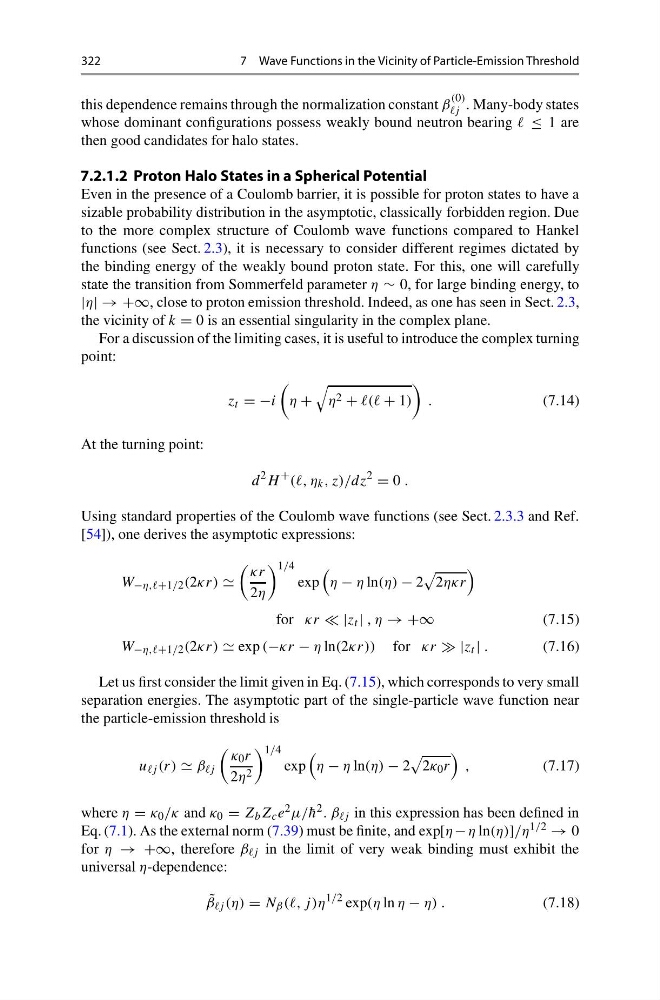
For a discussion of the limiting cases, it is useful to introduce the complex turning
point:
z t = −i
η +
η 2 + + 1)
.
(7.14)
At the turning point:
d
2 H
+ ((, η k , z)/dz
2
= 0 .
Using standard properties of the Coulomb wave functions (see Sect. 2.3.3 and Ref.
[54]), one derives the asymptotic expressions:
W −η,,+1/2 (2κr)
κr
2η
1/4
exp
η − η ln(η) − 2
2ηκr
for κr |z t | , η → +∞
(7.15)
W −η,,+1/2 (2κr) exp (−κr − η ln(2κr)) for κr |z t | .
(7.16)
Let us first consider the limit given in Eq. (7.15), which corresponds to very small
separation energies. The asymptotic part of the single-particle wave function near
the particle-emission threshold is
u j (r) β
κ 0 r
2η 2
1/4
exp
η − η ln(η) − 2
2κ 0 r
,
(7.17)
where η = κ 0 /κ and κ 0 = Z b Z c e 2 μ/ ¯
h
2 . β j in this expression has been defined in
Eq. (7.1). As the external norm (7.39) must be finite, and exp[η −η ln(η)]/η 1/2 → 0
for η → +∞, therefore β j in the limit of very weak binding must exhibit the
universal η-dependence:
˜
β j (η) = N β ((, j )η
1/2 exp(η ln η − η) .
(7.18)
7 Wave Functions in the Vicinity of Particle-Emission Threshold
this dependence remains through the normalization constant β
(0)
j . Many-body states
whose dominant configurations possess weakly bound neutron bearing ≤ 1 are
then good candidates for halo states.
7.2.1.2 Proton Halo States in a Spherical Potential
Even in the presence of a Coulomb barrier, it is possible for proton states to have a
sizable probability distribution in the asymptotic, classically forbidden region. Due
to the more complex structure of Coulomb wave functions compared to Hankel
functions (see Sect. 2.3), it is necessary to consider different regimes dictated by
the binding energy of the weakly bound proton state. For this, one will carefully
state the transition from Sommerfeld parameter η ∼ 0, for large binding energy, to
|η| → +∞, close to proton emission threshold. Indeed, as one has seen in Sect. 2.3,
the vicinity of k = 0 is an essential singularity in the complex plane.
For a discussion of the limiting cases, it is useful to introduce the complex turning
point:
z t = −i
η +
η 2 + + 1)
.
(7.14)
At the turning point:
d
2 H
+ ((, η k , z)/dz
2
= 0 .
Using standard properties of the Coulomb wave functions (see Sect. 2.3.3 and Ref.
[54]), one derives the asymptotic expressions:
W −η,,+1/2 (2κr)
κr
2η
1/4
exp
η − η ln(η) − 2
2ηκr
for κr |z t | , η → +∞
(7.15)
W −η,,+1/2 (2κr) exp (−κr − η ln(2κr)) for κr |z t | .
(7.16)
Let us first consider the limit given in Eq. (7.15), which corresponds to very small
separation energies. The asymptotic part of the single-particle wave function near
the particle-emission threshold is
u j (r) β
κ 0 r
2η 2
1/4
exp
η − η ln(η) − 2
2κ 0 r
,
(7.17)
where η = κ 0 /κ and κ 0 = Z b Z c e 2 μ/ ¯
h
2 . β j in this expression has been defined in
Eq. (7.1). As the external norm (7.39) must be finite, and exp[η −η ln(η)]/η 1/2 → 0
for η → +∞, therefore β j in the limit of very weak binding must exhibit the
universal η-dependence:
˜
β j (η) = N β ((, j )η
1/2 exp(η ln η − η) .
(7.18)