

290
6 Physical Applications of the Gamow Shell Model
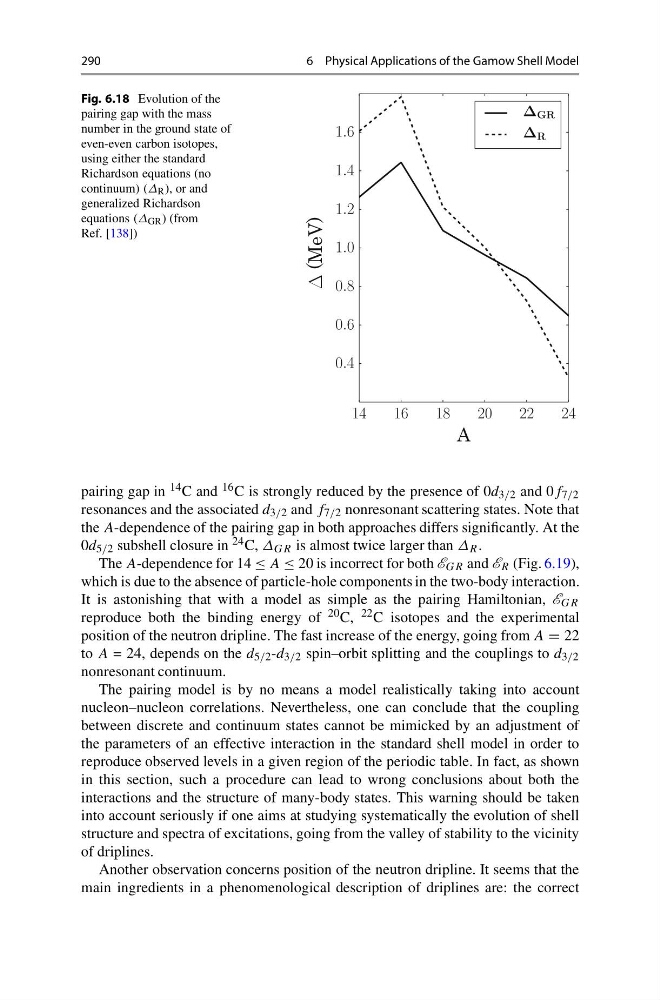
Fig. 6.18 Evolution of the
pairing gap with the mass
number in the ground state of
even-even carbon isotopes,
using either the standard
Richardson equations (no
continuum) (Δ R ), or and
generalized Richardson
equations (Δ GR ) (from
Ref. [138])
14
16
18
20
22
24
A
0.4
0.6
0.8
1.0
1.2
1.4
1.6
Δ
(MeV)
Δ GR
Δ R
pairing gap in 14 C and 16 C is strongly reduced by the presence of 0d 3/2 and 0f 7/2
resonances and the associated d 3/2 and f 7/2 nonresonant scattering states. Note that
the A-dependence of the pairing gap in both approaches differs significantly. At the
0d 5/2 subshell closure in 24 C, Δ GR is almost twice larger than Δ R .
The A-dependence for 14 ≤ A ≤ 20 is incorrect for both E GR and E R (Fig. 6.19),
which is due to the absence of particle-hole components in the two-body interaction.
It is astonishing that with a model as simple as the pairing Hamiltonian, E GR
reproduce both the binding energy of 20 C, 22 C isotopes and the experimental
position of the neutron dripline. The fast increase of the energy, going from A = 22
to A = 24, depends on the d 5/2 -d 3/2 spin–orbit splitting and the couplings to d 3/2
nonresonant continuum.
The pairing model is by no means a model realistically taking into account
nucleon–nucleon correlations. Nevertheless, one can conclude that the coupling
between discrete and continuum states cannot be mimicked by an adjustment of
the parameters of an effective interaction in the standard shell model in order to
reproduce observed levels in a given region of the periodic table. In fact, as shown
in this section, such a procedure can lead to wrong conclusions about both the
interactions and the structure of many-body states. This warning should be taken
into account seriously if one aims at studying systematically the evolution of shell
structure and spectra of excitations, going from the valley of stability to the vicinity
of driplines.
Another observation concerns position of the neutron dripline. It seems that the
main ingredients in a phenomenological description of driplines are: the correct
6 Physical Applications of the Gamow Shell Model
Fig. 6.18 Evolution of the
pairing gap with the mass
number in the ground state of
even-even carbon isotopes,
using either the standard
Richardson equations (no
continuum) (Δ R ), or and
generalized Richardson
equations (Δ GR ) (from
Ref. [138])
14
16
18
20
22
24
A
0.4
0.6
0.8
1.0
1.2
1.4
1.6
Δ
(MeV)
Δ GR
Δ R
pairing gap in 14 C and 16 C is strongly reduced by the presence of 0d 3/2 and 0f 7/2
resonances and the associated d 3/2 and f 7/2 nonresonant scattering states. Note that
the A-dependence of the pairing gap in both approaches differs significantly. At the
0d 5/2 subshell closure in 24 C, Δ GR is almost twice larger than Δ R .
The A-dependence for 14 ≤ A ≤ 20 is incorrect for both E GR and E R (Fig. 6.19),
which is due to the absence of particle-hole components in the two-body interaction.
It is astonishing that with a model as simple as the pairing Hamiltonian, E GR
reproduce both the binding energy of 20 C, 22 C isotopes and the experimental
position of the neutron dripline. The fast increase of the energy, going from A = 22
to A = 24, depends on the d 5/2 -d 3/2 spin–orbit splitting and the couplings to d 3/2
nonresonant continuum.
The pairing model is by no means a model realistically taking into account
nucleon–nucleon correlations. Nevertheless, one can conclude that the coupling
between discrete and continuum states cannot be mimicked by an adjustment of
the parameters of an effective interaction in the standard shell model in order to
reproduce observed levels in a given region of the periodic table. In fact, as shown
in this section, such a procedure can lead to wrong conclusions about both the
interactions and the structure of many-body states. This warning should be taken
into account seriously if one aims at studying systematically the evolution of shell
structure and spectra of excitations, going from the valley of stability to the vicinity
of driplines.
Another observation concerns position of the neutron dripline. It seems that the
main ingredients in a phenomenological description of driplines are: the correct