

6.6 Comparison of Gamow Shell Model and Hamiltonian Complex Scaling. . .
291
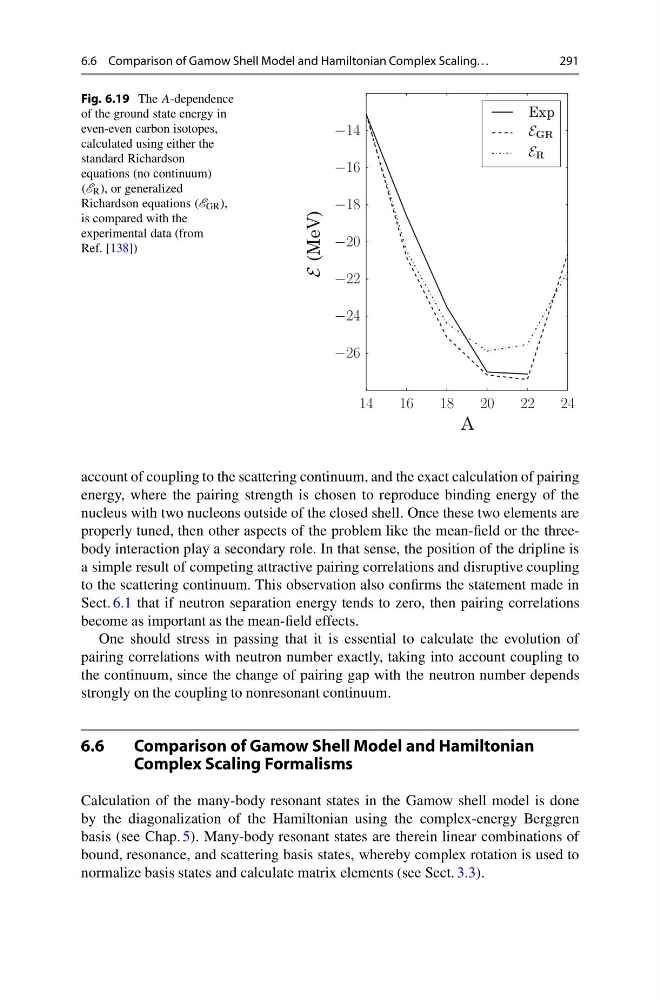
Fig. 6.19 The A-dependence
of the ground state energy in
even-even carbon isotopes,
calculated using either the
standard Richardson
equations (no continuum)
(E R ), or generalized
Richardson equations (E GR ),
is compared with the
experimental data (from
Ref. [138])
14
16
18
20
22
24
A
−26
−24
−22
−20
−18
−16
−14
E (MeV)
Exp
E GR
E R
account of coupling to the scattering continuum, and the exact calculation of pairing
energy, where the pairing strength is chosen to reproduce binding energy of the
nucleus with two nucleons outside of the closed shell. Once these two elements are
properly tuned, then other aspects of the problem like the mean-field or the threebody interaction play a secondary role. In that sense, the position of the dripline is
a simple result of competing attractive pairing correlations and disruptive coupling
to the scattering continuum. This observation also confirms the statement made in
Sect. 6.1 that if neutron separation energy tends to zero, then pairing correlations
become as important as the mean-field effects.
One should stress in passing that it is essential to calculate the evolution of
pairing correlations with neutron number exactly, taking into account coupling to
the continuum, since the change of pairing gap with the neutron number depends
strongly on the coupling to nonresonant continuum.
6.6
Comparison of Gamow Shell Model and Hamiltonian
Complex Scaling Formalisms
Calculation of the many-body resonant states in the Gamow shell model is done
by the diagonalization of the Hamiltonian using the complex-energy Berggren
basis (see Chap. 5). Many-body resonant states are therein linear combinations of
bound, resonance, and scattering basis states, whereby complex rotation is used to
normalize basis states and calculate matrix elements (see Sect. 3.3).
291
Fig. 6.19 The A-dependence
of the ground state energy in
even-even carbon isotopes,
calculated using either the
standard Richardson
equations (no continuum)
(E R ), or generalized
Richardson equations (E GR ),
is compared with the
experimental data (from
Ref. [138])
14
16
18
20
22
24
A
−26
−24
−22
−20
−18
−16
−14
E (MeV)
Exp
E GR
E R
account of coupling to the scattering continuum, and the exact calculation of pairing
energy, where the pairing strength is chosen to reproduce binding energy of the
nucleus with two nucleons outside of the closed shell. Once these two elements are
properly tuned, then other aspects of the problem like the mean-field or the threebody interaction play a secondary role. In that sense, the position of the dripline is
a simple result of competing attractive pairing correlations and disruptive coupling
to the scattering continuum. This observation also confirms the statement made in
Sect. 6.1 that if neutron separation energy tends to zero, then pairing correlations
become as important as the mean-field effects.
One should stress in passing that it is essential to calculate the evolution of
pairing correlations with neutron number exactly, taking into account coupling to
the continuum, since the change of pairing gap with the neutron number depends
strongly on the coupling to nonresonant continuum.
6.6
Comparison of Gamow Shell Model and Hamiltonian
Complex Scaling Formalisms
Calculation of the many-body resonant states in the Gamow shell model is done
by the diagonalization of the Hamiltonian using the complex-energy Berggren
basis (see Chap. 5). Many-body resonant states are therein linear combinations of
bound, resonance, and scattering basis states, whereby complex rotation is used to
normalize basis states and calculate matrix elements (see Sect. 3.3).