

6.5 Inclusion of Continuum Couplings in the Pairing Model
289
0 +
0.0
2 + , 4 +
4.613
2 + , 3 +
5.289
2 − , 3 −
8.183
0 − , 1 −
8.848
E R
0 +
0.0
2 + , 4 +
5.168
2 + , 3 +
5.578
2 − , 3 −
8.054
0 − , 1 −
8.452
E GR
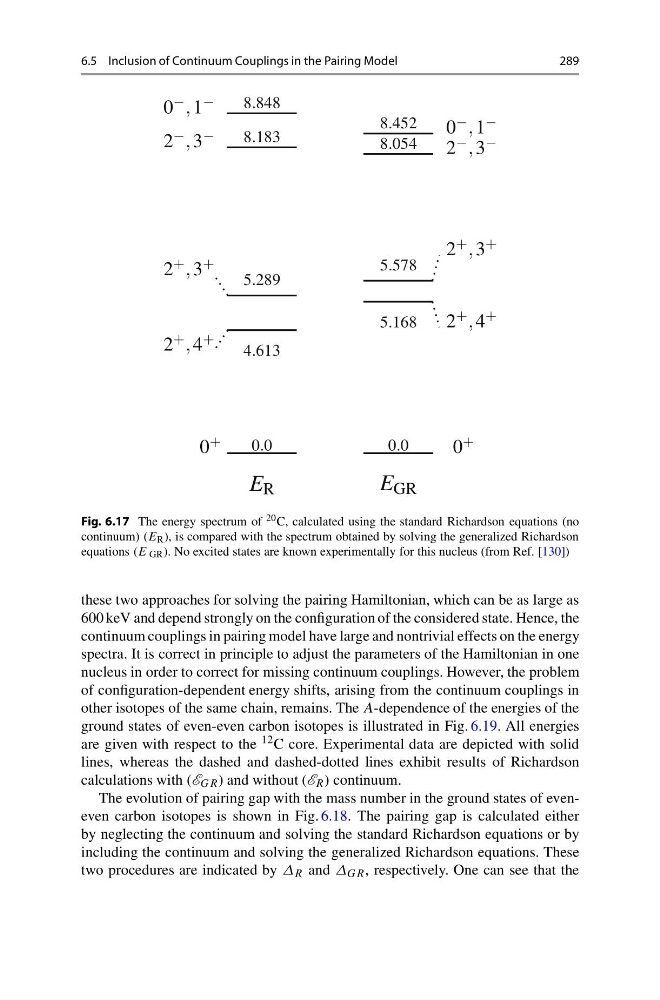
Fig. 6.17 The energy spectrum of 20 C, calculated using the standard Richardson equations (no
continuum) (E R ), is compared with the spectrum obtained by solving the generalized Richardson
equations (E GR ). No excited states are known experimentally for this nucleus (from Ref. [130])
these two approaches for solving the pairing Hamiltonian, which can be as large as
600 keV and depend strongly on the configuration of the considered state. Hence, the
continuum couplings in pairing model have large and nontrivial effects on the energy
spectra. It is correct in principle to adjust the parameters of the Hamiltonian in one
nucleus in order to correct for missing continuum couplings. However, the problem
of configuration-dependent energy shifts, arising from the continuum couplings in
other isotopes of the same chain, remains. The A-dependence of the energies of the
ground states of even-even carbon isotopes is illustrated in Fig. 6.19. All energies
are given with respect to the 12 C core. Experimental data are depicted with solid
lines, whereas the dashed and dashed-dotted lines exhibit results of Richardson
calculations with (E GR ) and without (E R ) continuum.
The evolution of pairing gap with the mass number in the ground states of eveneven carbon isotopes is shown in Fig. 6.18. The pairing gap is calculated either
by neglecting the continuum and solving the standard Richardson equations or by
including the continuum and solving the generalized Richardson equations. These
two procedures are indicated by Δ R and Δ GR , respectively. One can see that the
289
0 +
0.0
2 + , 4 +
4.613
2 + , 3 +
5.289
2 − , 3 −
8.183
0 − , 1 −
8.848
E R
0 +
0.0
2 + , 4 +
5.168
2 + , 3 +
5.578
2 − , 3 −
8.054
0 − , 1 −
8.452
E GR
Fig. 6.17 The energy spectrum of 20 C, calculated using the standard Richardson equations (no
continuum) (E R ), is compared with the spectrum obtained by solving the generalized Richardson
equations (E GR ). No excited states are known experimentally for this nucleus (from Ref. [130])
these two approaches for solving the pairing Hamiltonian, which can be as large as
600 keV and depend strongly on the configuration of the considered state. Hence, the
continuum couplings in pairing model have large and nontrivial effects on the energy
spectra. It is correct in principle to adjust the parameters of the Hamiltonian in one
nucleus in order to correct for missing continuum couplings. However, the problem
of configuration-dependent energy shifts, arising from the continuum couplings in
other isotopes of the same chain, remains. The A-dependence of the energies of the
ground states of even-even carbon isotopes is illustrated in Fig. 6.19. All energies
are given with respect to the 12 C core. Experimental data are depicted with solid
lines, whereas the dashed and dashed-dotted lines exhibit results of Richardson
calculations with (E GR ) and without (E R ) continuum.
The evolution of pairing gap with the mass number in the ground states of eveneven carbon isotopes is shown in Fig. 6.18. The pairing gap is calculated either
by neglecting the continuum and solving the standard Richardson equations or by
including the continuum and solving the generalized Richardson equations. These
two procedures are indicated by Δ R and Δ GR , respectively. One can see that the