

6.3 Effective Nucleon–Nucleon Interactions for Gamow Shell Model. . .
257
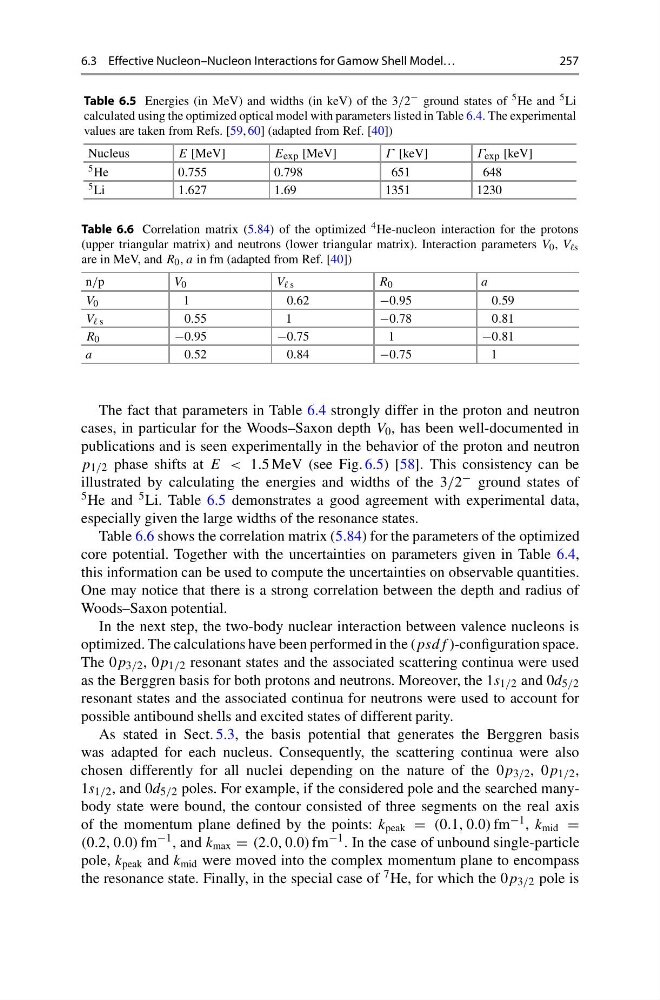
Table 6.5 Energies (in MeV) and widths (in keV) of the 3/2 − ground states of 5 He and 5 Li
calculated using the optimized optical model with parameters listed in Table 6.4. The experimental
values are taken from Refs. [59, 60] (adapted from Ref. [40])
Nucleus
E [MeV]
E exp [MeV]
Γ [keV]
Γ exp [keV]
5 He
0.755
0.798
651
648
5 Li
1.627
1.69
1351
1230
Table 6.6 Correlation matrix (5.84) of the optimized 4 He-nucleon interaction for the protons
(upper triangular matrix) and neutrons (lower triangular matrix). Interaction parameters V 0 , V
are in MeV, and R 0 , a in fm (adapted from Ref. [40])
n/p
V 0
V s
R 0
a
V 0
1
0.62
−0.95
0.59
V s
0.55
1
−0.78
0.81
R 0
−0.95
−0.75
1
−0.81
a
0.52
0.84
−0.75
1
The fact that parameters in Table 6.4 strongly differ in the proton and neutron
cases, in particular for the Woods–Saxon depth V 0 , has been well-documented in
publications and is seen experimentally in the behavior of the proton and neutron
p 1/2 phase shifts at E < 1.5 MeV (see Fig. 6.5) [58]. This consistency can be
illustrated by calculating the energies and widths of the 3/2 − ground states of
5 He and 5 Li. Table 6.5 demonstrates a good agreement with experimental data,
especially given the large widths of the resonance states.
Table 6.6 shows the correlation matrix (5.84) for the parameters of the optimized
core potential. Together with the uncertainties on parameters given in Table 6.4,
this information can be used to compute the uncertainties on observable quantities.
One may notice that there is a strong correlation between the depth and radius of
Woods–Saxon potential.
In the next step, the two-body nuclear interaction between valence nucleons is
optimized. The calculations have been performed in the (psdf )-configuration space.
The 0p 3/2 , 0p 1/2 resonant states and the associated scattering continua were used
as the Berggren basis for both protons and neutrons. Moreover, the 1s 1/2 and 0d 5/2
resonant states and the associated continua for neutrons were used to account for
possible antibound shells and excited states of different parity.
As stated in Sect. 5.3, the basis potential that generates the Berggren basis
was adapted for each nucleus. Consequently, the scattering continua were also
chosen differently for all nuclei depending on the nature of the 0p 3/2 , 0p 1/2 ,
1s 1/2 , and 0d 5/2 poles. For example, if the considered pole and the searched manybody state were bound, the contour consisted of three segments on the real axis
of the momentum plane defined by the points: k peak = (0.1, 0.0) fm −1 , k mid =
(0.2, 0.0) fm −1 , and k max = (2.0, 0.0) fm −1 . In the case of unbound single-particle
pole, k peak and k mid were moved into the complex momentum plane to encompass
the resonance state. Finally, in the special case of 7 He, for which the 0p 3/2 pole is
257
Table 6.5 Energies (in MeV) and widths (in keV) of the 3/2 − ground states of 5 He and 5 Li
calculated using the optimized optical model with parameters listed in Table 6.4. The experimental
values are taken from Refs. [59, 60] (adapted from Ref. [40])
Nucleus
E [MeV]
E exp [MeV]
Γ [keV]
Γ exp [keV]
5 He
0.755
0.798
651
648
5 Li
1.627
1.69
1351
1230
Table 6.6 Correlation matrix (5.84) of the optimized 4 He-nucleon interaction for the protons
(upper triangular matrix) and neutrons (lower triangular matrix). Interaction parameters V 0 , V
are in MeV, and R 0 , a in fm (adapted from Ref. [40])
n/p
V 0
V s
R 0
a
V 0
1
0.62
−0.95
0.59
V s
0.55
1
−0.78
0.81
R 0
−0.95
−0.75
1
−0.81
a
0.52
0.84
−0.75
1
The fact that parameters in Table 6.4 strongly differ in the proton and neutron
cases, in particular for the Woods–Saxon depth V 0 , has been well-documented in
publications and is seen experimentally in the behavior of the proton and neutron
p 1/2 phase shifts at E < 1.5 MeV (see Fig. 6.5) [58]. This consistency can be
illustrated by calculating the energies and widths of the 3/2 − ground states of
5 He and 5 Li. Table 6.5 demonstrates a good agreement with experimental data,
especially given the large widths of the resonance states.
Table 6.6 shows the correlation matrix (5.84) for the parameters of the optimized
core potential. Together with the uncertainties on parameters given in Table 6.4,
this information can be used to compute the uncertainties on observable quantities.
One may notice that there is a strong correlation between the depth and radius of
Woods–Saxon potential.
In the next step, the two-body nuclear interaction between valence nucleons is
optimized. The calculations have been performed in the (psdf )-configuration space.
The 0p 3/2 , 0p 1/2 resonant states and the associated scattering continua were used
as the Berggren basis for both protons and neutrons. Moreover, the 1s 1/2 and 0d 5/2
resonant states and the associated continua for neutrons were used to account for
possible antibound shells and excited states of different parity.
As stated in Sect. 5.3, the basis potential that generates the Berggren basis
was adapted for each nucleus. Consequently, the scattering continua were also
chosen differently for all nuclei depending on the nature of the 0p 3/2 , 0p 1/2 ,
1s 1/2 , and 0d 5/2 poles. For example, if the considered pole and the searched manybody state were bound, the contour consisted of three segments on the real axis
of the momentum plane defined by the points: k peak = (0.1, 0.0) fm −1 , k mid =
(0.2, 0.0) fm −1 , and k max = (2.0, 0.0) fm −1 . In the case of unbound single-particle
pole, k peak and k mid were moved into the complex momentum plane to encompass
the resonance state. Finally, in the special case of 7 He, for which the 0p 3/2 pole is