

256
6 Physical Applications of the Gamow Shell Model
energies on experimental data, as is described in the following. The GaussNewton method is a variation of the standard Newton minimization algorithm for
optimization problems. The singular value decomposition removes the instability of
the Gauss-Newton method, appearing when the Jacobian matrix is non-invertible
or has a very small determinant. This indeed happens when the fit-observables are
highly correlated and/or some parameters are unconstrained (see Ref. [49] for a full
description of the method).
The core-nucleon interaction of Eq. (3.83) was optimized to the experimental
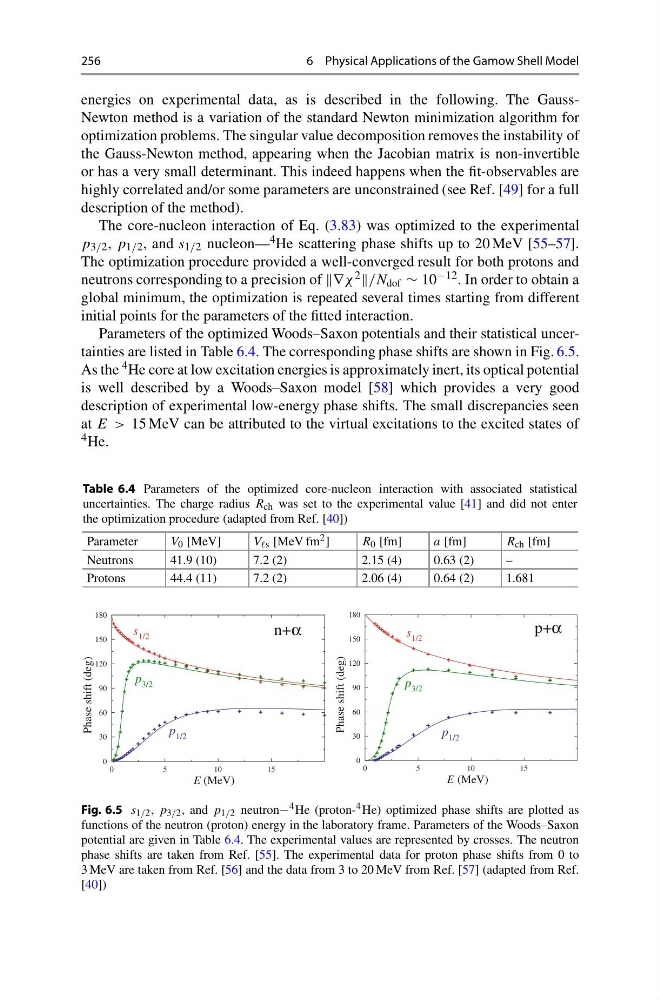
p 3/2 , p 1/2 , and s 1/2 nucleon— 4 He scattering phase shifts up to 20 MeV [55–57].
The optimization procedure provided a well-converged result for both protons and
neutrons corresponding to a precision of 2 /N dof ∼ 10 −12 . In order to obtain a
global minimum, the optimization is repeated several times starting from different
initial points for the parameters of the fitted interaction.
Parameters of the optimized Woods–Saxon potentials and their statistical uncertainties are listed in Table 6.4. The corresponding phase shifts are shown in Fig. 6.5.
As the 4 He core at low excitation energies is approximately inert, its optical potential
is well described by a Woods–Saxon model [58] which provides a very good
description of experimental low-energy phase shifts. The small discrepancies seen
at E > 15 MeV can be attributed to the virtual excitations to the excited states of
4 He.
Table 6.4 Parameters of the optimized core-nucleon interaction with associated statistical
uncertainties. The charge radius R ch was set to the experimental value [41] and did not enter
the optimization procedure (adapted from Ref. [40])
Parameter
V 0 [MeV]
V [MeV fm 2 ]
R 0 [fm]
a [fm]
R ch [fm]
Neutrons
41.9 (10)
7.2 (2)
2.15 (4)
0.63 (2)
–
Protons
44.4 (11)
7.2 (2)
2.06 (4)
0.64 (2)
1.681
0
30
60
90
120
150
180
Phase shift (deg)
0
5
10
15
E (MeV)
s 1/2
p 3/2
p 1/2
n+α
0
30
60
90
120
150
180
Phase shift (deg)
0
5
10
15
E (MeV)
s 1/2
p 3/2
p 1/2
p+α
Fig. 6.5 s 1/2 , p 3/2 , and p 1/2 neutron− 4 He (proton- 4 He) optimized phase shifts are plotted as
functions of the neutron (proton) energy in the laboratory frame. Parameters of the Woods–Saxon
potential are given in Table 6.4. The experimental values are represented by crosses. The neutron
phase shifts are taken from Ref. [55]. The experimental data for proton phase shifts from 0 to
3 MeV are taken from Ref. [56] and the data from 3 to 20 MeV from Ref. [57] (adapted from Ref.
[40])
6 Physical Applications of the Gamow Shell Model
energies on experimental data, as is described in the following. The GaussNewton method is a variation of the standard Newton minimization algorithm for
optimization problems. The singular value decomposition removes the instability of
the Gauss-Newton method, appearing when the Jacobian matrix is non-invertible
or has a very small determinant. This indeed happens when the fit-observables are
highly correlated and/or some parameters are unconstrained (see Ref. [49] for a full
description of the method).
The core-nucleon interaction of Eq. (3.83) was optimized to the experimental
p 3/2 , p 1/2 , and s 1/2 nucleon— 4 He scattering phase shifts up to 20 MeV [55–57].
The optimization procedure provided a well-converged result for both protons and
neutrons corresponding to a precision of 2 /N dof ∼ 10 −12 . In order to obtain a
global minimum, the optimization is repeated several times starting from different
initial points for the parameters of the fitted interaction.
Parameters of the optimized Woods–Saxon potentials and their statistical uncertainties are listed in Table 6.4. The corresponding phase shifts are shown in Fig. 6.5.
As the 4 He core at low excitation energies is approximately inert, its optical potential
is well described by a Woods–Saxon model [58] which provides a very good
description of experimental low-energy phase shifts. The small discrepancies seen
at E > 15 MeV can be attributed to the virtual excitations to the excited states of
4 He.
Table 6.4 Parameters of the optimized core-nucleon interaction with associated statistical
uncertainties. The charge radius R ch was set to the experimental value [41] and did not enter
the optimization procedure (adapted from Ref. [40])
Parameter
V 0 [MeV]
V [MeV fm 2 ]
R 0 [fm]
a [fm]
R ch [fm]
Neutrons
41.9 (10)
7.2 (2)
2.15 (4)
0.63 (2)
–
Protons
44.4 (11)
7.2 (2)
2.06 (4)
0.64 (2)
1.681
0
30
60
90
120
150
180
Phase shift (deg)
0
5
10
15
E (MeV)
s 1/2
p 3/2
p 1/2
n+α
0
30
60
90
120
150
180
Phase shift (deg)
0
5
10
15
E (MeV)
s 1/2
p 3/2
p 1/2
p+α
Fig. 6.5 s 1/2 , p 3/2 , and p 1/2 neutron− 4 He (proton- 4 He) optimized phase shifts are plotted as
functions of the neutron (proton) energy in the laboratory frame. Parameters of the Woods–Saxon
potential are given in Table 6.4. The experimental values are represented by crosses. The neutron
phase shifts are taken from Ref. [55]. The experimental data for proton phase shifts from 0 to
3 MeV are taken from Ref. [56] and the data from 3 to 20 MeV from Ref. [57] (adapted from Ref.
[40])