

6.3 Effective Nucleon–Nucleon Interactions for Gamow Shell Model. . .
255
orbit components in order to reproduce the experimental quadrupole moment of
the deuteron. An interaction of this type built from Gaussian form factors could
reproduce nucleon–nucleon scattering data up to 300 MeV [44]. The nucleon–
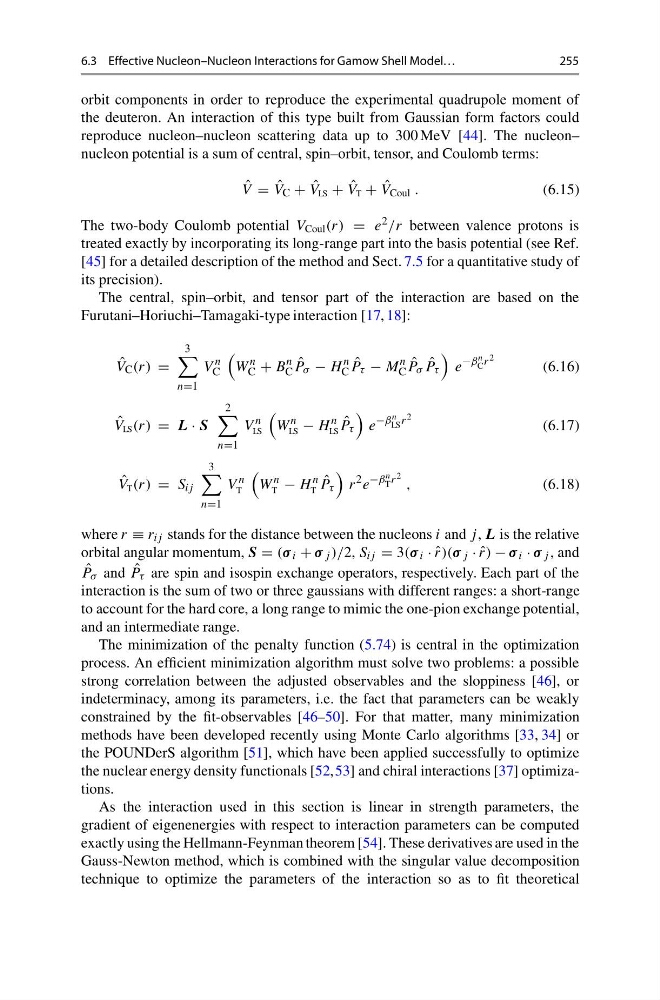
nucleon potential is a sum of central, spin–orbit, tensor, and Coulomb terms:
ˆ
V = ˆ
V C + ˆ
V LS + ˆ
V T + ˆ
V Coul .
(6.15)
The two-body Coulomb potential V Coul (r) = e 2 /r between valence protons is
treated exactly by incorporating its long-range part into the basis potential (see Ref.
[45] for a detailed description of the method and Sect. 7.5 for a quantitative study of
its precision).
The central, spin–orbit, and tensor part of the interaction are based on the
Furutani–Horiuchi–Tamagaki-type interaction [17, 18]:
ˆ
V C (r) =
3
n=1
V
n
C
W
n
C + B
n
C
ˆ
P σ − H
n
C
ˆ
P τ − M
n
C
ˆ
P σ ˆ
P τ
e
−β n
C r 2
(6.16)
ˆ
V LS (r) = L · S
2
n=1
V
n
LS
W
n
LS − H
n
LS
ˆ
P τ
e
−β n
LS r 2
(6.17)
ˆ
V T (r) = S ij
3
n=1
V
n
T
W
n
T − H
n
T
ˆ
P τ
r
2 e
−β n
T r 2
,
(6.18)
where r ≡ r ij stands for the distance between the nucleons i and j , L is the relative
orbital angular momentum, S = (σ i + σ j )/2, S ij = 3(σ i · ˆ
r)(σ j · ˆ
r) − σ i · σ j , and
ˆ
P σ and ˆ
P τ are spin and isospin exchange operators, respectively. Each part of the
interaction is the sum of two or three gaussians with different ranges: a short-range
to account for the hard core, a long range to mimic the one-pion exchange potential,
and an intermediate range.
The minimization of the penalty function (5.74) is central in the optimization
process. An efficient minimization algorithm must solve two problems: a possible
strong correlation between the adjusted observables and the sloppiness [46], or
indeterminacy, among its parameters, i.e. the fact that parameters can be weakly
constrained by the fit-observables [46–50]. For that matter, many minimization
methods have been developed recently using Monte Carlo algorithms [33, 34] or
the POUNDerS algorithm [51], which have been applied successfully to optimize
the nuclear energy density functionals [52,53] and chiral interactions [37] optimizations.
As the interaction used in this section is linear in strength parameters, the
gradient of eigenenergies with respect to interaction parameters can be computed
exactly using the Hellmann-Feynman theorem [54]. These derivatives are used in the
Gauss-Newton method, which is combined with the singular value decomposition
technique to optimize the parameters of the interaction so as to fit theoretical
255
orbit components in order to reproduce the experimental quadrupole moment of
the deuteron. An interaction of this type built from Gaussian form factors could
reproduce nucleon–nucleon scattering data up to 300 MeV [44]. The nucleon–
nucleon potential is a sum of central, spin–orbit, tensor, and Coulomb terms:
ˆ
V = ˆ
V C + ˆ
V LS + ˆ
V T + ˆ
V Coul .
(6.15)
The two-body Coulomb potential V Coul (r) = e 2 /r between valence protons is
treated exactly by incorporating its long-range part into the basis potential (see Ref.
[45] for a detailed description of the method and Sect. 7.5 for a quantitative study of
its precision).
The central, spin–orbit, and tensor part of the interaction are based on the
Furutani–Horiuchi–Tamagaki-type interaction [17, 18]:
ˆ
V C (r) =
3
n=1
V
n
C
W
n
C + B
n
C
ˆ
P σ − H
n
C
ˆ
P τ − M
n
C
ˆ
P σ ˆ
P τ
e
−β n
C r 2
(6.16)
ˆ
V LS (r) = L · S
2
n=1
V
n
LS
W
n
LS − H
n
LS
ˆ
P τ
e
−β n
LS r 2
(6.17)
ˆ
V T (r) = S ij
3
n=1
V
n
T
W
n
T − H
n
T
ˆ
P τ
r
2 e
−β n
T r 2
,
(6.18)
where r ≡ r ij stands for the distance between the nucleons i and j , L is the relative
orbital angular momentum, S = (σ i + σ j )/2, S ij = 3(σ i · ˆ
r)(σ j · ˆ
r) − σ i · σ j , and
ˆ
P σ and ˆ
P τ are spin and isospin exchange operators, respectively. Each part of the
interaction is the sum of two or three gaussians with different ranges: a short-range
to account for the hard core, a long range to mimic the one-pion exchange potential,
and an intermediate range.
The minimization of the penalty function (5.74) is central in the optimization
process. An efficient minimization algorithm must solve two problems: a possible
strong correlation between the adjusted observables and the sloppiness [46], or
indeterminacy, among its parameters, i.e. the fact that parameters can be weakly
constrained by the fit-observables [46–50]. For that matter, many minimization
methods have been developed recently using Monte Carlo algorithms [33, 34] or
the POUNDerS algorithm [51], which have been applied successfully to optimize
the nuclear energy density functionals [52,53] and chiral interactions [37] optimizations.
As the interaction used in this section is linear in strength parameters, the
gradient of eigenenergies with respect to interaction parameters can be computed
exactly using the Hellmann-Feynman theorem [54]. These derivatives are used in the
Gauss-Newton method, which is combined with the singular value decomposition
technique to optimize the parameters of the interaction so as to fit theoretical