

248
6 Physical Applications of the Gamow Shell Model
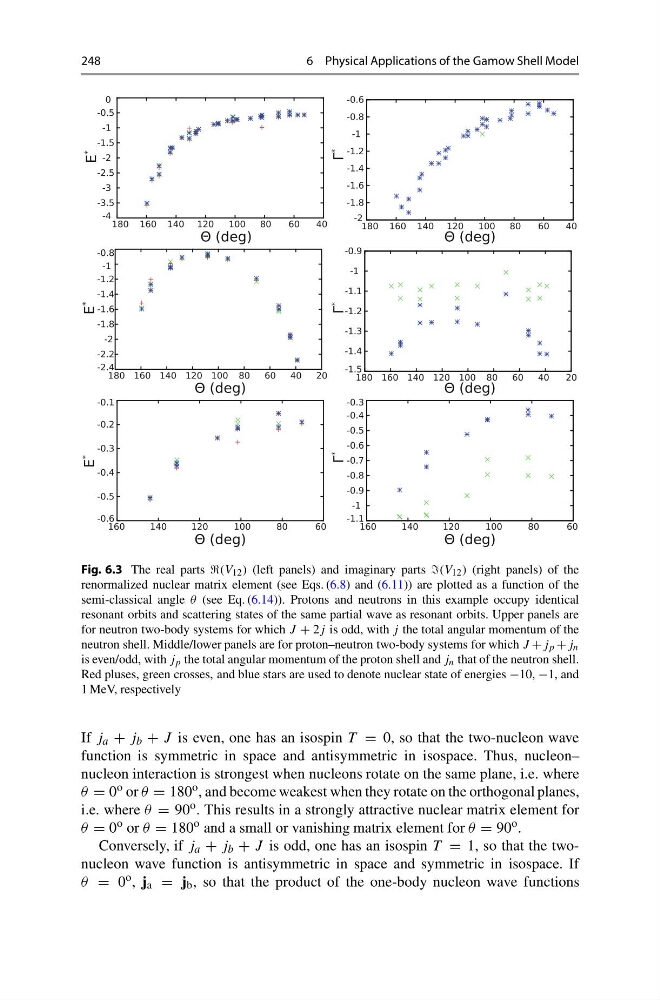
Fig. 6.3 The real parts (V 12 ) (left panels) and imaginary parts (V 12 ) (right panels) of the
renormalized nuclear matrix element (see Eqs. (6.8) and (6.11)) are plotted as a function of the
semi-classical angle θ (see Eq. (6.14)). Protons and neutrons in this example occupy identical
resonant orbits and scattering states of the same partial wave as resonant orbits. Upper panels are
for neutron two-body systems for which J + 2j is odd, with j the total angular momentum of the
neutron shell. Middle/lower panels are for proton–neutron two-body systems for which J +j p +j n
is even/odd, with j p the total angular momentum of the proton shell and j n that of the neutron shell.
Red pluses, green crosses, and blue stars are used to denote nuclear state of energies −10, −1, and
1 MeV, respectively
If j a + j b + J is even, one has an isospin T = 0, so that the two-nucleon wave
function is symmetric in space and antisymmetric in isospace. Thus, nucleon–
nucleon interaction is strongest when nucleons rotate on the same plane, i.e. where
θ = 0 o or θ = 180 o , and become weakest when they rotate on the orthogonal planes,
i.e. where θ = 90 o . This results in a strongly attractive nuclear matrix element for
θ = 0 o or θ = 180 o and a small or vanishing matrix element for θ = 90 o .
Conversely, if j a + j b + J is odd, one has an isospin T = 1, so that the twonucleon wave function is antisymmetric in space and symmetric in isospace. If
θ = 0 o , j a = j b , so that the product of the one-body nucleon wave functions
6 Physical Applications of the Gamow Shell Model
Fig. 6.3 The real parts (V 12 ) (left panels) and imaginary parts (V 12 ) (right panels) of the
renormalized nuclear matrix element (see Eqs. (6.8) and (6.11)) are plotted as a function of the
semi-classical angle θ (see Eq. (6.14)). Protons and neutrons in this example occupy identical
resonant orbits and scattering states of the same partial wave as resonant orbits. Upper panels are
for neutron two-body systems for which J + 2j is odd, with j the total angular momentum of the
neutron shell. Middle/lower panels are for proton–neutron two-body systems for which J +j p +j n
is even/odd, with j p the total angular momentum of the proton shell and j n that of the neutron shell.
Red pluses, green crosses, and blue stars are used to denote nuclear state of energies −10, −1, and
1 MeV, respectively
If j a + j b + J is even, one has an isospin T = 0, so that the two-nucleon wave
function is symmetric in space and antisymmetric in isospace. Thus, nucleon–
nucleon interaction is strongest when nucleons rotate on the same plane, i.e. where
θ = 0 o or θ = 180 o , and become weakest when they rotate on the orthogonal planes,
i.e. where θ = 90 o . This results in a strongly attractive nuclear matrix element for
θ = 0 o or θ = 180 o and a small or vanishing matrix element for θ = 90 o .
Conversely, if j a + j b + J is odd, one has an isospin T = 1, so that the twonucleon wave function is antisymmetric in space and symmetric in isospace. If
θ = 0 o , j a = j b , so that the product of the one-body nucleon wave functions