

6.2 T = 0, 1 Nuclear Matrix Elements in the Berggren Basis
247
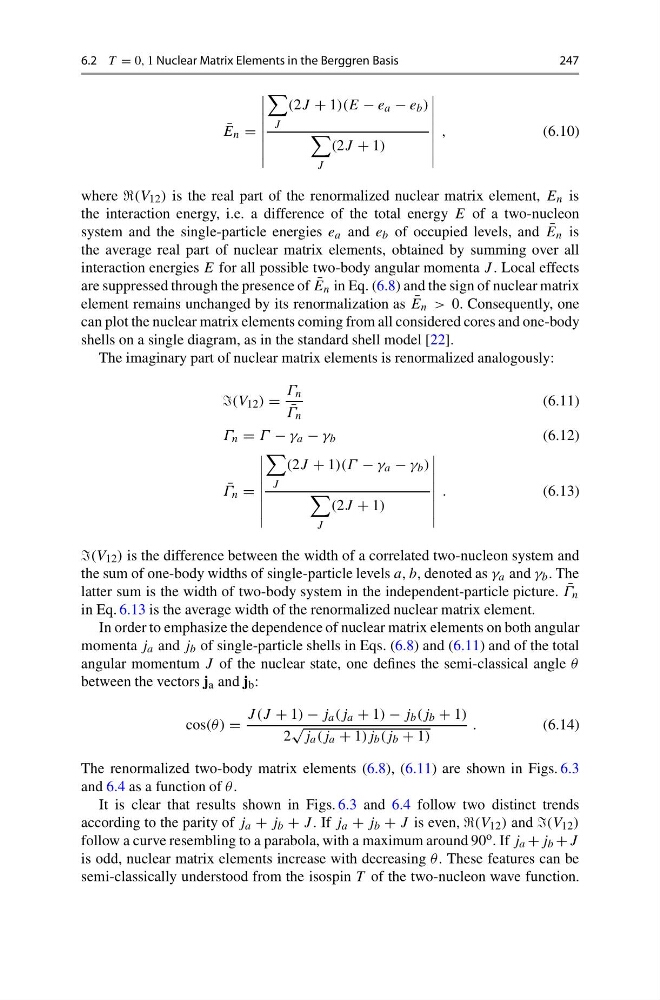
¯
E n =
J
(2J + 1)(E − e a − e b )
J
(2J + 1)
,
(6.10)
where (V 12 ) is the real part of the renormalized nuclear matrix element, E n is
the interaction energy, i.e. a difference of the total energy E of a two-nucleon
system and the single-particle energies e a and e b of occupied levels, and ¯
E n is
the average real part of nuclear matrix elements, obtained by summing over all
interaction energies E for all possible two-body angular momenta J . Local effects
are suppressed through the presence of ¯
E n in Eq. (6.8) and the sign of nuclear matrix
element remains unchanged by its renormalization as ¯
E n > 0. Consequently, one
can plot the nuclear matrix elements coming from all considered cores and one-body
shells on a single diagram, as in the standard shell model [22].
The imaginary part of nuclear matrix elements is renormalized analogously:
(V 12 ) =
Γ n
¯
Γ n
(6.11)
Γ n = Γ − γ a − γ b
(6.12)
¯
Γ n =
J
(2J + 1)(Γ − γ a − γ b )
J
(2J + 1)
.
(6.13)
(V 12 ) is the difference between the width of a correlated two-nucleon system and
the sum of one-body widths of single-particle levels a, b, denoted as γ a and γ b . The
latter sum is the width of two-body system in the independent-particle picture. ¯
Γ n
in Eq. 6.13 is the average width of the renormalized nuclear matrix element.
In order to emphasize the dependence of nuclear matrix elements on both angular
momenta j a and j b of single-particle shells in Eqs. (6.8) and (6.11) and of the total
angular momentum J of the nuclear state, one defines the semi-classical angle θ
between the vectors j a and j b :
cos(θ ) =
J (J + 1) − j a (j a + 1) − j b (j b + 1)
2
√
j a (j a + 1)j b (j b + 1)
.
(6.14)
The renormalized two-body matrix elements (6.8), (6.11) are shown in Figs. 6.3
and 6.4 as a function of θ .
It is clear that results shown in Figs. 6.3 and 6.4 follow two distinct trends
according to the parity of j a + j b + J . If j a + j b + J is even, (V 12 ) and (V 12 )
follow a curve resembling to a parabola, with a maximum around 90 o . If j a + j b + J
is odd, nuclear matrix elements increase with decreasing θ . These features can be
semi-classically understood from the isospin T of the two-nucleon wave function.
247
¯
E n =
J
(2J + 1)(E − e a − e b )
J
(2J + 1)
,
(6.10)
where (V 12 ) is the real part of the renormalized nuclear matrix element, E n is
the interaction energy, i.e. a difference of the total energy E of a two-nucleon
system and the single-particle energies e a and e b of occupied levels, and ¯
E n is
the average real part of nuclear matrix elements, obtained by summing over all
interaction energies E for all possible two-body angular momenta J . Local effects
are suppressed through the presence of ¯
E n in Eq. (6.8) and the sign of nuclear matrix
element remains unchanged by its renormalization as ¯
E n > 0. Consequently, one
can plot the nuclear matrix elements coming from all considered cores and one-body
shells on a single diagram, as in the standard shell model [22].
The imaginary part of nuclear matrix elements is renormalized analogously:
(V 12 ) =
Γ n
¯
Γ n
(6.11)
Γ n = Γ − γ a − γ b
(6.12)
¯
Γ n =
J
(2J + 1)(Γ − γ a − γ b )
J
(2J + 1)
.
(6.13)
(V 12 ) is the difference between the width of a correlated two-nucleon system and
the sum of one-body widths of single-particle levels a, b, denoted as γ a and γ b . The
latter sum is the width of two-body system in the independent-particle picture. ¯
Γ n
in Eq. 6.13 is the average width of the renormalized nuclear matrix element.
In order to emphasize the dependence of nuclear matrix elements on both angular
momenta j a and j b of single-particle shells in Eqs. (6.8) and (6.11) and of the total
angular momentum J of the nuclear state, one defines the semi-classical angle θ
between the vectors j a and j b :
cos(θ ) =
J (J + 1) − j a (j a + 1) − j b (j b + 1)
2
√
j a (j a + 1)j b (j b + 1)
.
(6.14)
The renormalized two-body matrix elements (6.8), (6.11) are shown in Figs. 6.3
and 6.4 as a function of θ .
It is clear that results shown in Figs. 6.3 and 6.4 follow two distinct trends
according to the parity of j a + j b + J . If j a + j b + J is even, (V 12 ) and (V 12 )
follow a curve resembling to a parabola, with a maximum around 90 o . If j a + j b + J
is odd, nuclear matrix elements increase with decreasing θ . These features can be
semi-classically understood from the isospin T of the two-nucleon wave function.