

6.2 T = 0, 1 Nuclear Matrix Elements in the Berggren Basis
249
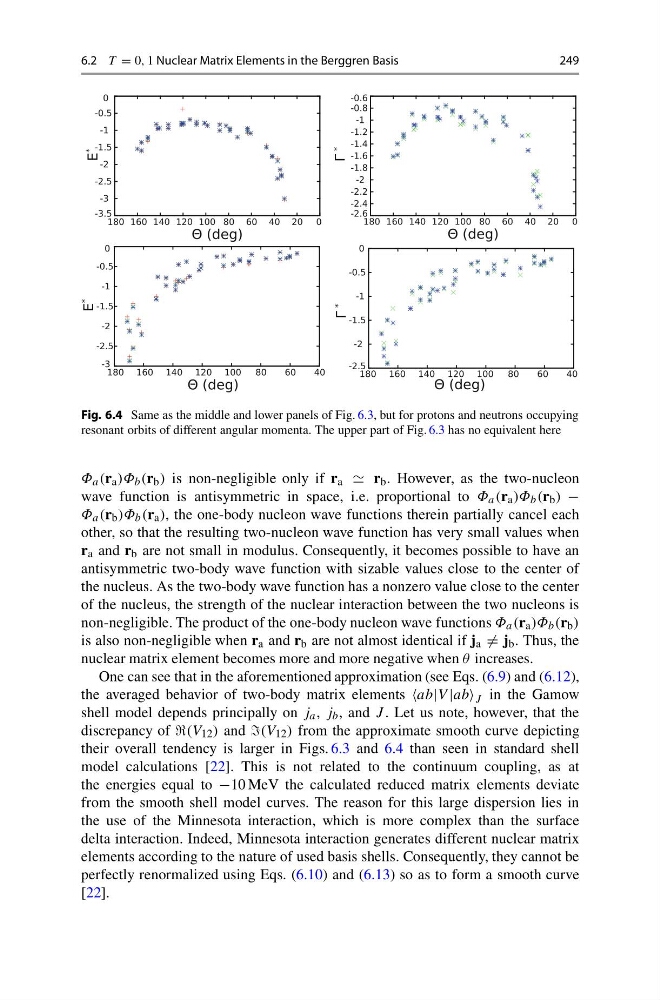
Fig. 6.4 Same as the middle and lower panels of Fig. 6.3, but for protons and neutrons occupying
resonant orbits of different angular momenta. The upper part of Fig. 6.3 has no equivalent here
Φ a (r a )Φ b (r b ) is non-negligible only if r a r b . However, as the two-nucleon
wave function is antisymmetric in space, i.e. proportional to Φ a (r a )Φ b (r b ) −
Φ a (r b )Φ b (r a ), the one-body nucleon wave functions therein partially cancel each
other, so that the resulting two-nucleon wave function has very small values when
r a and r b are not small in modulus. Consequently, it becomes possible to have an
antisymmetric two-body wave function with sizable values close to the center of
the nucleus. As the two-body wave function has a nonzero value close to the center
of the nucleus, the strength of the nuclear interaction between the two nucleons is
non-negligible. The product of the one-body nucleon wave functions Φ a (r a )Φ b (r b )
is also non-negligible when r a and r b are not almost identical if j a = j b . Thus, the
nuclear matrix element becomes more and more negative when θ increases.
One can see that in the aforementioned approximation (see Eqs. (6.9) and (6.12),
the averaged behavior of two-body matrix elements ab|V |ab J in the Gamow
shell model depends principally on j a , j b , and J . Let us note, however, that the
discrepancy of (V 12 ) and (V 12 ) from the approximate smooth curve depicting
their overall tendency is larger in Figs. 6.3 and 6.4 than seen in standard shell
model calculations [22]. This is not related to the continuum coupling, as at
the energies equal to −10 MeV the calculated reduced matrix elements deviate
from the smooth shell model curves. The reason for this large dispersion lies in
the use of the Minnesota interaction, which is more complex than the surface
delta interaction. Indeed, Minnesota interaction generates different nuclear matrix
elements according to the nature of used basis shells. Consequently, they cannot be
perfectly renormalized using Eqs. (6.10) and (6.13) so as to form a smooth curve
[22].
249
Fig. 6.4 Same as the middle and lower panels of Fig. 6.3, but for protons and neutrons occupying
resonant orbits of different angular momenta. The upper part of Fig. 6.3 has no equivalent here
Φ a (r a )Φ b (r b ) is non-negligible only if r a r b . However, as the two-nucleon
wave function is antisymmetric in space, i.e. proportional to Φ a (r a )Φ b (r b ) −
Φ a (r b )Φ b (r a ), the one-body nucleon wave functions therein partially cancel each
other, so that the resulting two-nucleon wave function has very small values when
r a and r b are not small in modulus. Consequently, it becomes possible to have an
antisymmetric two-body wave function with sizable values close to the center of
the nucleus. As the two-body wave function has a nonzero value close to the center
of the nucleus, the strength of the nuclear interaction between the two nucleons is
non-negligible. The product of the one-body nucleon wave functions Φ a (r a )Φ b (r b )
is also non-negligible when r a and r b are not almost identical if j a = j b . Thus, the
nuclear matrix element becomes more and more negative when θ increases.
One can see that in the aforementioned approximation (see Eqs. (6.9) and (6.12),
the averaged behavior of two-body matrix elements ab|V |ab J in the Gamow
shell model depends principally on j a , j b , and J . Let us note, however, that the
discrepancy of (V 12 ) and (V 12 ) from the approximate smooth curve depicting
their overall tendency is larger in Figs. 6.3 and 6.4 than seen in standard shell
model calculations [22]. This is not related to the continuum coupling, as at
the energies equal to −10 MeV the calculated reduced matrix elements deviate
from the smooth shell model curves. The reason for this large dispersion lies in
the use of the Minnesota interaction, which is more complex than the surface
delta interaction. Indeed, Minnesota interaction generates different nuclear matrix
elements according to the nature of used basis shells. Consequently, they cannot be
perfectly renormalized using Eqs. (6.10) and (6.13) so as to form a smooth curve
[22].