

188
5 Formulation and Implementation of the Gamow Shell Model
5.1.2 Complex Observables and Their Interpretation
The interpretation of a rigged Hilbert spaces formulation of quantum mechanics is
still an open issue, and the relations between Berggren and rigged Hilbert spaces
formulations are not fully solved [5]. In particular, the complex matrix elements
of operators and the probabilistic interpretation of unbound wave function do not
have a well-defined interpretation common to all quantum mechanics frameworks
describing unbound states.
The interpretation of Berggren of the real and imaginary parts of the expectation
value of an operator relies on the interference effects in reaction cross sections
[6]. Berggren also studied observables which commute with Hamiltonian, which
will be considered in this section. If one remains at the leading order, the rigged
Hilbert spaces formulation of Bohm and Gadella [7, 8] and that of Berggren [9]
are equivalent. When considering radial operators, expectation values have been
studied using a two-channel model [10]. These expectation values follow Berggren’s
prescription and allow to identify resonances as long as the wavelength of the
decaying wave is shorter than the radial extension of the resonance state.
One will extend here Berggren’s prescription to the case of observables which
do not commute with Hamiltonian. For this, one will consider explicitly the time
dependence of resonance states in the quasi-stationary approximation and will
connect complex observables to the latter. Indeed, Gamow states are supposed to
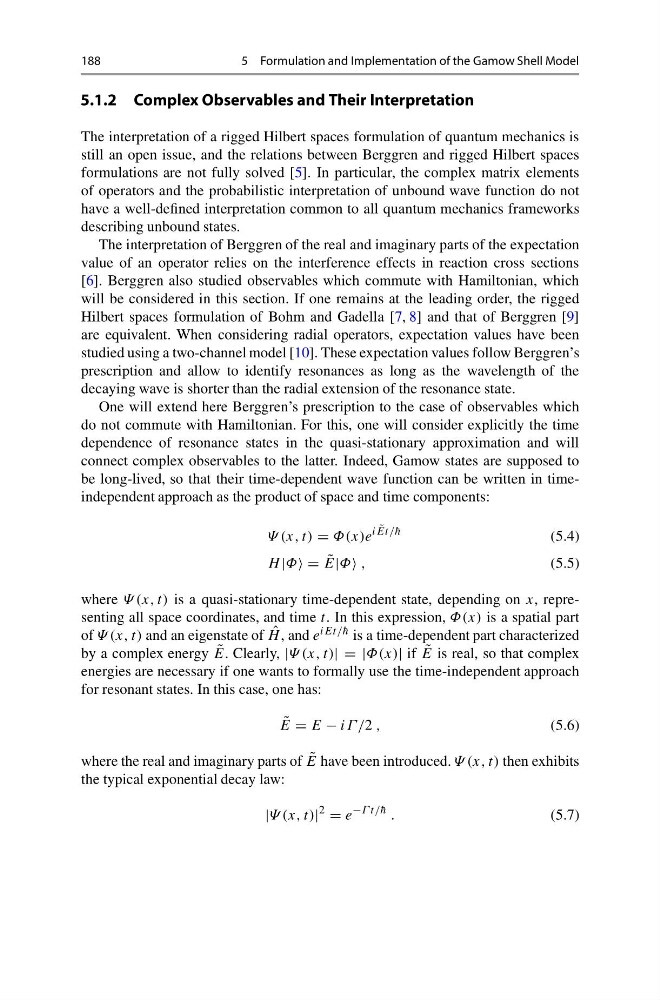
be long-lived, so that their time-dependent wave function can be written in timeindependent approach as the product of space and time components:
Ψ (x, t) = Φ(x)e
i ˜
Et/¯ h
(5.4)
H |Φ = ˜
E|Φ ,
(5.5)
where Ψ (x, t) is a quasi-stationary time-dependent state, depending on x, representing all space coordinates, and time t. In this expression, Φ(x) is a spatial part
of Ψ (x, t) and an eigenstate of ˆ
H , and e iEt/¯ h is a time-dependent part characterized
by a complex energy ˜
E. Clearly, |Ψ (x, t)| = |Φ(x)| if ˜
E is real, so that complex
energies are necessary if one wants to formally use the time-independent approach
for resonant states. In this case, one has:
˜
E = E − iΓ /2 ,
(5.6)
where the real and imaginary parts of ˜
E have been introduced. Ψ (x, t) then exhibits
the typical exponential decay law:
|Ψ (x, t)|
2
= e
−Γ t/¯ h .
(5.7)
5 Formulation and Implementation of the Gamow Shell Model
5.1.2 Complex Observables and Their Interpretation
The interpretation of a rigged Hilbert spaces formulation of quantum mechanics is
still an open issue, and the relations between Berggren and rigged Hilbert spaces
formulations are not fully solved [5]. In particular, the complex matrix elements
of operators and the probabilistic interpretation of unbound wave function do not
have a well-defined interpretation common to all quantum mechanics frameworks
describing unbound states.
The interpretation of Berggren of the real and imaginary parts of the expectation
value of an operator relies on the interference effects in reaction cross sections
[6]. Berggren also studied observables which commute with Hamiltonian, which
will be considered in this section. If one remains at the leading order, the rigged
Hilbert spaces formulation of Bohm and Gadella [7, 8] and that of Berggren [9]
are equivalent. When considering radial operators, expectation values have been
studied using a two-channel model [10]. These expectation values follow Berggren’s
prescription and allow to identify resonances as long as the wavelength of the
decaying wave is shorter than the radial extension of the resonance state.
One will extend here Berggren’s prescription to the case of observables which
do not commute with Hamiltonian. For this, one will consider explicitly the time
dependence of resonance states in the quasi-stationary approximation and will
connect complex observables to the latter. Indeed, Gamow states are supposed to
be long-lived, so that their time-dependent wave function can be written in timeindependent approach as the product of space and time components:
Ψ (x, t) = Φ(x)e
i ˜
Et/¯ h
(5.4)
H |Φ = ˜
E|Φ ,
(5.5)
where Ψ (x, t) is a quasi-stationary time-dependent state, depending on x, representing all space coordinates, and time t. In this expression, Φ(x) is a spatial part
of Ψ (x, t) and an eigenstate of ˆ
H , and e iEt/¯ h is a time-dependent part characterized
by a complex energy ˜
E. Clearly, |Ψ (x, t)| = |Φ(x)| if ˜
E is real, so that complex
energies are necessary if one wants to formally use the time-independent approach
for resonant states. In this case, one has:
˜
E = E − iΓ /2 ,
(5.6)
where the real and imaginary parts of ˜
E have been introduced. Ψ (x, t) then exhibits
the typical exponential decay law:
|Ψ (x, t)|
2
= e
−Γ t/¯ h .
(5.7)