

5.1 Mathematical Foundation of the Gamow Shell Model
187
resonance, and scattering states all belong to Φ × . In fact, the inclusion of H is
there to emphasize the more stringent properties which are demanded in Φ. Indeed,
the test functions of Φ have to decrease quickly on the r-axis, whereas H functions
diverge in general for r → +∞.
For the case of bound states, Φ ∼ H ∼ Φ × , as quantum states and their dual
belong to anti-isomorphic spaces, so that their properties, i.e., those of bound states,
are identical. On the other hand, the non-integrable character of Φ
elements, i.e.,
linear functionals on Φ, which mathematically depict resonant and scattering states,
imply that the Φ states must possess stronger regularity properties than those of the
Hilbert space. In fact, Φ bears much resemblance with the Schwarz space, whose
elements decrease on the real axis faster than any rational functions. One may note in
passing that the Heisenberg uncertainty relations, involving position and impulsion
which are unbounded operators, are properly defined on Φ, Φ × and not on H .
Rigged Hilbert spaces also provide with the mathematical setting to deal with
time-dependent processes, such as particle capture or decay. Therefore, unbound
states of complex eigenvalues, i.e., resonance or Gamow states, which are timedependent, can be represented by a ket state of Φ × in rigged Hilbert spaces. It is
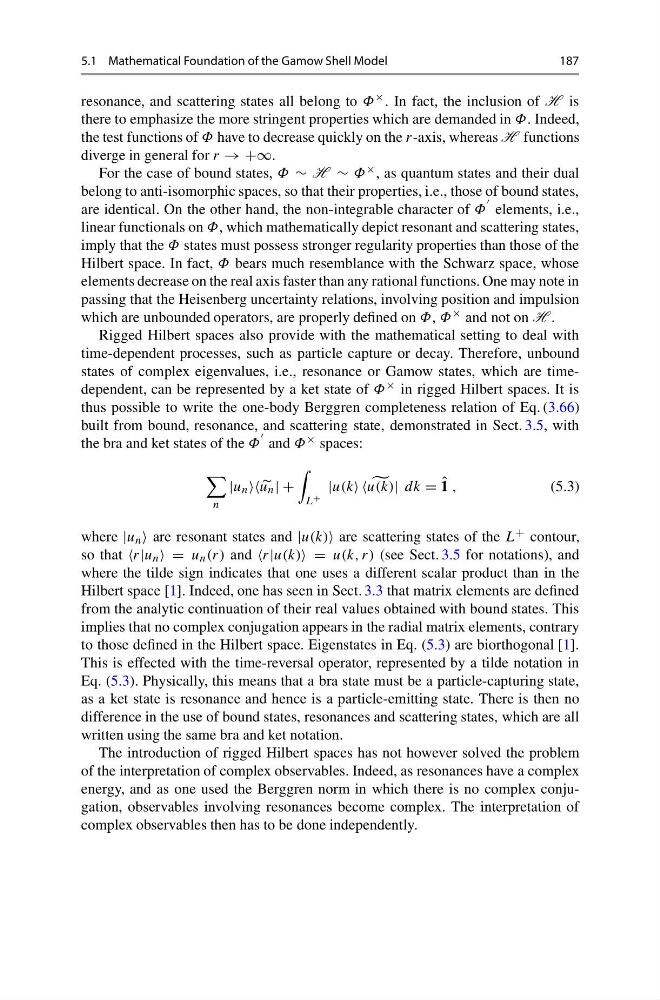
thus possible to write the one-body Berggren completeness relation of Eq. (3.66)
built from bound, resonance, and scattering state, demonstrated in Sect. 3.5, with
the bra and ket states of the Φ
and Φ × spaces:
n
|u n
u n | +
L +
|u(k
u(k)| dk = ˆ
1 ,
(5.3)
where |u n are resonant states and |u(k) are scattering states of the L + contour,
so that n = u n (r) and = u(k, r) (see Sect. 3.5 for notations), and
where the tilde sign indicates that one uses a different scalar product than in the
Hilbert space [1]. Indeed, one has seen in Sect. 3.3 that matrix elements are defined
from the analytic continuation of their real values obtained with bound states. This
implies that no complex conjugation appears in the radial matrix elements, contrary
to those defined in the Hilbert space. Eigenstates in Eq. (5.3) are biorthogonal [1].
This is effected with the time-reversal operator, represented by a tilde notation in
Eq. (5.3). Physically, this means that a bra state must be a particle-capturing state,
as a ket state is resonance and hence is a particle-emitting state. There is then no
difference in the use of bound states, resonances and scattering states, which are all
written using the same bra and ket notation.
The introduction of rigged Hilbert spaces has not however solved the problem
of the interpretation of complex observables. Indeed, as resonances have a complex
energy, and as one used the Berggren norm in which there is no complex conjugation, observables involving resonances become complex. The interpretation of
complex observables then has to be done independently.
187
resonance, and scattering states all belong to Φ × . In fact, the inclusion of H is
there to emphasize the more stringent properties which are demanded in Φ. Indeed,
the test functions of Φ have to decrease quickly on the r-axis, whereas H functions
diverge in general for r → +∞.
For the case of bound states, Φ ∼ H ∼ Φ × , as quantum states and their dual
belong to anti-isomorphic spaces, so that their properties, i.e., those of bound states,
are identical. On the other hand, the non-integrable character of Φ
elements, i.e.,
linear functionals on Φ, which mathematically depict resonant and scattering states,
imply that the Φ states must possess stronger regularity properties than those of the
Hilbert space. In fact, Φ bears much resemblance with the Schwarz space, whose
elements decrease on the real axis faster than any rational functions. One may note in
passing that the Heisenberg uncertainty relations, involving position and impulsion
which are unbounded operators, are properly defined on Φ, Φ × and not on H .
Rigged Hilbert spaces also provide with the mathematical setting to deal with
time-dependent processes, such as particle capture or decay. Therefore, unbound
states of complex eigenvalues, i.e., resonance or Gamow states, which are timedependent, can be represented by a ket state of Φ × in rigged Hilbert spaces. It is
thus possible to write the one-body Berggren completeness relation of Eq. (3.66)
built from bound, resonance, and scattering state, demonstrated in Sect. 3.5, with
the bra and ket states of the Φ
and Φ × spaces:
n
|u n
u n | +
L +
|u(k
u(k)| dk = ˆ
1 ,
(5.3)
where |u n are resonant states and |u(k) are scattering states of the L + contour,
so that n = u n (r) and = u(k, r) (see Sect. 3.5 for notations), and
where the tilde sign indicates that one uses a different scalar product than in the
Hilbert space [1]. Indeed, one has seen in Sect. 3.3 that matrix elements are defined
from the analytic continuation of their real values obtained with bound states. This
implies that no complex conjugation appears in the radial matrix elements, contrary
to those defined in the Hilbert space. Eigenstates in Eq. (5.3) are biorthogonal [1].
This is effected with the time-reversal operator, represented by a tilde notation in
Eq. (5.3). Physically, this means that a bra state must be a particle-capturing state,
as a ket state is resonance and hence is a particle-emitting state. There is then no
difference in the use of bound states, resonances and scattering states, which are all
written using the same bra and ket notation.
The introduction of rigged Hilbert spaces has not however solved the problem
of the interpretation of complex observables. Indeed, as resonances have a complex
energy, and as one used the Berggren norm in which there is no complex conjugation, observables involving resonances become complex. The interpretation of
complex observables then has to be done independently.