

138
3 Berggren Basis and Completeness Relations
C. When considering neutron s-states, one can check that if 0 < r ≤ R and
r ≥ R then the situation is treated as in Eq. (3.107), with the exception of the
following replacements: u +
app (k, r) → H
+
,η (kr), u −
app (k, r) → 0, A + (k) → 1
and B + (k) → 0, whereas all functions of r remain the same.
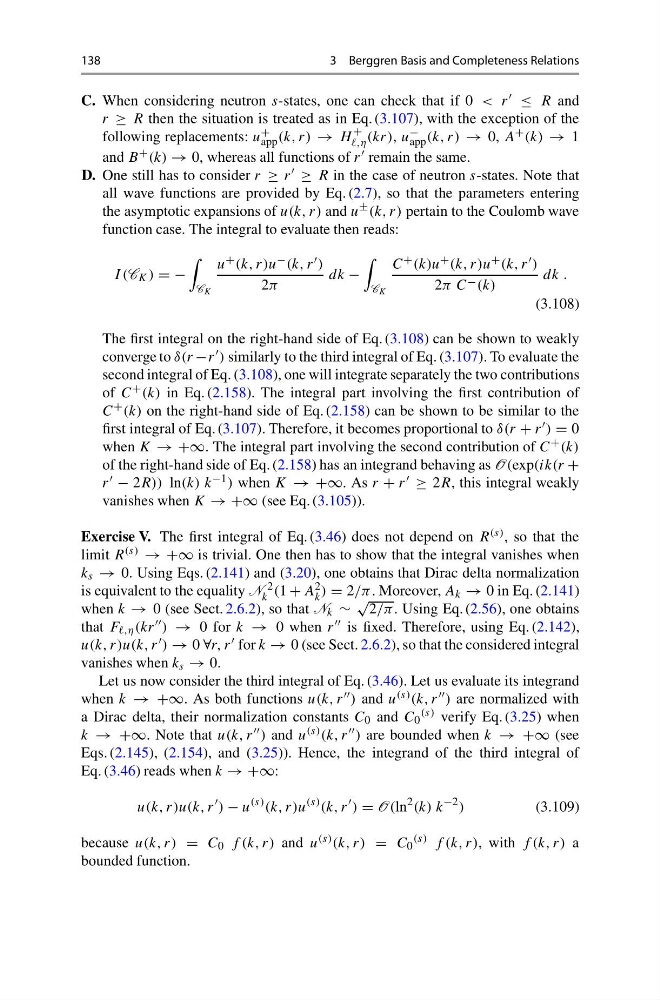
D. One still has to consider r ≥ r ≥ R in the case of neutron s-states. Note that
all wave functions are provided by Eq. (2.7), so that the parameters entering
the asymptotic expansions of u(k, r) and u ± (k, r) pertain to the Coulomb wave
function case. The integral to evaluate then reads:
I (C K ) = −
C K
u + (k, r)u − (k, r )
2π
dk −
C K
C + (k)u + (k, r)u + (k, r )
2π C − (k)
dk .
(3.108)
The first integral on the right-hand side of Eq. (3.108) can be shown to weakly
converge to δ(r −r ) similarly to the third integral of Eq. (3.107). To evaluate the
second integral of Eq. (3.108), one will integrate separately the two contributions
of C + (k) in Eq. (2.158). The integral part involving the first contribution of
C + (k) on the right-hand side of Eq. (2.158) can be shown to be similar to the
first integral of Eq. (3.107). Therefore, it becomes proportional to δ(r + r ) = 0
when K → +∞. The integral part involving the second contribution of C + (k)
of the right-hand side of Eq. (2.158) has an integrand behaving as O(exp(ik(r +
r − 2R)) ln(k) k −1 ) when K → +∞. As r + r ≥ 2R, this integral weakly
vanishes when K → +∞ (see Eq. (3.105)).
Exercise V. The first integral of Eq. (3.46) does not depend on R (s) , so that the
limit R (s) → +∞ is trivial. One then has to show that the integral vanishes when
k s → 0. Using Eqs. (2.141) and (3.20), one obtains that Dirac delta normalization
is equivalent to the equality N 2
k (1 + A 2
k ) = 2/π. Moreover, A k → 0 in Eq. (2.141)
when k → 0 (see Sect. 2.6.2), so that N k ∼
√
2/π. Using Eq. (2.56), one obtains
that F ,η (kr ) → 0 for k → 0 when r is fixed. Therefore, using Eq. (2.142),
u(k, r)u(k, r ) → 0 ∀r, r for k → 0 (see Sect. 2.6.2), so that the considered integral
vanishes when k s → 0.
Let us now consider the third integral of Eq. (3.46). Let us evaluate its integrand
when k → +∞. As both functions u(k, r ) and u (s) (k, r ) are normalized with
a Dirac delta, their normalization constants C 0 and C 0
(s) verify Eq. (3.25) when
k → +∞. Note that u(k, r ) and u (s) (k, r ) are bounded when k → +∞ (see
Eqs. (2.145), (2.154), and (3.25)). Hence, the integrand of the third integral of
Eq. (3.46) reads when k → +∞:
u(k, r)u(k, r
) − u
(s) (k, r)u
(s) (k, r
) = O(ln
2 (k) k
−2 )
(3.109)
because u(k, r) = C 0 f (k, r) and u (s) (k, r) = C 0
(s) f (k, r), with f (k, r) a
bounded function.
3 Berggren Basis and Completeness Relations
C. When considering neutron s-states, one can check that if 0 < r ≤ R and
r ≥ R then the situation is treated as in Eq. (3.107), with the exception of the
following replacements: u +
app (k, r) → H
+
,η (kr), u −
app (k, r) → 0, A + (k) → 1
and B + (k) → 0, whereas all functions of r remain the same.
D. One still has to consider r ≥ r ≥ R in the case of neutron s-states. Note that
all wave functions are provided by Eq. (2.7), so that the parameters entering
the asymptotic expansions of u(k, r) and u ± (k, r) pertain to the Coulomb wave
function case. The integral to evaluate then reads:
I (C K ) = −
C K
u + (k, r)u − (k, r )
2π
dk −
C K
C + (k)u + (k, r)u + (k, r )
2π C − (k)
dk .
(3.108)
The first integral on the right-hand side of Eq. (3.108) can be shown to weakly
converge to δ(r −r ) similarly to the third integral of Eq. (3.107). To evaluate the
second integral of Eq. (3.108), one will integrate separately the two contributions
of C + (k) in Eq. (2.158). The integral part involving the first contribution of
C + (k) on the right-hand side of Eq. (2.158) can be shown to be similar to the
first integral of Eq. (3.107). Therefore, it becomes proportional to δ(r + r ) = 0
when K → +∞. The integral part involving the second contribution of C + (k)
of the right-hand side of Eq. (2.158) has an integrand behaving as O(exp(ik(r +
r − 2R)) ln(k) k −1 ) when K → +∞. As r + r ≥ 2R, this integral weakly
vanishes when K → +∞ (see Eq. (3.105)).
Exercise V. The first integral of Eq. (3.46) does not depend on R (s) , so that the
limit R (s) → +∞ is trivial. One then has to show that the integral vanishes when
k s → 0. Using Eqs. (2.141) and (3.20), one obtains that Dirac delta normalization
is equivalent to the equality N 2
k (1 + A 2
k ) = 2/π. Moreover, A k → 0 in Eq. (2.141)
when k → 0 (see Sect. 2.6.2), so that N k ∼
√
2/π. Using Eq. (2.56), one obtains
that F ,η (kr ) → 0 for k → 0 when r is fixed. Therefore, using Eq. (2.142),
u(k, r)u(k, r ) → 0 ∀r, r for k → 0 (see Sect. 2.6.2), so that the considered integral
vanishes when k s → 0.
Let us now consider the third integral of Eq. (3.46). Let us evaluate its integrand
when k → +∞. As both functions u(k, r ) and u (s) (k, r ) are normalized with
a Dirac delta, their normalization constants C 0 and C 0
(s) verify Eq. (3.25) when
k → +∞. Note that u(k, r ) and u (s) (k, r ) are bounded when k → +∞ (see
Eqs. (2.145), (2.154), and (3.25)). Hence, the integrand of the third integral of
Eq. (3.46) reads when k → +∞:
u(k, r)u(k, r
) − u
(s) (k, r)u
(s) (k, r
) = O(ln
2 (k) k
−2 )
(3.109)
because u(k, r) = C 0 f (k, r) and u (s) (k, r) = C 0
(s) f (k, r), with f (k, r) a
bounded function.