

Solutions to Exercises
137
−
1
2π
C K
A + (k) C 0 u +
app (k, r) u −
app (k, r )
−2i C − (k)
1 + O
k
−2
dk
+
1
2π
C K
B + (k) C 0 u −
app (k, r) u +
app (k, r )
−2i C − (k)
1 + O
k
−2
dk .
(3.106)
± (k, r) and ±
u (k, r) (see Sect. 2.6.2) could both be replaced by O(k −2 )
because |k| → +∞ in Eq. (3.106).
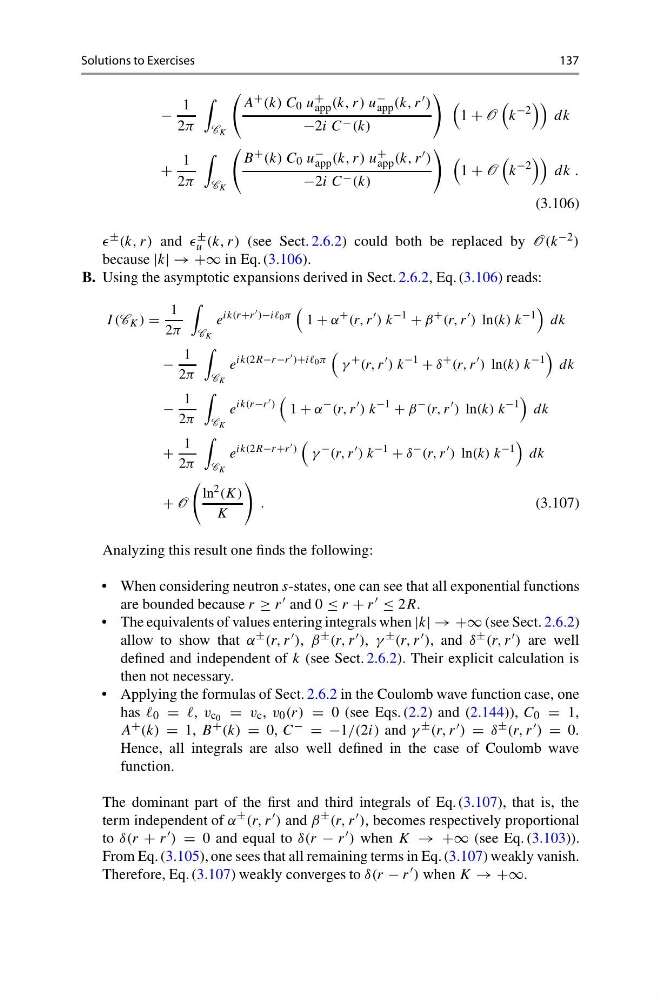
B. Using the asymptotic expansions derived in Sect. 2.6.2, Eq. (3.106) reads:
I (C K ) =
1
2π
C K
e
ik(r+r )−ii 0 π
1 + α
+ (r, r
) k
−1
+ β
+ (r, r
) ln(k) k
−1
dk
−
1
2π
C K
e
ik(2R−r−r )+ii 0 π
γ
+ (r, r
) k
−1
+ δ
+ (r, r
) ln(k) k
−1
dk
−
1
2π
C K
e
ik(r−r )
1 + α
− (r, r
) k
−1
+ β
− (r, r
) ln(k) k
−1
dk
+
1
2π
C K
e
ik(2R−r+r )
γ
− (r, r
) k
−1
+ δ
− (r, r
) ln(k) k
−1
dk
+ O
ln
2 (K)
K
.
(3.107)
Analyzing this result one finds the following:
• When considering neutron s-states, one can see that all exponential functions
are bounded because r ≥ r and 0 ≤ r + r ≤ 2R.
• The equivalents of values entering integrals when |k| → +∞ (see Sect. 2.6.2)
allow to show that α ± (r, r ), β ± (r, r ), γ ± (r, r ), and δ ± (r, r ) are well
defined and independent of k (see Sect. 2.6.2). Their explicit calculation is
then not necessary.
• Applying the formulas of Sect. 2.6.2 in the Coulomb wave function case, one
has 0 = v c 0 = v c , v 0 (r) = 0 (see Eqs. (2.2) and (2.144)), C 0 = 1,
A + (k) = 1, B + (k) = 0, C − = −1/(2i) and γ ± (r, r ) = δ ± (r, r ) = 0.
Hence, all integrals are also well defined in the case of Coulomb wave
function.
The dominant part of the first and third integrals of Eq. (3.107), that is, the
term independent of α ± (r, r ) and β ± (r, r ), becomes respectively proportional
to δ(r + r ) = 0 and equal to δ(r − r ) when K → +∞ (see Eq. (3.103)).
From Eq. (3.105), one sees that all remaining terms in Eq. (3.107) weakly vanish.
Therefore, Eq. (3.107) weakly converges to δ(r − r ) when K → +∞.
137
−
1
2π
C K
A + (k) C 0 u +
app (k, r) u −
app (k, r )
−2i C − (k)
1 + O
k
−2
dk
+
1
2π
C K
B + (k) C 0 u −
app (k, r) u +
app (k, r )
−2i C − (k)
1 + O
k
−2
dk .
(3.106)
± (k, r) and ±
u (k, r) (see Sect. 2.6.2) could both be replaced by O(k −2 )
because |k| → +∞ in Eq. (3.106).
B. Using the asymptotic expansions derived in Sect. 2.6.2, Eq. (3.106) reads:
I (C K ) =
1
2π
C K
e
ik(r+r )−ii 0 π
1 + α
+ (r, r
) k
−1
+ β
+ (r, r
) ln(k) k
−1
dk
−
1
2π
C K
e
ik(2R−r−r )+ii 0 π
γ
+ (r, r
) k
−1
+ δ
+ (r, r
) ln(k) k
−1
dk
−
1
2π
C K
e
ik(r−r )
1 + α
− (r, r
) k
−1
+ β
− (r, r
) ln(k) k
−1
dk
+
1
2π
C K
e
ik(2R−r+r )
γ
− (r, r
) k
−1
+ δ
− (r, r
) ln(k) k
−1
dk
+ O
ln
2 (K)
K
.
(3.107)
Analyzing this result one finds the following:
• When considering neutron s-states, one can see that all exponential functions
are bounded because r ≥ r and 0 ≤ r + r ≤ 2R.
• The equivalents of values entering integrals when |k| → +∞ (see Sect. 2.6.2)
allow to show that α ± (r, r ), β ± (r, r ), γ ± (r, r ), and δ ± (r, r ) are well
defined and independent of k (see Sect. 2.6.2). Their explicit calculation is
then not necessary.
• Applying the formulas of Sect. 2.6.2 in the Coulomb wave function case, one
has 0 = v c 0 = v c , v 0 (r) = 0 (see Eqs. (2.2) and (2.144)), C 0 = 1,
A + (k) = 1, B + (k) = 0, C − = −1/(2i) and γ ± (r, r ) = δ ± (r, r ) = 0.
Hence, all integrals are also well defined in the case of Coulomb wave
function.
The dominant part of the first and third integrals of Eq. (3.107), that is, the
term independent of α ± (r, r ) and β ± (r, r ), becomes respectively proportional
to δ(r + r ) = 0 and equal to δ(r − r ) when K → +∞ (see Eq. (3.103)).
From Eq. (3.105), one sees that all remaining terms in Eq. (3.107) weakly vanish.
Therefore, Eq. (3.107) weakly converges to δ(r − r ) when K → +∞.