

Solutions to Exercises
139
Consequently, one can determine the limit R (s) → +∞ of the third integral of
Eq. (3.46) by letting R (s) → +∞ inside the integral. As u (s) (k, r ) → u(k, r )
when R (s) → +∞ (see Sect. 2.6.5), the limit is equal to zero.
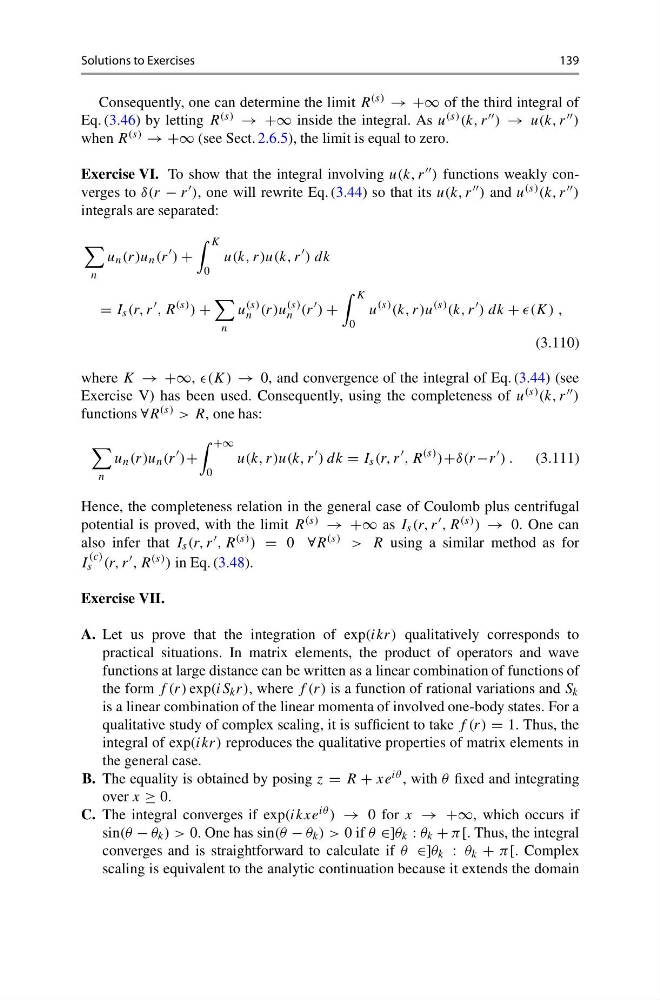
Exercise VI. To show that the integral involving u(k, r ) functions weakly converges to δ(r − r ), one will rewrite Eq. (3.44) so that its u(k, r ) and u (s) (k, r )
integrals are separated:
n
u n (r)u n (r
) +
K
0
u(k, r)u(k, r
) dk
= I s (r, r
, R
(s) ) +
n
u
(s)
n (r)u
(s)
n (r
) +
K
0
u
(s) (k, r)u
(s) (k, r
) dk + (K) ,
(3.110)
where K → +∞, (K) → 0, and convergence of the integral of Eq. (3.44) (see
Exercise V) has been used. Consequently, using the completeness of u (s) (k, r )
functions ∀R (s) > R, one has:
n
u n (r)u n (r
)+
+∞
0
u(k, r)u(k, r
) dk = I s (r, r
, R
(s) )+δ(r −r
) .
(3.111)
Hence, the completeness relation in the general case of Coulomb plus centrifugal
potential is proved, with the limit R (s) → +∞ as I s (r, r , R (s) ) → 0. One can
also infer that I s (r, r , R (s) ) = 0 ∀R (s) > R using a similar method as for
I
(c)
s (r, r , R (s) ) in Eq. (3.48).
Exercise VII.
A. Let us prove that the integration of exp(ikr) qualitatively corresponds to
practical situations. In matrix elements, the product of operators and wave
functions at large distance can be written as a linear combination of functions of
the form f (r) exp(iS k r), where f (r) is a function of rational variations and S k
is a linear combination of the linear momenta of involved one-body states. For a
qualitative study of complex scaling, it is sufficient to take f (r) = 1. Thus, the
integral of exp(ikr) reproduces the qualitative properties of matrix elements in
the general case.
B. The equality is obtained by posing z = R + xe iθ , with θ fixed and integrating
over x ≥ 0.
C. The integral converges if exp(ikxe iθ ) → 0 for x → +∞, which occurs if
sin(θ − θ k ) > 0. One has sin(θ − θ k ) > 0 if θ ∈]θ k : θ k + π[. Thus, the integral
converges and is straightforward to calculate if θ ∈]θ k : θ k + π[. Complex
scaling is equivalent to the analytic continuation because it extends the domain
139
Consequently, one can determine the limit R (s) → +∞ of the third integral of
Eq. (3.46) by letting R (s) → +∞ inside the integral. As u (s) (k, r ) → u(k, r )
when R (s) → +∞ (see Sect. 2.6.5), the limit is equal to zero.
Exercise VI. To show that the integral involving u(k, r ) functions weakly converges to δ(r − r ), one will rewrite Eq. (3.44) so that its u(k, r ) and u (s) (k, r )
integrals are separated:
n
u n (r)u n (r
) +
K
0
u(k, r)u(k, r
) dk
= I s (r, r
, R
(s) ) +
n
u
(s)
n (r)u
(s)
n (r
) +
K
0
u
(s) (k, r)u
(s) (k, r
) dk + (K) ,
(3.110)
where K → +∞, (K) → 0, and convergence of the integral of Eq. (3.44) (see
Exercise V) has been used. Consequently, using the completeness of u (s) (k, r )
functions ∀R (s) > R, one has:
n
u n (r)u n (r
)+
+∞
0
u(k, r)u(k, r
) dk = I s (r, r
, R
(s) )+δ(r −r
) .
(3.111)
Hence, the completeness relation in the general case of Coulomb plus centrifugal
potential is proved, with the limit R (s) → +∞ as I s (r, r , R (s) ) → 0. One can
also infer that I s (r, r , R (s) ) = 0 ∀R (s) > R using a similar method as for
I
(c)
s (r, r , R (s) ) in Eq. (3.48).
Exercise VII.
A. Let us prove that the integration of exp(ikr) qualitatively corresponds to
practical situations. In matrix elements, the product of operators and wave
functions at large distance can be written as a linear combination of functions of
the form f (r) exp(iS k r), where f (r) is a function of rational variations and S k
is a linear combination of the linear momenta of involved one-body states. For a
qualitative study of complex scaling, it is sufficient to take f (r) = 1. Thus, the
integral of exp(ikr) reproduces the qualitative properties of matrix elements in
the general case.
B. The equality is obtained by posing z = R + xe iθ , with θ fixed and integrating
over x ≥ 0.
C. The integral converges if exp(ikxe iθ ) → 0 for x → +∞, which occurs if
sin(θ − θ k ) > 0. One has sin(θ − θ k ) > 0 if θ ∈]θ k : θ k + π[. Thus, the integral
converges and is straightforward to calculate if θ ∈]θ k : θ k + π[. Complex
scaling is equivalent to the analytic continuation because it extends the domain