

114
3 Berggren Basis and Completeness Relations
0
0.5
1
1.5
2
Re(k) (fm
-1
)
-0.1
real part
imaginary part
c
2
(k)
0
0.1
0.2
0.3
0.4
0.5
0.6
0.7
0.8
0.9
1
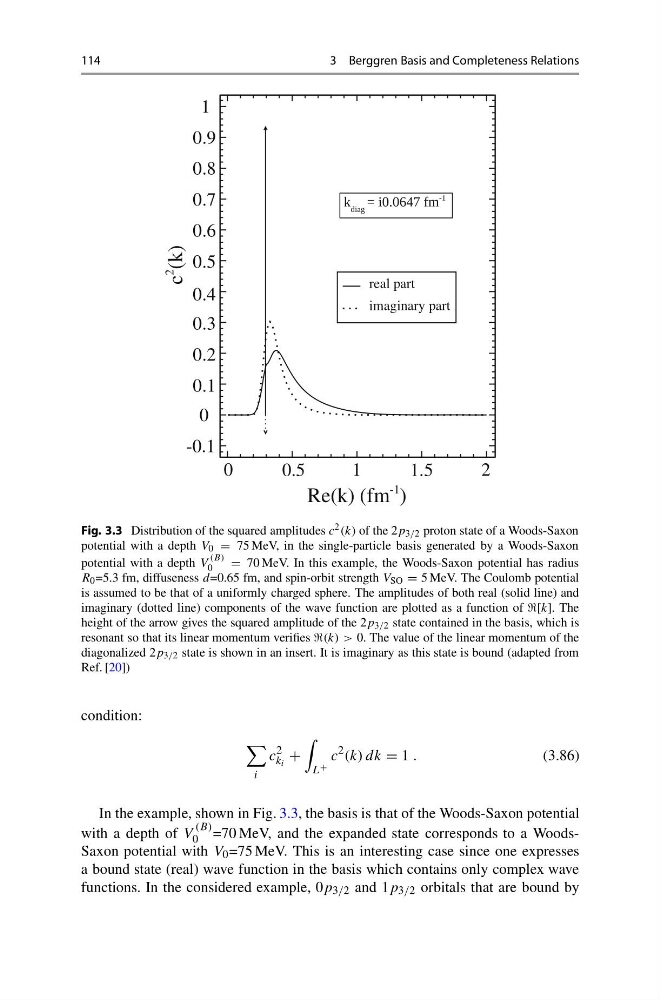
Fig. 3.3 Distribution of the squared amplitudes c 2 (k) of the 2p 3/2 proton state of a Woods-Saxon
potential with a depth V 0 = 75 MeV, in the single-particle basis generated by a Woods-Saxon
potential with a depth V
(B)
0
= 70 MeV. In this example, the Woods-Saxon potential has radius
R 0 =5.3 fm, diffuseness d=0.65 fm, and spin-orbit strength V SO = 5 MeV. The Coulomb potential
is assumed to be that of a uniformly charged sphere. The amplitudes of both real (solid line) and
imaginary (dotted line) components of the wave function are plotted as a function of The
height of the arrow gives the squared amplitude of the 2p 3/2 state contained in the basis, which is
resonant so that its linear momentum verifies (k) > 0. The value of the linear momentum of the
diagonalized 2p 3/2 state is shown in an insert. It is imaginary as this state is bound (adapted from
Ref. [20])
condition:
i
c
2
k i
+
L +
c
2 (k) dk = 1 .
(3.86)
In the example, shown in Fig. 3.3, the basis is that of the Woods-Saxon potential
with a depth of V
(B)
0 =70 MeV, and the expanded state corresponds to a WoodsSaxon potential with V 0 =75 MeV. This is an interesting case since one expresses
a bound state (real) wave function in the basis which contains only complex wave
functions. In the considered example, 0p 3/2 and 1p 3/2 orbitals that are bound by
3 Berggren Basis and Completeness Relations
0
0.5
1
1.5
2
Re(k) (fm
-1
)
-0.1
real part
imaginary part
c
2
(k)
0
0.1
0.2
0.3
0.4
0.5
0.6
0.7
0.8
0.9
1
Fig. 3.3 Distribution of the squared amplitudes c 2 (k) of the 2p 3/2 proton state of a Woods-Saxon
potential with a depth V 0 = 75 MeV, in the single-particle basis generated by a Woods-Saxon
potential with a depth V
(B)
0
= 70 MeV. In this example, the Woods-Saxon potential has radius
R 0 =5.3 fm, diffuseness d=0.65 fm, and spin-orbit strength V SO = 5 MeV. The Coulomb potential
is assumed to be that of a uniformly charged sphere. The amplitudes of both real (solid line) and
imaginary (dotted line) components of the wave function are plotted as a function of The
height of the arrow gives the squared amplitude of the 2p 3/2 state contained in the basis, which is
resonant so that its linear momentum verifies (k) > 0. The value of the linear momentum of the
diagonalized 2p 3/2 state is shown in an insert. It is imaginary as this state is bound (adapted from
Ref. [20])
condition:
i
c
2
k i
+
L +
c
2 (k) dk = 1 .
(3.86)
In the example, shown in Fig. 3.3, the basis is that of the Woods-Saxon potential
with a depth of V
(B)
0 =70 MeV, and the expanded state corresponds to a WoodsSaxon potential with V 0 =75 MeV. This is an interesting case since one expresses
a bound state (real) wave function in the basis which contains only complex wave
functions. In the considered example, 0p 3/2 and 1p 3/2 orbitals that are bound by