

98
3 Berggren Basis and Completeness Relations
3.3
Normalization and Orthogonality of Gamow States
and One-Body Matrix Elements
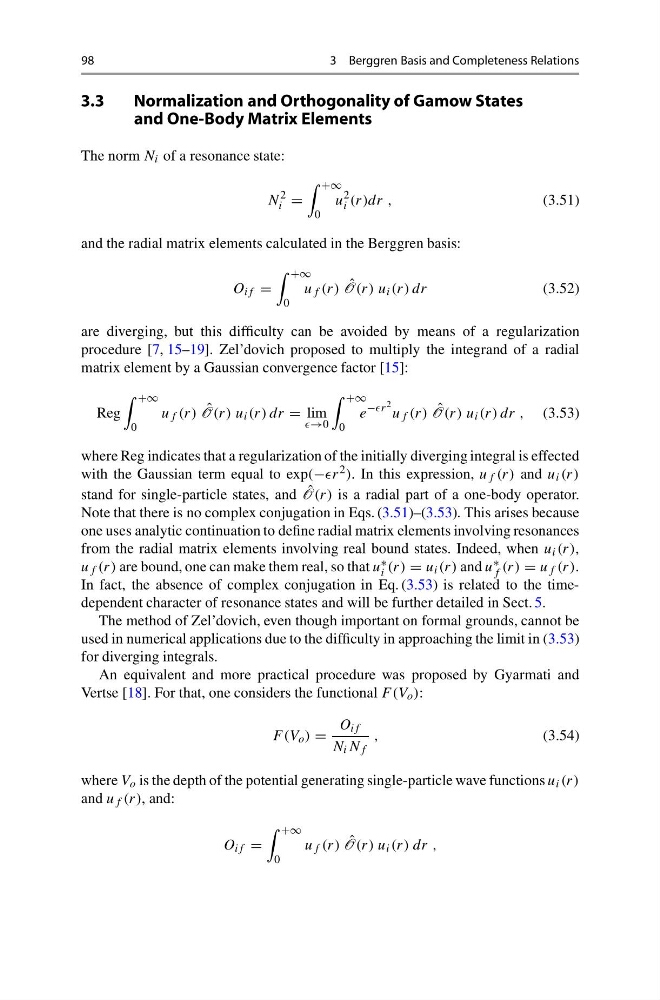
The norm N i of a resonance state:
N
2
i =
+∞
0
u
2
i (r)dr ,
(3.51)
and the radial matrix elements calculated in the Berggren basis:
O if =
+∞
0
u f (r) ˆ
O(r) u i (r) dr
(3.52)
are diverging, but this difficulty can be avoided by means of a regularization
procedure [7, 15–19]. Zel’dovich proposed to multiply the integrand of a radial
matrix element by a Gaussian convergence factor [15]:
Reg
+∞
0
u f (r) ˆ
O(r) u i (r) dr = lim
+∞
0
e
− 2
u f (r) ˆ
O(r) u i (r) dr , (3.53)
where Reg indicates that a regularization of the initially diverging integral is effected
with the Gaussian term equal to exp(− 2 ). In this expression, u f (r) and u i (r)
stand for single-particle states, and ˆ
O(r) is a radial part of a one-body operator.
Note that there is no complex conjugation in Eqs. (3.51)–(3.53). This arises because
one uses analytic continuation to define radial matrix elements involving resonances
from the radial matrix elements involving real bound states. Indeed, when u i (r),
u f (r) are bound, one can make them real, so that u ∗
i (r) = u i (r) and u ∗
f (r) = u f (r).
In fact, the absence of complex conjugation in Eq. (3.53) is related to the timedependent character of resonance states and will be further detailed in Sect. 5.
The method of Zel’dovich, even though important on formal grounds, cannot be
used in numerical applications due to the difficulty in approaching the limit in (3.53)
for diverging integrals.
An equivalent and more practical procedure was proposed by Gyarmati and
Vertse [18]. For that, one considers the functional F (V o ):
F (V o ) =
O if
N i N f
,
(3.54)
where V o is the depth of the potential generating single-particle wave functions u i (r)
and u f (r), and:
O if =
+∞
0
u f (r) ˆ
O(r) u i (r) dr ,
3 Berggren Basis and Completeness Relations
3.3
Normalization and Orthogonality of Gamow States
and One-Body Matrix Elements
The norm N i of a resonance state:
N
2
i =
+∞
0
u
2
i (r)dr ,
(3.51)
and the radial matrix elements calculated in the Berggren basis:
O if =
+∞
0
u f (r) ˆ
O(r) u i (r) dr
(3.52)
are diverging, but this difficulty can be avoided by means of a regularization
procedure [7, 15–19]. Zel’dovich proposed to multiply the integrand of a radial
matrix element by a Gaussian convergence factor [15]:
Reg
+∞
0
u f (r) ˆ
O(r) u i (r) dr = lim
+∞
0
e
− 2
u f (r) ˆ
O(r) u i (r) dr , (3.53)
where Reg indicates that a regularization of the initially diverging integral is effected
with the Gaussian term equal to exp(− 2 ). In this expression, u f (r) and u i (r)
stand for single-particle states, and ˆ
O(r) is a radial part of a one-body operator.
Note that there is no complex conjugation in Eqs. (3.51)–(3.53). This arises because
one uses analytic continuation to define radial matrix elements involving resonances
from the radial matrix elements involving real bound states. Indeed, when u i (r),
u f (r) are bound, one can make them real, so that u ∗
i (r) = u i (r) and u ∗
f (r) = u f (r).
In fact, the absence of complex conjugation in Eq. (3.53) is related to the timedependent character of resonance states and will be further detailed in Sect. 5.
The method of Zel’dovich, even though important on formal grounds, cannot be
used in numerical applications due to the difficulty in approaching the limit in (3.53)
for diverging integrals.
An equivalent and more practical procedure was proposed by Gyarmati and
Vertse [18]. For that, one considers the functional F (V o ):
F (V o ) =
O if
N i N f
,
(3.54)
where V o is the depth of the potential generating single-particle wave functions u i (r)
and u f (r), and:
O if =
+∞
0
u f (r) ˆ
O(r) u i (r) dr ,