

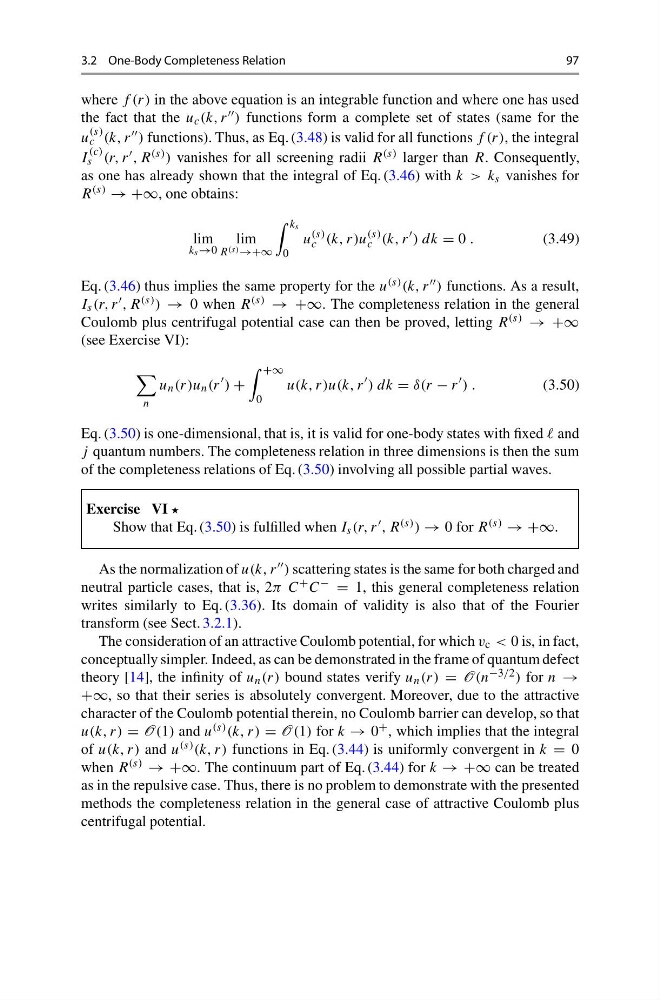
3.2 One-Body Completeness Relation
97
where f (r) in the above equation is an integrable function and where one has used
the fact that the u c (k, r ) functions form a complete set of states (same for the
u
(s)
c (k, r ) functions). Thus, as Eq. (3.48) is valid for all functions f (r), the integral
I
(c)
s (r, r , R (s) ) vanishes for all screening radii R (s) larger than R. Consequently,
as one has already shown that the integral of Eq. (3.46) with k > k s vanishes for
R (s) → +∞, one obtains:
lim
k s →0
lim
R (s) →+∞
k s
0
u
(s)
c (k, r)u
(s)
c (k, r
) dk = 0 .
(3.49)
Eq. (3.46) thus implies the same property for the u (s) (k, r ) functions. As a result,
I s (r, r , R (s) ) → 0 when R (s) → +∞. The completeness relation in the general
Coulomb plus centrifugal potential case can then be proved, letting R (s) → +∞
(see Exercise VI):
n
u n (r)u n (r
) +
+∞
0
u(k, r)u(k, r
) dk = δ(r − r
) .
(3.50)
Eq. (3.50) is one-dimensional, that is, it is valid for one-body states with fixed and
j quantum numbers. The completeness relation in three dimensions is then the sum
of the completeness relations of Eq. (3.50) involving all possible partial waves.
Exercise VI
Show that Eq. (3.50) is fulfilled when I s (r, r , R (s) ) → 0 for R (s) → +∞.
As the normalization of u(k, r ) scattering states is the same for both charged and
neutral particle cases, that is, 2π C + C − = 1, this general completeness relation
writes similarly to Eq. (3.36). Its domain of validity is also that of the Fourier
transform (see Sect. 3.2.1).
The consideration of an attractive Coulomb potential, for which v c < 0 is, in fact,
conceptually simpler. Indeed, as can be demonstrated in the frame of quantum defect
theory [14], the infinity of u n (r) bound states verify u n (r) = O(n −3/2 ) for n →
+∞, so that their series is absolutely convergent. Moreover, due to the attractive
character of the Coulomb potential therein, no Coulomb barrier can develop, so that
u(k, r) = O(1) and u (s) (k, r) = O(1) for k → 0 + , which implies that the integral
of u(k, r) and u (s) (k, r) functions in Eq. (3.44) is uniformly convergent in k = 0
when R (s) → +∞. The continuum part of Eq. (3.44) for k → +∞ can be treated
as in the repulsive case. Thus, there is no problem to demonstrate with the presented
methods the completeness relation in the general case of attractive Coulomb plus
centrifugal potential.
97
where f (r) in the above equation is an integrable function and where one has used
the fact that the u c (k, r ) functions form a complete set of states (same for the
u
(s)
c (k, r ) functions). Thus, as Eq. (3.48) is valid for all functions f (r), the integral
I
(c)
s (r, r , R (s) ) vanishes for all screening radii R (s) larger than R. Consequently,
as one has already shown that the integral of Eq. (3.46) with k > k s vanishes for
R (s) → +∞, one obtains:
lim
k s →0
lim
R (s) →+∞
k s
0
u
(s)
c (k, r)u
(s)
c (k, r
) dk = 0 .
(3.49)
Eq. (3.46) thus implies the same property for the u (s) (k, r ) functions. As a result,
I s (r, r , R (s) ) → 0 when R (s) → +∞. The completeness relation in the general
Coulomb plus centrifugal potential case can then be proved, letting R (s) → +∞
(see Exercise VI):
n
u n (r)u n (r
) +
+∞
0
u(k, r)u(k, r
) dk = δ(r − r
) .
(3.50)
Eq. (3.50) is one-dimensional, that is, it is valid for one-body states with fixed and
j quantum numbers. The completeness relation in three dimensions is then the sum
of the completeness relations of Eq. (3.50) involving all possible partial waves.
Exercise VI
Show that Eq. (3.50) is fulfilled when I s (r, r , R (s) ) → 0 for R (s) → +∞.
As the normalization of u(k, r ) scattering states is the same for both charged and
neutral particle cases, that is, 2π C + C − = 1, this general completeness relation
writes similarly to Eq. (3.36). Its domain of validity is also that of the Fourier
transform (see Sect. 3.2.1).
The consideration of an attractive Coulomb potential, for which v c < 0 is, in fact,
conceptually simpler. Indeed, as can be demonstrated in the frame of quantum defect
theory [14], the infinity of u n (r) bound states verify u n (r) = O(n −3/2 ) for n →
+∞, so that their series is absolutely convergent. Moreover, due to the attractive
character of the Coulomb potential therein, no Coulomb barrier can develop, so that
u(k, r) = O(1) and u (s) (k, r) = O(1) for k → 0 + , which implies that the integral
of u(k, r) and u (s) (k, r) functions in Eq. (3.44) is uniformly convergent in k = 0
when R (s) → +∞. The continuum part of Eq. (3.44) for k → +∞ can be treated
as in the repulsive case. Thus, there is no problem to demonstrate with the presented
methods the completeness relation in the general case of attractive Coulomb plus
centrifugal potential.