

96
3 Berggren Basis and Completeness Relations
A direct calculation of this limit is in principle possible by calculating asymptotic
expansions of u (s) (k, r ) ∀k ∈]0 : k s ], using the results of Sects. 2.3.3 and 2.6.2.
However, this method is very cumbersome, as one would have to (1) devise three
different WKB approximations for u (s) (k, r ), respectively, valid for r r t (k),
r ∼ r t (k), and r r t (k) (see Eq. (2.68)), (2) generate a Neumann series
solutions from these ansatz (see Sect. 2.6.2), and (3) connect them at the limits of
their respective domains of validity.
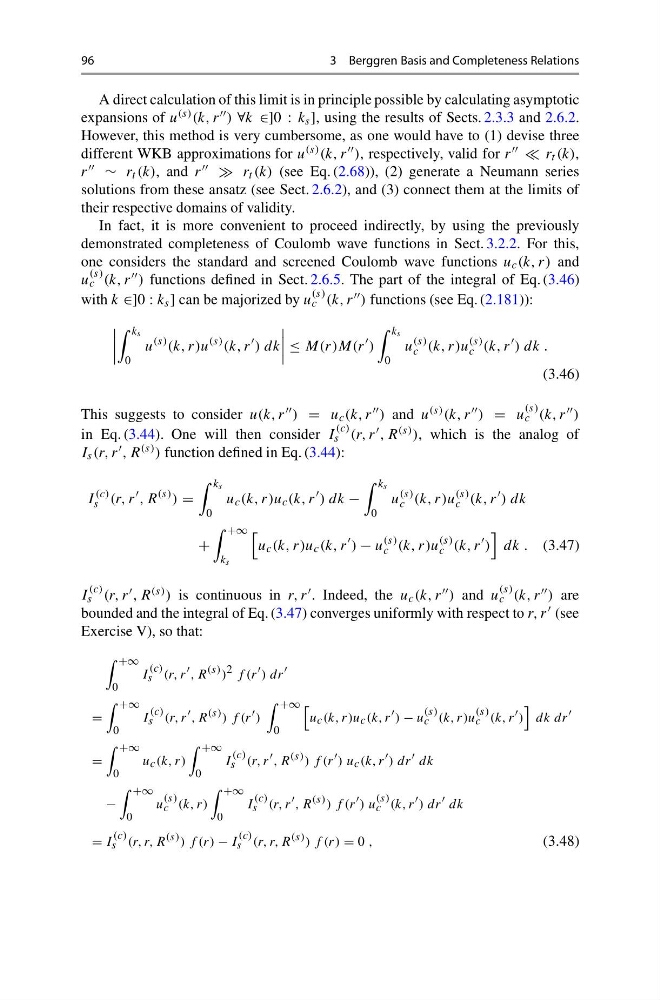
In fact, it is more convenient to proceed indirectly, by using the previously
demonstrated completeness of Coulomb wave functions in Sect. 3.2.2. For this,
one considers the standard and screened Coulomb wave functions u c (k, r) and
u
(s)
c (k, r ) functions defined in Sect. 2.6.5. The part of the integral of Eq. (3.46)
with k ∈]0 : k s ] can be majorized by u
(s)
c (k, r ) functions (see Eq. (2.181)):
k s
0
u
(s) (k, r)u
(s) (k, r
) dk
≤ M(r)M(r
)
k s
0
u
(s)
c (k, r)u
(s)
c (k, r
) dk .
(3.46)
This suggests to consider u(k, r ) = u c (k, r ) and u (s) (k, r ) = u
(s)
c (k, r )
in Eq. (3.44). One will then consider I
(c)
s (r, r , R (s) ), which is the analog of
I s (r, r , R (s) ) function defined in Eq. (3.44):
I
(c)
s (r, r
, R
(s) ) =
k s
0
u c (k, r)u c (k, r
) dk −
k s
0
u
(s)
c (k, r)u
(s)
c (k, r
) dk
+
+∞
k s
u c (k, r)u c (k, r
) − u
(s)
c (k, r)u
(s)
c (k, r
)
dk . (3.47)
I
(c)
s (r, r , R (s) ) is continuous in r, r . Indeed, the u c (k, r ) and u
(s)
c (k, r ) are
bounded and the integral of Eq. (3.47) converges uniformly with respect to r, r (see
Exercise V), so that:
+∞
0
I
(c)
s (r, r , R (s) ) 2 f (r ) dr
=
+∞
0
I
(c)
s (r, r , R (s) ) f (r )
+∞
0
u c (k, r)u c (k, r ) − u
(s)
c (k, r)u
(s)
c (k, r )
dk dr
=
+∞
0
u c (k, r)
+∞
0
I
(c)
s (r, r , R (s) ) f (r ) u c (k, r ) dr dk
−
+∞
0
u
(s)
c (k, r)
+∞
0
I
(c)
s (r, r , R (s) ) f (r ) u
(s)
c (k, r ) dr dk
= I
(c)
s (r, r, R (s) ) f (r) − I
(c)
s (r, r, R (s) ) f (r) = 0 ,
(3.48)
3 Berggren Basis and Completeness Relations
A direct calculation of this limit is in principle possible by calculating asymptotic
expansions of u (s) (k, r ) ∀k ∈]0 : k s ], using the results of Sects. 2.3.3 and 2.6.2.
However, this method is very cumbersome, as one would have to (1) devise three
different WKB approximations for u (s) (k, r ), respectively, valid for r r t (k),
r ∼ r t (k), and r r t (k) (see Eq. (2.68)), (2) generate a Neumann series
solutions from these ansatz (see Sect. 2.6.2), and (3) connect them at the limits of
their respective domains of validity.
In fact, it is more convenient to proceed indirectly, by using the previously
demonstrated completeness of Coulomb wave functions in Sect. 3.2.2. For this,
one considers the standard and screened Coulomb wave functions u c (k, r) and
u
(s)
c (k, r ) functions defined in Sect. 2.6.5. The part of the integral of Eq. (3.46)
with k ∈]0 : k s ] can be majorized by u
(s)
c (k, r ) functions (see Eq. (2.181)):
k s
0
u
(s) (k, r)u
(s) (k, r
) dk
≤ M(r)M(r
)
k s
0
u
(s)
c (k, r)u
(s)
c (k, r
) dk .
(3.46)
This suggests to consider u(k, r ) = u c (k, r ) and u (s) (k, r ) = u
(s)
c (k, r )
in Eq. (3.44). One will then consider I
(c)
s (r, r , R (s) ), which is the analog of
I s (r, r , R (s) ) function defined in Eq. (3.44):
I
(c)
s (r, r
, R
(s) ) =
k s
0
u c (k, r)u c (k, r
) dk −
k s
0
u
(s)
c (k, r)u
(s)
c (k, r
) dk
+
+∞
k s
u c (k, r)u c (k, r
) − u
(s)
c (k, r)u
(s)
c (k, r
)
dk . (3.47)
I
(c)
s (r, r , R (s) ) is continuous in r, r . Indeed, the u c (k, r ) and u
(s)
c (k, r ) are
bounded and the integral of Eq. (3.47) converges uniformly with respect to r, r (see
Exercise V), so that:
+∞
0
I
(c)
s (r, r , R (s) ) 2 f (r ) dr
=
+∞
0
I
(c)
s (r, r , R (s) ) f (r )
+∞
0
u c (k, r)u c (k, r ) − u
(s)
c (k, r)u
(s)
c (k, r )
dk dr
=
+∞
0
u c (k, r)
+∞
0
I
(c)
s (r, r , R (s) ) f (r ) u c (k, r ) dr dk
−
+∞
0
u
(s)
c (k, r)
+∞
0
I
(c)
s (r, r , R (s) ) f (r ) u
(s)
c (k, r ) dr dk
= I
(c)
s (r, r, R (s) ) f (r) − I
(c)
s (r, r, R (s) ) f (r) = 0 ,
(3.48)