

3.3 Normalization and Orthogonality of Gamow States and One-Body Matrix. . .
99
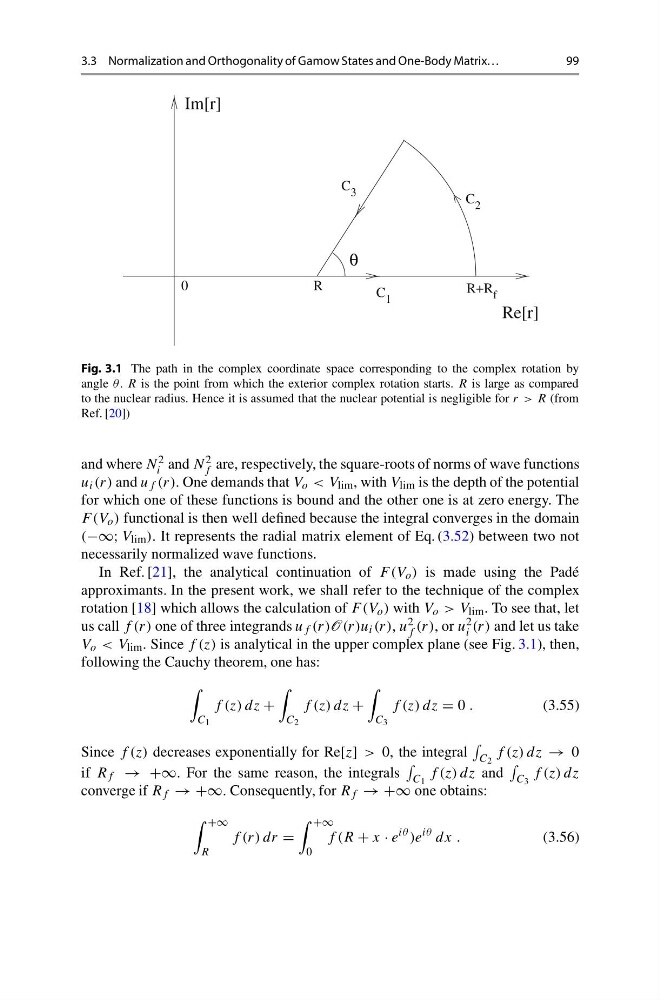
Fig. 3.1 The path in the complex coordinate space corresponding to the complex rotation by
angle θ. R is the point from which the exterior complex rotation starts. R is large as compared
to the nuclear radius. Hence it is assumed that the nuclear potential is negligible for r > R (from
Ref. [20])
and where N 2
i and N 2
f are, respectively, the square-roots of norms of wave functions
u i (r) and u f (r). One demands that V o < V lim , with V lim is the depth of the potential
for which one of these functions is bound and the other one is at zero energy. The
F (V o ) functional is then well defined because the integral converges in the domain
(−∞; V lim ). It represents the radial matrix element of Eq. (3.52) between two not
necessarily normalized wave functions.
In Ref. [21], the analytical continuation of F (V o ) is made using the Padé
approximants. In the present work, we shall refer to the technique of the complex
rotation [18] which allows the calculation of F (V o ) with V o > V lim . To see that, let
us call f (r) one of three integrands u f (r)O(r)u i (r), u 2
f (r), or u 2
i (r) and let us take
V o < V lim . Since f (z) is analytical in the upper complex plane (see Fig. 3.1), then,
following the Cauchy theorem, one has:
C 1
f (z) dz +
C 2
f (z) dz +
C 3
f (z) dz = 0 .
(3.55)
Since f (z) decreases exponentially for Re[z] > 0, the integral
C 2
f (z) dz → 0
if R f → +∞. For the same reason, the integrals
C 1
f (z) dz and
C 3
f (z) dz
converge if R f → +∞. Consequently, for R f → +∞ one obtains:
+∞
R
f (r) dr =
+∞
0
f (R + x · e
iθ )e
iθ dx .
(3.56)
99
Fig. 3.1 The path in the complex coordinate space corresponding to the complex rotation by
angle θ. R is the point from which the exterior complex rotation starts. R is large as compared
to the nuclear radius. Hence it is assumed that the nuclear potential is negligible for r > R (from
Ref. [20])
and where N 2
i and N 2
f are, respectively, the square-roots of norms of wave functions
u i (r) and u f (r). One demands that V o < V lim , with V lim is the depth of the potential
for which one of these functions is bound and the other one is at zero energy. The
F (V o ) functional is then well defined because the integral converges in the domain
(−∞; V lim ). It represents the radial matrix element of Eq. (3.52) between two not
necessarily normalized wave functions.
In Ref. [21], the analytical continuation of F (V o ) is made using the Padé
approximants. In the present work, we shall refer to the technique of the complex
rotation [18] which allows the calculation of F (V o ) with V o > V lim . To see that, let
us call f (r) one of three integrands u f (r)O(r)u i (r), u 2
f (r), or u 2
i (r) and let us take
V o < V lim . Since f (z) is analytical in the upper complex plane (see Fig. 3.1), then,
following the Cauchy theorem, one has:
C 1
f (z) dz +
C 2
f (z) dz +
C 3
f (z) dz = 0 .
(3.55)
Since f (z) decreases exponentially for Re[z] > 0, the integral
C 2
f (z) dz → 0
if R f → +∞. For the same reason, the integrals
C 1
f (z) dz and
C 3
f (z) dz
converge if R f → +∞. Consequently, for R f → +∞ one obtains:
+∞
R
f (r) dr =
+∞
0
f (R + x · e
iθ )e
iθ dx .
(3.56)