

88
3 Single Molecule Non-cleavable Multiply Active Antibacterials
Although not the only resistance mechanism, bacterial efflux pumps are important for counteracting antibacterials by pumping them out of the cell resulting in
concentration reduction to sub-effective levels in bacterial pathogens (Blanco et al.
2018; Costa et al. 2013; Van Bambeke et al. 2009). Additionally, efflux pumps also
have a range of other functions, such as extrusion of endogenous metabolites like the
siderophore, enterobactin, or the efflux of toxic endogenous metabolic intermediates
(Blanco et al. 2016). Thus there has been a great deal of work done on the development of inhibitors for efflux pump inhibitors as a way to potentiate antibacterial
action either through combinations or hybrids.
Incorporating other pharmacophoric elements in hybrid design for indirect activities with those expressing direct antibacterial activity can then be a powerful
approach to efficacious triple acting hybrids. Such design can be based on inputs
from drug combination results. In their review, Blanco et al. 2018 discuss antibiotic hybrids including an efflux pump inhibitor (EPI) which can synergise with
other antibacterials, for example tobramycin-efflux pump inhibitor conjugates and
fluoroquinolones against a drug resistant strain of Pseudomonas aeruginosa. This
combination then suggests single molecule hybrid equivalents such as covalently
linking the tobramycin-efflux pump inhibitor conjugate with a fluoroquinolone with
the linkage being positioned to enable retention of the original modes of action. Hence
such hybrids would be dual or higher order active agents which could form a good
starting point for futher multiple-activity single molecule design. A simpler established version of this comes from the work of German et al. reviewed in Schindler
et al. (2013) in which the oxafloxacin-efflux pump blocker (NorA) hybrid Q6CA
showed highly potent EPI activity while retaining antibacterial effectiveness against
Staphylococcus aureus, presumably with the latter due to gyrase and topoisomerase
IV interactions giving a total of three activity sites.
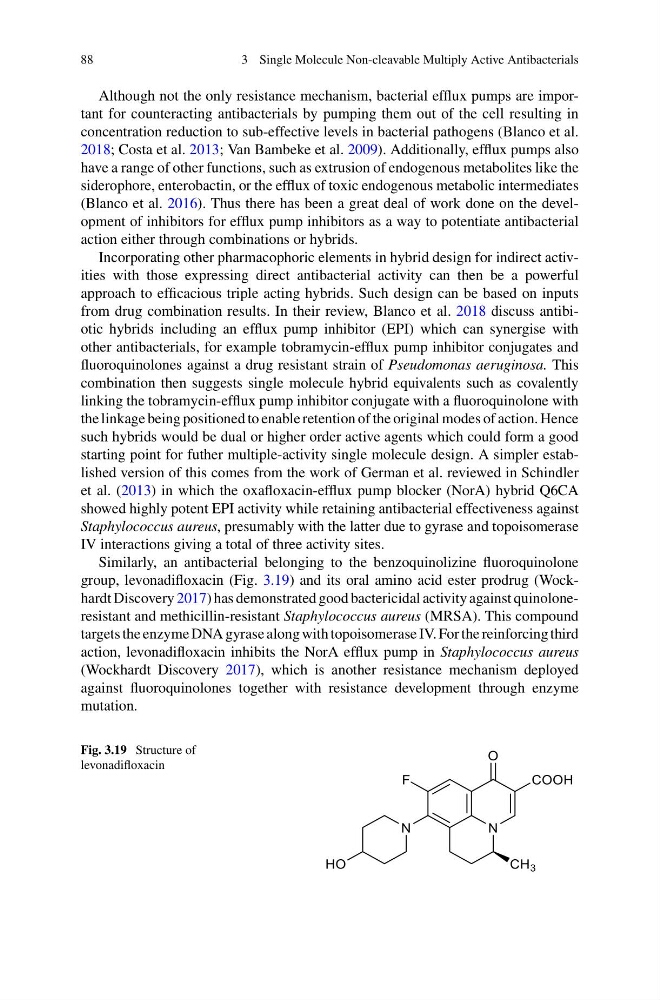
Similarly, an antibacterial belonging to the benzoquinolizine fluoroquinolone
group, levonadifloxacin (Fig. 3.19) and its oral amino acid ester prodrug (Wockhardt Discovery 2017) has demonstrated good bactericidal activity against quinoloneresistant and methicillin-resistant Staphylococcus aureus (MRSA). This compound
targets the enzyme DNA gyrase along with topoisomerase IV. For the reinforcing third
action, levonadifloxacin inhibits the NorA efflux pump in Staphylococcus aureus
(Wockhardt Discovery 2017), which is another resistance mechanism deployed
against fluoroquinolones together with resistance development through enzyme
mutation.
Fig. 3.19 Structure of
levonadifloxacin
3 Single Molecule Non-cleavable Multiply Active Antibacterials
Although not the only resistance mechanism, bacterial efflux pumps are important for counteracting antibacterials by pumping them out of the cell resulting in
concentration reduction to sub-effective levels in bacterial pathogens (Blanco et al.
2018; Costa et al. 2013; Van Bambeke et al. 2009). Additionally, efflux pumps also
have a range of other functions, such as extrusion of endogenous metabolites like the
siderophore, enterobactin, or the efflux of toxic endogenous metabolic intermediates
(Blanco et al. 2016). Thus there has been a great deal of work done on the development of inhibitors for efflux pump inhibitors as a way to potentiate antibacterial
action either through combinations or hybrids.
Incorporating other pharmacophoric elements in hybrid design for indirect activities with those expressing direct antibacterial activity can then be a powerful
approach to efficacious triple acting hybrids. Such design can be based on inputs
from drug combination results. In their review, Blanco et al. 2018 discuss antibiotic hybrids including an efflux pump inhibitor (EPI) which can synergise with
other antibacterials, for example tobramycin-efflux pump inhibitor conjugates and
fluoroquinolones against a drug resistant strain of Pseudomonas aeruginosa. This
combination then suggests single molecule hybrid equivalents such as covalently
linking the tobramycin-efflux pump inhibitor conjugate with a fluoroquinolone with
the linkage being positioned to enable retention of the original modes of action. Hence
such hybrids would be dual or higher order active agents which could form a good
starting point for futher multiple-activity single molecule design. A simpler established version of this comes from the work of German et al. reviewed in Schindler
et al. (2013) in which the oxafloxacin-efflux pump blocker (NorA) hybrid Q6CA
showed highly potent EPI activity while retaining antibacterial effectiveness against
Staphylococcus aureus, presumably with the latter due to gyrase and topoisomerase
IV interactions giving a total of three activity sites.
Similarly, an antibacterial belonging to the benzoquinolizine fluoroquinolone
group, levonadifloxacin (Fig. 3.19) and its oral amino acid ester prodrug (Wockhardt Discovery 2017) has demonstrated good bactericidal activity against quinoloneresistant and methicillin-resistant Staphylococcus aureus (MRSA). This compound
targets the enzyme DNA gyrase along with topoisomerase IV. For the reinforcing third
action, levonadifloxacin inhibits the NorA efflux pump in Staphylococcus aureus
(Wockhardt Discovery 2017), which is another resistance mechanism deployed
against fluoroquinolones together with resistance development through enzyme
mutation.
Fig. 3.19 Structure of
levonadifloxacin