

3.3 Triple Action Antibacterial Hybrid Agents
87
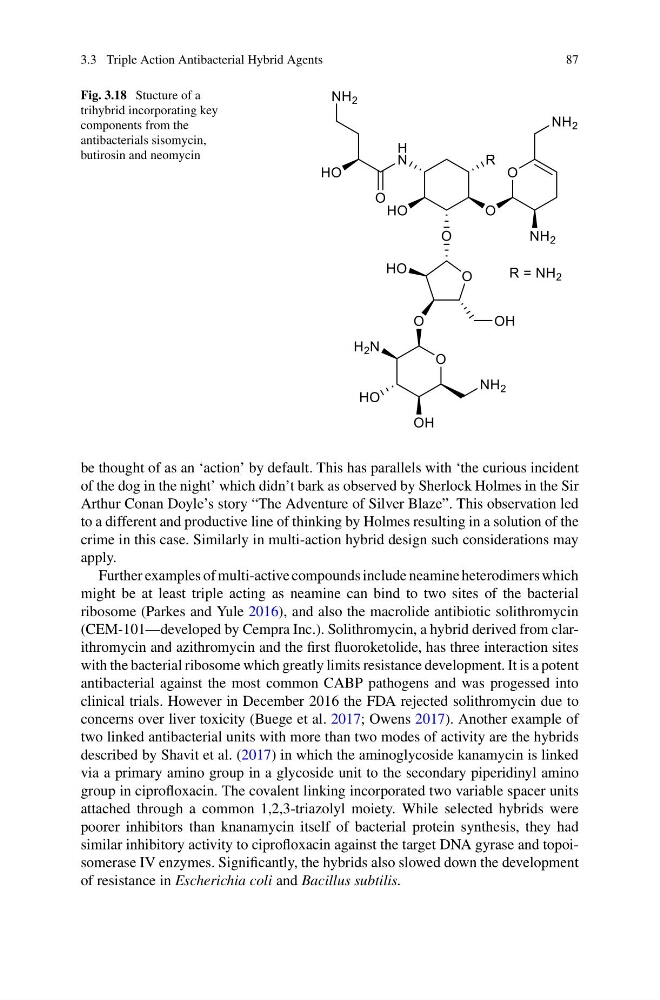
Fig. 3.18 Stucture of a
trihybrid incorporating key
components from the
antibacterials sisomycin,
butirosin and neomycin
be thought of as an ‘action’ by default. This has parallels with ‘the curious incident
of the dog in the night’ which didn’t bark as observed by Sherlock Holmes in the Sir
Arthur Conan Doyle’s story “The Adventure of Silver Blaze”. This observation led
to a different and productive line of thinking by Holmes resulting in a solution of the
crime in this case. Similarly in multi-action hybrid design such considerations may
apply.
Further examples of multi-active compounds include neamine heterodimers which
might be at least triple acting as neamine can bind to two sites of the bacterial
ribosome (Parkes and Yule 2016), and also the macrolide antibiotic solithromycin
(CEM-101—developed by Cempra Inc.). Solithromycin, a hybrid derived from clarithromycin and azithromycin and the first fluoroketolide, has three interaction sites
with the bacterial ribosome which greatly limits resistance development. It is a potent
antibacterial against the most common CABP pathogens and was progessed into
clinical trials. However in December 2016 the FDA rejected solithromycin due to
concerns over liver toxicity (Buege et al. 2017; Owens 2017). Another example of
two linked antibacterial units with more than two modes of activity are the hybrids
described by Shavit et al. (2017) in which the aminoglycoside kanamycin is linked
via a primary amino group in a glycoside unit to the secondary piperidinyl amino
group in ciprofloxacin. The covalent linking incorporated two variable spacer units
attached through a common 1,2,3-triazolyl moiety. While selected hybrids were
poorer inhibitors than knanamycin itself of bacterial protein synthesis, they had
similar inhibitory activity to ciprofloxacin against the target DNA gyrase and topoisomerase IV enzymes. Significantly, the hybrids also slowed down the development
of resistance in Escherichia coli and Bacillus subtilis.
87
Fig. 3.18 Stucture of a
trihybrid incorporating key
components from the
antibacterials sisomycin,
butirosin and neomycin
be thought of as an ‘action’ by default. This has parallels with ‘the curious incident
of the dog in the night’ which didn’t bark as observed by Sherlock Holmes in the Sir
Arthur Conan Doyle’s story “The Adventure of Silver Blaze”. This observation led
to a different and productive line of thinking by Holmes resulting in a solution of the
crime in this case. Similarly in multi-action hybrid design such considerations may
apply.
Further examples of multi-active compounds include neamine heterodimers which
might be at least triple acting as neamine can bind to two sites of the bacterial
ribosome (Parkes and Yule 2016), and also the macrolide antibiotic solithromycin
(CEM-101—developed by Cempra Inc.). Solithromycin, a hybrid derived from clarithromycin and azithromycin and the first fluoroketolide, has three interaction sites
with the bacterial ribosome which greatly limits resistance development. It is a potent
antibacterial against the most common CABP pathogens and was progessed into
clinical trials. However in December 2016 the FDA rejected solithromycin due to
concerns over liver toxicity (Buege et al. 2017; Owens 2017). Another example of
two linked antibacterial units with more than two modes of activity are the hybrids
described by Shavit et al. (2017) in which the aminoglycoside kanamycin is linked
via a primary amino group in a glycoside unit to the secondary piperidinyl amino
group in ciprofloxacin. The covalent linking incorporated two variable spacer units
attached through a common 1,2,3-triazolyl moiety. While selected hybrids were
poorer inhibitors than knanamycin itself of bacterial protein synthesis, they had
similar inhibitory activity to ciprofloxacin against the target DNA gyrase and topoisomerase IV enzymes. Significantly, the hybrids also slowed down the development
of resistance in Escherichia coli and Bacillus subtilis.