

3.3 Triple Action Antibacterial Hybrid Agents
89
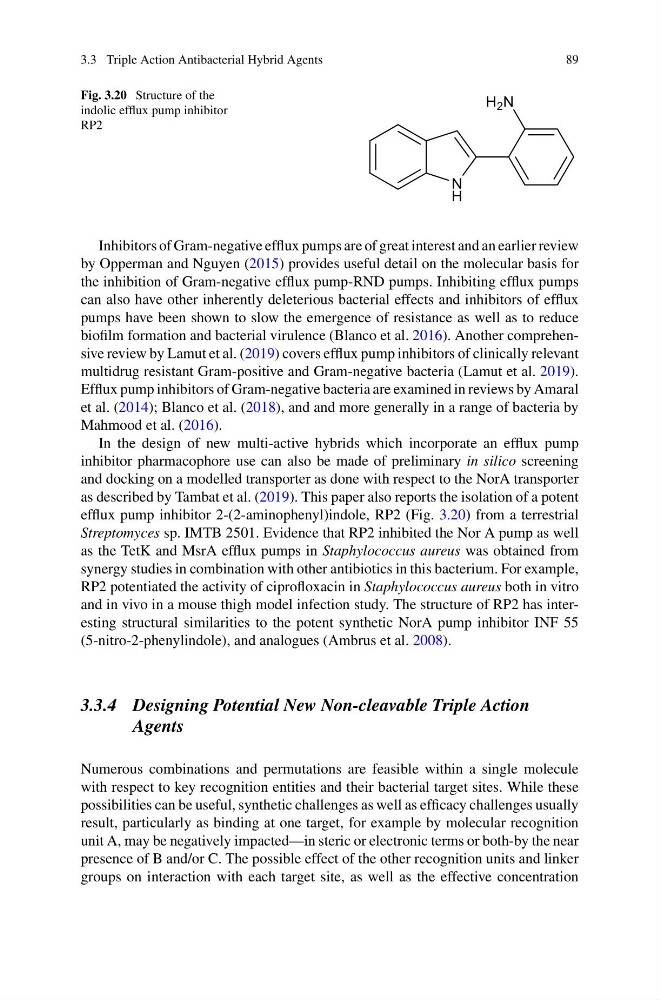
Fig. 3.20 Structure of the
indolic efflux pump inhibitor
RP2
Inhibitors of Gram-negative efflux pumps are of great interest and an earlier review
by Opperman and Nguyen (2015) provides useful detail on the molecular basis for
the inhibition of Gram-negative efflux pump-RND pumps. Inhibiting efflux pumps
can also have other inherently deleterious bacterial effects and inhibitors of efflux
pumps have been shown to slow the emergence of resistance as well as to reduce
biofilm formation and bacterial virulence (Blanco et al. 2016). Another comprehensive review by Lamut et al. (2019) covers efflux pump inhibitors of clinically relevant
multidrug resistant Gram-positive and Gram-negative bacteria (Lamut et al. 2019).
Efflux pump inhibitors of Gram-negative bacteria are examined in reviews by Amaral
et al. (2014); Blanco et al. (2018), and and more generally in a range of bacteria by
Mahmood et al. (2016).
In the design of new multi-active hybrids which incorporate an efflux pump
inhibitor pharmacophore use can also be made of preliminary in silico screening
and docking on a modelled transporter as done with respect to the NorA transporter
as described by Tambat et al. (2019). This paper also reports the isolation of a potent
efflux pump inhibitor 2-(2-aminophenyl)indole, RP2 (Fig. 3.20) from a terrestrial
Streptomyces sp. IMTB 2501. Evidence that RP2 inhibited the Nor A pump as well
as the TetK and MsrA efflux pumps in Staphylococcus aureus was obtained from
synergy studies in combination with other antibiotics in this bacterium. For example,
RP2 potentiated the activity of ciprofloxacin in Staphylococcus aureus both in vitro
and in vivo in a mouse thigh model infection study. The structure of RP2 has interesting structural similarities to the potent synthetic NorA pump inhibitor INF 55
(5-nitro-2-phenylindole), and analogues (Ambrus et al. 2008).
3.3.4 Designing Potential New Non-cleavable Triple Action
Agents
Numerous combinations and permutations are feasible within a single molecule
with respect to key recognition entities and their bacterial target sites. While these
possibilities can be useful, synthetic challenges as well as efficacy challenges usually
result, particularly as binding at one target, for example by molecular recognition
unit A, may be negatively impacted—in steric or electronic terms or both-by the near
presence of B and/or C. The possible effect of the other recognition units and linker
groups on interaction with each target site, as well as the effective concentration
89
Fig. 3.20 Structure of the
indolic efflux pump inhibitor
RP2
Inhibitors of Gram-negative efflux pumps are of great interest and an earlier review
by Opperman and Nguyen (2015) provides useful detail on the molecular basis for
the inhibition of Gram-negative efflux pump-RND pumps. Inhibiting efflux pumps
can also have other inherently deleterious bacterial effects and inhibitors of efflux
pumps have been shown to slow the emergence of resistance as well as to reduce
biofilm formation and bacterial virulence (Blanco et al. 2016). Another comprehensive review by Lamut et al. (2019) covers efflux pump inhibitors of clinically relevant
multidrug resistant Gram-positive and Gram-negative bacteria (Lamut et al. 2019).
Efflux pump inhibitors of Gram-negative bacteria are examined in reviews by Amaral
et al. (2014); Blanco et al. (2018), and and more generally in a range of bacteria by
Mahmood et al. (2016).
In the design of new multi-active hybrids which incorporate an efflux pump
inhibitor pharmacophore use can also be made of preliminary in silico screening
and docking on a modelled transporter as done with respect to the NorA transporter
as described by Tambat et al. (2019). This paper also reports the isolation of a potent
efflux pump inhibitor 2-(2-aminophenyl)indole, RP2 (Fig. 3.20) from a terrestrial
Streptomyces sp. IMTB 2501. Evidence that RP2 inhibited the Nor A pump as well
as the TetK and MsrA efflux pumps in Staphylococcus aureus was obtained from
synergy studies in combination with other antibiotics in this bacterium. For example,
RP2 potentiated the activity of ciprofloxacin in Staphylococcus aureus both in vitro
and in vivo in a mouse thigh model infection study. The structure of RP2 has interesting structural similarities to the potent synthetic NorA pump inhibitor INF 55
(5-nitro-2-phenylindole), and analogues (Ambrus et al. 2008).
3.3.4 Designing Potential New Non-cleavable Triple Action
Agents
Numerous combinations and permutations are feasible within a single molecule
with respect to key recognition entities and their bacterial target sites. While these
possibilities can be useful, synthetic challenges as well as efficacy challenges usually
result, particularly as binding at one target, for example by molecular recognition
unit A, may be negatively impacted—in steric or electronic terms or both-by the near
presence of B and/or C. The possible effect of the other recognition units and linker
groups on interaction with each target site, as well as the effective concentration