

64
3 Single Molecule Non-cleavable Multiply Active Antibacterials
route to analogues (Parmar et al. 2017) together the gram-scale total synthesis of
teixobactin itself (Zong et al. 2019).
A dual mode of action has also been demonstrated with the natural antibacterial
platencin produced by Streptomyces platensis. This antibacterial interferes with fatty
acid synthesis by inhibiting the β-ketoacyl-[acyl carrier protein (ACP)] synthase II
(FabF) and synthase III (FabH) (Wang et al. 2007). Plantencin displays potent broadspectrum Gram-positive activity in vitro, including strains resistant to other antibiotics, and no observed toxicity from in vivo studies. While reduced susceptibility to
resistance development might be anticipated through inhibiting two enzymes, caution
is necessary as it appears possible in light of the self-resistance mechanisms observed
in other strains of S. platensis which produce platencin and the related antibacterial
platensimycin (Peterson et al. 2014).
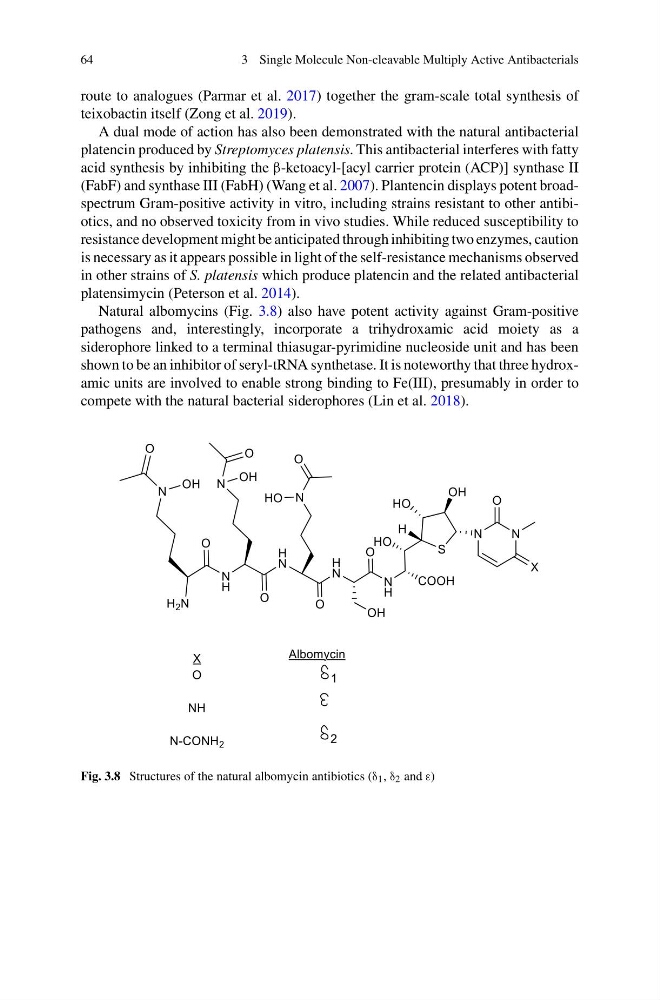
Natural albomycins (Fig. 3.8) also have potent activity against Gram-positive
pathogens and, interestingly, incorporate a trihydroxamic acid moiety as a
siderophore linked to a terminal thiasugar-pyrimidine nucleoside unit and has been
shown to be an inhibitor of seryl-tRNA synthetase. It is noteworthy that three hydroxamic units are involved to enable strong binding to Fe(III), presumably in order to
compete with the natural bacterial siderophores (Lin et al. 2018).
Fig. 3.8 Structures of the natural albomycin antibiotics (δ 1 , δ 2 and ε)
3 Single Molecule Non-cleavable Multiply Active Antibacterials
route to analogues (Parmar et al. 2017) together the gram-scale total synthesis of
teixobactin itself (Zong et al. 2019).
A dual mode of action has also been demonstrated with the natural antibacterial
platencin produced by Streptomyces platensis. This antibacterial interferes with fatty
acid synthesis by inhibiting the β-ketoacyl-[acyl carrier protein (ACP)] synthase II
(FabF) and synthase III (FabH) (Wang et al. 2007). Plantencin displays potent broadspectrum Gram-positive activity in vitro, including strains resistant to other antibiotics, and no observed toxicity from in vivo studies. While reduced susceptibility to
resistance development might be anticipated through inhibiting two enzymes, caution
is necessary as it appears possible in light of the self-resistance mechanisms observed
in other strains of S. platensis which produce platencin and the related antibacterial
platensimycin (Peterson et al. 2014).
Natural albomycins (Fig. 3.8) also have potent activity against Gram-positive
pathogens and, interestingly, incorporate a trihydroxamic acid moiety as a
siderophore linked to a terminal thiasugar-pyrimidine nucleoside unit and has been
shown to be an inhibitor of seryl-tRNA synthetase. It is noteworthy that three hydroxamic units are involved to enable strong binding to Fe(III), presumably in order to
compete with the natural bacterial siderophores (Lin et al. 2018).
Fig. 3.8 Structures of the natural albomycin antibiotics (δ 1 , δ 2 and ε)