

3.2 Designing for Mainly Dual Activity
65
3.2.3 Berberine as a Starting Point for Design
3.2.3.1 General Introduction to Berberine
Berberine is an isoquinoline alkaloid belonging to the protoberberine group and
occurs in a number of plant species such as Berberis species in the Berberidaceae
family. Berberine-containing plants are an important component in Chinese herbal
medicines, and other herbal medicines, for the treatment of bacterial infections and for
other diseases. Berberine is a quaternary salt which is readily available commercially
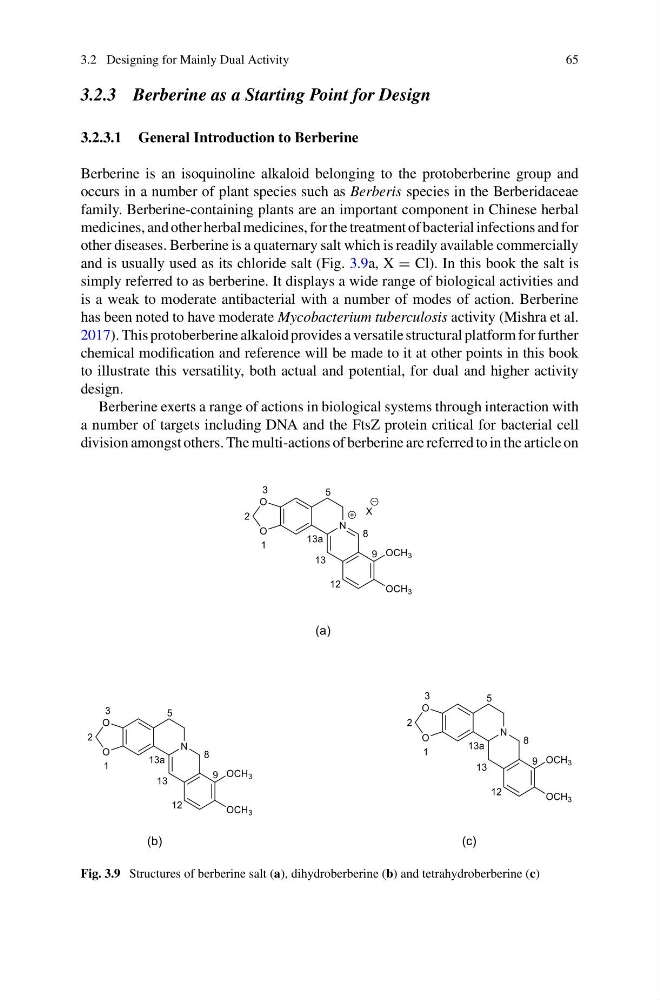
and is usually used as its chloride salt (Fig. 3.9a, X = Cl). In this book the salt is
simply referred to as berberine. It displays a wide range of biological activities and
is a weak to moderate antibacterial with a number of modes of action. Berberine
has been noted to have moderate Mycobacterium tuberculosis activity (Mishra et al.
2017). This protoberberine alkaloid provides a versatile structural platform for further
chemical modification and reference will be made to it at other points in this book
to illustrate this versatility, both actual and potential, for dual and higher activity
design.
Berberine exerts a range of actions in biological systems through interaction with
a number of targets including DNA and the FtsZ protein critical for bacterial cell
division amongst others. The multi-actions of berberine are referred to in the article on
Fig. 3.9 Structures of berberine salt (a), dihydroberberine (b) and tetrahydroberberine (c)
65
3.2.3 Berberine as a Starting Point for Design
3.2.3.1 General Introduction to Berberine
Berberine is an isoquinoline alkaloid belonging to the protoberberine group and
occurs in a number of plant species such as Berberis species in the Berberidaceae
family. Berberine-containing plants are an important component in Chinese herbal
medicines, and other herbal medicines, for the treatment of bacterial infections and for
other diseases. Berberine is a quaternary salt which is readily available commercially
and is usually used as its chloride salt (Fig. 3.9a, X = Cl). In this book the salt is
simply referred to as berberine. It displays a wide range of biological activities and
is a weak to moderate antibacterial with a number of modes of action. Berberine
has been noted to have moderate Mycobacterium tuberculosis activity (Mishra et al.
2017). This protoberberine alkaloid provides a versatile structural platform for further
chemical modification and reference will be made to it at other points in this book
to illustrate this versatility, both actual and potential, for dual and higher activity
design.
Berberine exerts a range of actions in biological systems through interaction with
a number of targets including DNA and the FtsZ protein critical for bacterial cell
division amongst others. The multi-actions of berberine are referred to in the article on
Fig. 3.9 Structures of berberine salt (a), dihydroberberine (b) and tetrahydroberberine (c)