

62
3 Single Molecule Non-cleavable Multiply Active Antibacterials
The results with the more potent Irresistin-16 suggested that the biphenylmethyl
substituent is important for the membrane interaction and presumably not for the
interaction with DHFR.
3.2.2 Examples of Dual Action Agents from Nature
Perhaps not surprisingly, bifunctional antibiotics have also been found in nature. One
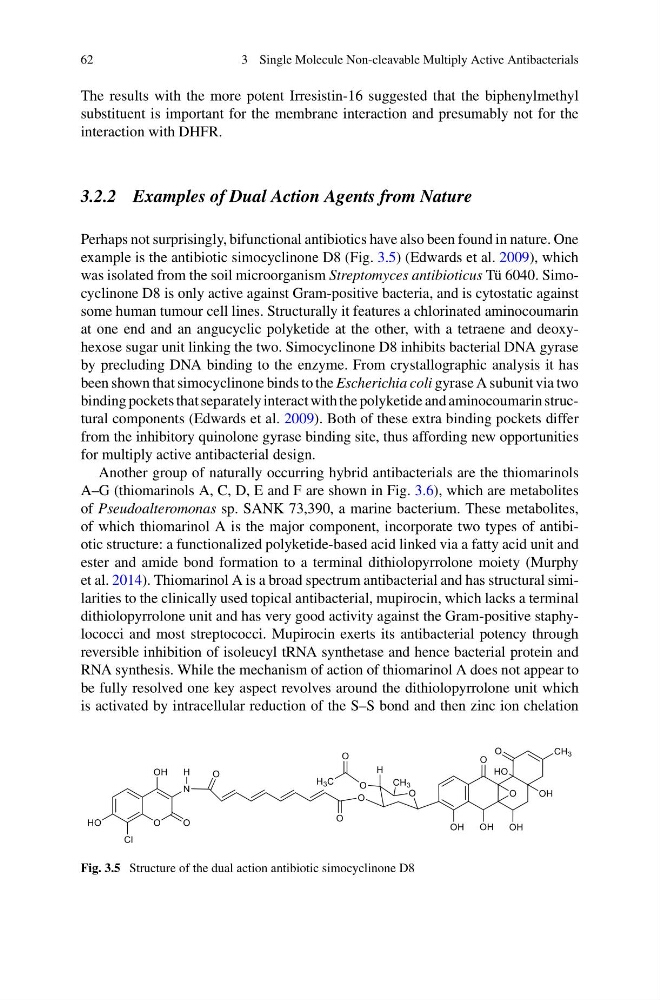
example is the antibiotic simocyclinone D8 (Fig. 3.5) (Edwards et al. 2009), which
was isolated from the soil microorganism Streptomyces antibioticus Tü 6040. Simocyclinone D8 is only active against Gram-positive bacteria, and is cytostatic against
some human tumour cell lines. Structurally it features a chlorinated aminocoumarin
at one end and an angucyclic polyketide at the other, with a tetraene and deoxyhexose sugar unit linking the two. Simocyclinone D8 inhibits bacterial DNA gyrase
by precluding DNA binding to the enzyme. From crystallographic analysis it has
been shown that simocyclinone binds to the Escherichia coli gyrase A subunit via two
binding pockets that separately interact with the polyketide and aminocoumarin structural components (Edwards et al. 2009). Both of these extra binding pockets differ
from the inhibitory quinolone gyrase binding site, thus affording new opportunities
for multiply active antibacterial design.
Another group of naturally occurring hybrid antibacterials are the thiomarinols
A–G (thiomarinols A, C, D, E and F are shown in Fig. 3.6), which are metabolites
of Pseudoalteromonas sp. SANK 73,390, a marine bacterium. These metabolites,
of which thiomarinol A is the major component, incorporate two types of antibiotic structure: a functionalized polyketide-based acid linked via a fatty acid unit and
ester and amide bond formation to a terminal dithiolopyrrolone moiety (Murphy
et al. 2014). Thiomarinol A is a broad spectrum antibacterial and has structural similarities to the clinically used topical antibacterial, mupirocin, which lacks a terminal
dithiolopyrrolone unit and has very good activity against the Gram-positive staphylococci and most streptococci. Mupirocin exerts its antibacterial potency through
reversible inhibition of isoleucyl tRNA synthetase and hence bacterial protein and
RNA synthesis. While the mechanism of action of thiomarinol A does not appear to
be fully resolved one key aspect revolves around the dithiolopyrrolone unit which
is activated by intracellular reduction of the S–S bond and then zinc ion chelation
Fig. 3.5 Structure of the dual action antibiotic simocyclinone D8
3 Single Molecule Non-cleavable Multiply Active Antibacterials
The results with the more potent Irresistin-16 suggested that the biphenylmethyl
substituent is important for the membrane interaction and presumably not for the
interaction with DHFR.
3.2.2 Examples of Dual Action Agents from Nature
Perhaps not surprisingly, bifunctional antibiotics have also been found in nature. One
example is the antibiotic simocyclinone D8 (Fig. 3.5) (Edwards et al. 2009), which
was isolated from the soil microorganism Streptomyces antibioticus Tü 6040. Simocyclinone D8 is only active against Gram-positive bacteria, and is cytostatic against
some human tumour cell lines. Structurally it features a chlorinated aminocoumarin
at one end and an angucyclic polyketide at the other, with a tetraene and deoxyhexose sugar unit linking the two. Simocyclinone D8 inhibits bacterial DNA gyrase
by precluding DNA binding to the enzyme. From crystallographic analysis it has
been shown that simocyclinone binds to the Escherichia coli gyrase A subunit via two
binding pockets that separately interact with the polyketide and aminocoumarin structural components (Edwards et al. 2009). Both of these extra binding pockets differ
from the inhibitory quinolone gyrase binding site, thus affording new opportunities
for multiply active antibacterial design.
Another group of naturally occurring hybrid antibacterials are the thiomarinols
A–G (thiomarinols A, C, D, E and F are shown in Fig. 3.6), which are metabolites
of Pseudoalteromonas sp. SANK 73,390, a marine bacterium. These metabolites,
of which thiomarinol A is the major component, incorporate two types of antibiotic structure: a functionalized polyketide-based acid linked via a fatty acid unit and
ester and amide bond formation to a terminal dithiolopyrrolone moiety (Murphy
et al. 2014). Thiomarinol A is a broad spectrum antibacterial and has structural similarities to the clinically used topical antibacterial, mupirocin, which lacks a terminal
dithiolopyrrolone unit and has very good activity against the Gram-positive staphylococci and most streptococci. Mupirocin exerts its antibacterial potency through
reversible inhibition of isoleucyl tRNA synthetase and hence bacterial protein and
RNA synthesis. While the mechanism of action of thiomarinol A does not appear to
be fully resolved one key aspect revolves around the dithiolopyrrolone unit which
is activated by intracellular reduction of the S–S bond and then zinc ion chelation
Fig. 3.5 Structure of the dual action antibiotic simocyclinone D8