

3.2 Designing for Mainly Dual Activity
61
mode of action involving inhibition of protein synthesis through interactions with
two sites, A and P, in the peptidyl transferase centre in the 23S ribosomal RNA of the
50S subunit. These interactions result in a closing of the bacterial ribosome binding
pocket with negative consequences for the correct positioning of tRNA (CenterWatch
2019).
Novel binaphthyl-based dicationic tripeptidic derivatives have also been developed with good bactericidal activity against a range of Gram-positive pathogens.
These compounds show very low resistance development properties in vitro and
more than one mode of action has been tentatively proposed including cell-membrane
disruption and the inhibition of cross-linking in the cell wall (Bremner et al. 2010a).
The basic design rationale for these compounds centred on smaller and simpler
cationic peptide derivatives with some related design features to the antibiotic
vancomycin and which could still interact with the peptide-glycan moiety in the cell
wall in both vancomycin-resistant and vancomycin-sensitive bacterial strains. Later
work on cationic systems with a 1,2,3-triazolyl-containing substituent attached to
the biaryl core produced potent antibacterials which depolarized the cytoplasmic
membrane and permeabilized it in both Staphylococcus aureus and Escherichia
coli (Tague et al. 2019b). Some related amphiphiles, which have both hydrophilic
and hydrophobic moieties, also showed promising efficacy in vivo in a model of
Clostridium difficile infection in the mouse (Tague et al. 2019a).
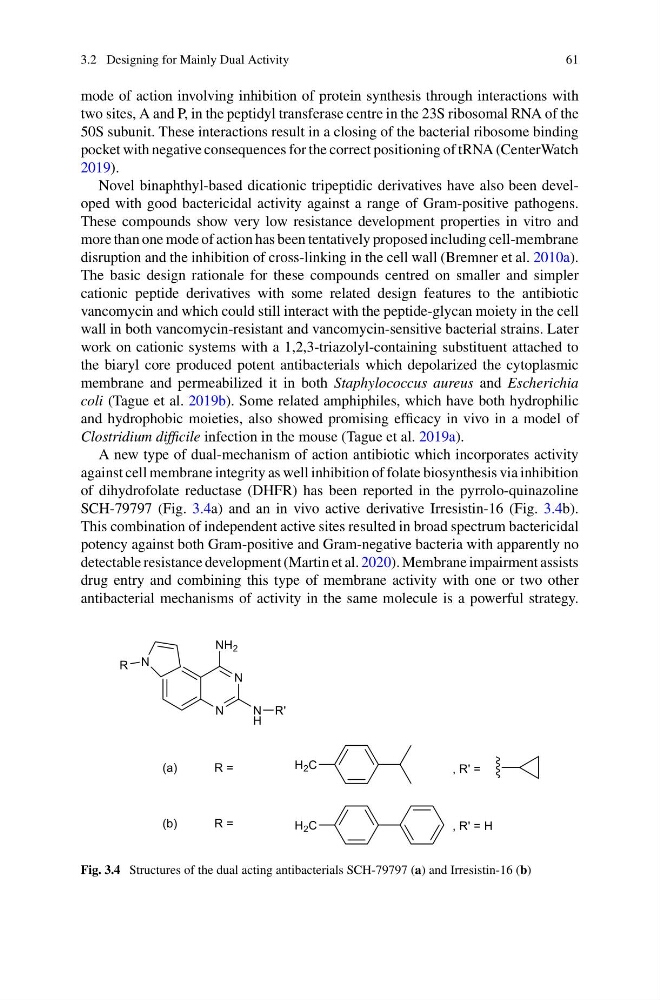
A new type of dual-mechanism of action antibiotic which incorporates activity
against cell membrane integrity as well inhibition of folate biosynthesis via inhibition
of dihydrofolate reductase (DHFR) has been reported in the pyrrolo-quinazoline
SCH-79797 (Fig. 3.4a) and an in vivo active derivative Irresistin-16 (Fig. 3.4b).
This combination of independent active sites resulted in broad spectrum bactericidal
potency against both Gram-positive and Gram-negative bacteria with apparently no
detectable resistance development (Martin et al. 2020). Membrane impairment assists
drug entry and combining this type of membrane activity with one or two other
antibacterial mechanisms of activity in the same molecule is a powerful strategy.
Fig. 3.4 Structures of the dual acting antibacterials SCH-79797 (a) and Irresistin-16 (b)
61
mode of action involving inhibition of protein synthesis through interactions with
two sites, A and P, in the peptidyl transferase centre in the 23S ribosomal RNA of the
50S subunit. These interactions result in a closing of the bacterial ribosome binding
pocket with negative consequences for the correct positioning of tRNA (CenterWatch
2019).
Novel binaphthyl-based dicationic tripeptidic derivatives have also been developed with good bactericidal activity against a range of Gram-positive pathogens.
These compounds show very low resistance development properties in vitro and
more than one mode of action has been tentatively proposed including cell-membrane
disruption and the inhibition of cross-linking in the cell wall (Bremner et al. 2010a).
The basic design rationale for these compounds centred on smaller and simpler
cationic peptide derivatives with some related design features to the antibiotic
vancomycin and which could still interact with the peptide-glycan moiety in the cell
wall in both vancomycin-resistant and vancomycin-sensitive bacterial strains. Later
work on cationic systems with a 1,2,3-triazolyl-containing substituent attached to
the biaryl core produced potent antibacterials which depolarized the cytoplasmic
membrane and permeabilized it in both Staphylococcus aureus and Escherichia
coli (Tague et al. 2019b). Some related amphiphiles, which have both hydrophilic
and hydrophobic moieties, also showed promising efficacy in vivo in a model of
Clostridium difficile infection in the mouse (Tague et al. 2019a).
A new type of dual-mechanism of action antibiotic which incorporates activity
against cell membrane integrity as well inhibition of folate biosynthesis via inhibition
of dihydrofolate reductase (DHFR) has been reported in the pyrrolo-quinazoline
SCH-79797 (Fig. 3.4a) and an in vivo active derivative Irresistin-16 (Fig. 3.4b).
This combination of independent active sites resulted in broad spectrum bactericidal
potency against both Gram-positive and Gram-negative bacteria with apparently no
detectable resistance development (Martin et al. 2020). Membrane impairment assists
drug entry and combining this type of membrane activity with one or two other
antibacterial mechanisms of activity in the same molecule is a powerful strategy.
Fig. 3.4 Structures of the dual acting antibacterials SCH-79797 (a) and Irresistin-16 (b)