

40
2 Antibacterial Combinations
to change shape or conformational preferences once a suitable functional group is
exposed. It is worth noting that the related principle of multi-action reinforcement
has been used with great effect by Richardson and colleagues (Stacy et al. 2016)
in the development of the dipyridyl thiosemicarbazone-based anti-cancer agents. In
the lysosome, the pH change to around 5 was crucial in avoiding efflux as well as
allowing for the effective scavenging of free copper (II) ions and the subsequent
redox cycling to generate reactive oxygen species. Antibacterial design possibilities
involving utilization of pH changes within the bacterial cell might also be further
explored.
Berberine is a good DNA binder so perhaps it may potentially be beneficial to
look at designing modified photosensitisers with similar overall shape and charge
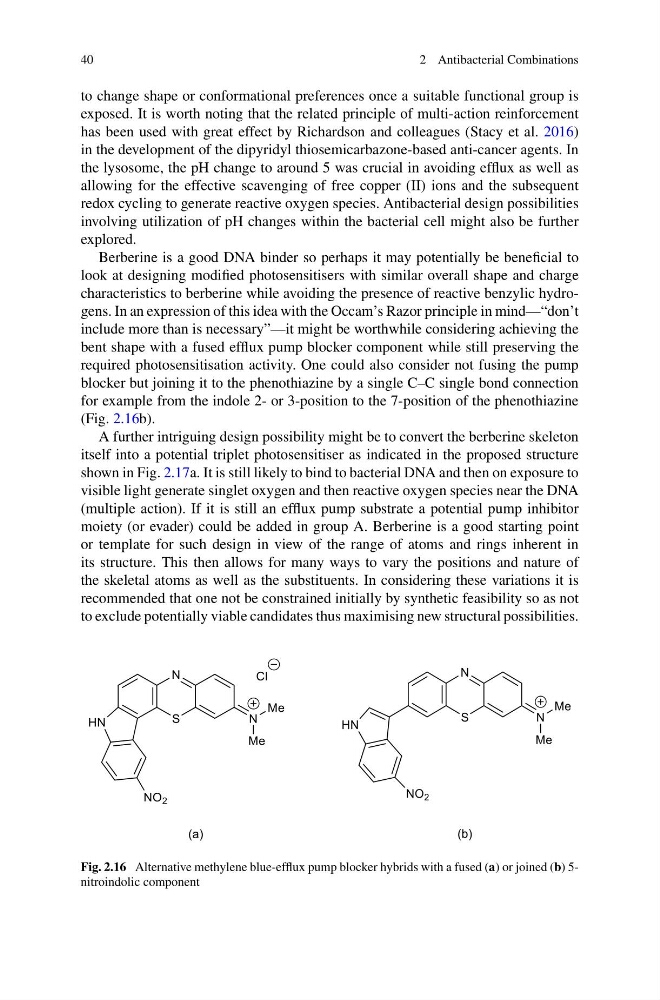
characteristics to berberine while avoiding the presence of reactive benzylic hydrogens. In an expression of this idea with the Occam’s Razor principle in mind—“don’t
include more than is necessary”—it might be worthwhile considering achieving the
bent shape with a fused efflux pump blocker component while still preserving the
required photosensitisation activity. One could also consider not fusing the pump
blocker but joining it to the phenothiazine by a single C–C single bond connection
for example from the indole 2- or 3-position to the 7-position of the phenothiazine
(Fig. 2.16b).
A further intriguing design possibility might be to convert the berberine skeleton
itself into a potential triplet photosensitiser as indicated in the proposed structure
shown in Fig. 2.17a. It is still likely to bind to bacterial DNA and then on exposure to
visible light generate singlet oxygen and then reactive oxygen species near the DNA
(multiple action). If it is still an efflux pump substrate a potential pump inhibitor
moiety (or evader) could be added in group A. Berberine is a good starting point
or template for such design in view of the range of atoms and rings inherent in
its structure. This then allows for many ways to vary the positions and nature of
the skeletal atoms as well as the substituents. In considering these variations it is
recommended that one not be constrained initially by synthetic feasibility so as not
to exclude potentially viable candidates thus maximising new structural possibilities.
Fig. 2.16 Alternative methylene blue-efflux pump blocker hybrids with a fused (a) or joined (b) 5nitroindolic component
2 Antibacterial Combinations
to change shape or conformational preferences once a suitable functional group is
exposed. It is worth noting that the related principle of multi-action reinforcement
has been used with great effect by Richardson and colleagues (Stacy et al. 2016)
in the development of the dipyridyl thiosemicarbazone-based anti-cancer agents. In
the lysosome, the pH change to around 5 was crucial in avoiding efflux as well as
allowing for the effective scavenging of free copper (II) ions and the subsequent
redox cycling to generate reactive oxygen species. Antibacterial design possibilities
involving utilization of pH changes within the bacterial cell might also be further
explored.
Berberine is a good DNA binder so perhaps it may potentially be beneficial to
look at designing modified photosensitisers with similar overall shape and charge
characteristics to berberine while avoiding the presence of reactive benzylic hydrogens. In an expression of this idea with the Occam’s Razor principle in mind—“don’t
include more than is necessary”—it might be worthwhile considering achieving the
bent shape with a fused efflux pump blocker component while still preserving the
required photosensitisation activity. One could also consider not fusing the pump
blocker but joining it to the phenothiazine by a single C–C single bond connection
for example from the indole 2- or 3-position to the 7-position of the phenothiazine
(Fig. 2.16b).
A further intriguing design possibility might be to convert the berberine skeleton
itself into a potential triplet photosensitiser as indicated in the proposed structure
shown in Fig. 2.17a. It is still likely to bind to bacterial DNA and then on exposure to
visible light generate singlet oxygen and then reactive oxygen species near the DNA
(multiple action). If it is still an efflux pump substrate a potential pump inhibitor
moiety (or evader) could be added in group A. Berberine is a good starting point
or template for such design in view of the range of atoms and rings inherent in
its structure. This then allows for many ways to vary the positions and nature of
the skeletal atoms as well as the substituents. In considering these variations it is
recommended that one not be constrained initially by synthetic feasibility so as not
to exclude potentially viable candidates thus maximising new structural possibilities.
Fig. 2.16 Alternative methylene blue-efflux pump blocker hybrids with a fused (a) or joined (b) 5nitroindolic component