

28
2 Antibacterial Combinations
and binding to DNA, as well as binding to the crucial FtsZ protein and blocking
bacterial cell division. Further references to the mode of antibacterial action of
berberine are given in Wang et al. (2016). Antibacterial synergy has been observed
with berberine (designated as A) and other antibacterial agents (designated as B)
against multi-drug resistant clinical isolates of MRSA (Zuo et al. 2012). Also the
combination of berberine with the antibiotic azithromycin was effective against clinical isolates of Pseudomonas aeruginosa from the sputum of cystic fibrosis patients
and, promisingly, this combination was shown to be active in vivo as well in a mouse
model (Shaw and Wuest 2020).
One also needs to differentiate combinations in this sub-type (i) category where
one or both compounds have antibacterial activity as well as some other not directly
antibacterial activity. For example the dual antibacterial combination of berberine and
azithromycin assessed by Shaw and Wuest also inhibited biofilm and virulence factor
output through compromising the Las and Rhl quorum sensing systems (Shaw and
Wuest 2020). Ideally the non-directly active antibacterial activity or actions would
enhance the direct antibacterial activities and this may be achieved in a number of
ways. For example by nullifying resistance mechanisms like those mediated by efflux
pumps (Bremner et al. 2007; Brown and Wright 2016) or by aiding antibacterial
penetration as in the case of the highly basic drug pentamidine which in Gramnegative pathogenic bacteria disrupts the outer membrane thus allowing entry by the
active agent (Stokes et al. 2017).
Blocking efflux pumps can be a very effective potentiating action. There have been
intensive investigations of small molecule efflux pump inhibitors and how to achieve
such inhibition (Ramaswamy et al. 2017; Haynes et al. 2017; Abdali et al. 2017).
Other references to efflux pump inhibitors are also given in Chap. 3 (Sect. 3.3.3).
The antibacterial berberine (Fig. 2.5) is a substrate for the NorA efflux pump in
Staphylococcus aureus but the NorA efflux pump inhibitor INF-55 greatly boosts
the antibacterial activity of berberine against this bacterium in vitro when they are
used in a combination (Ball et al. 2006).
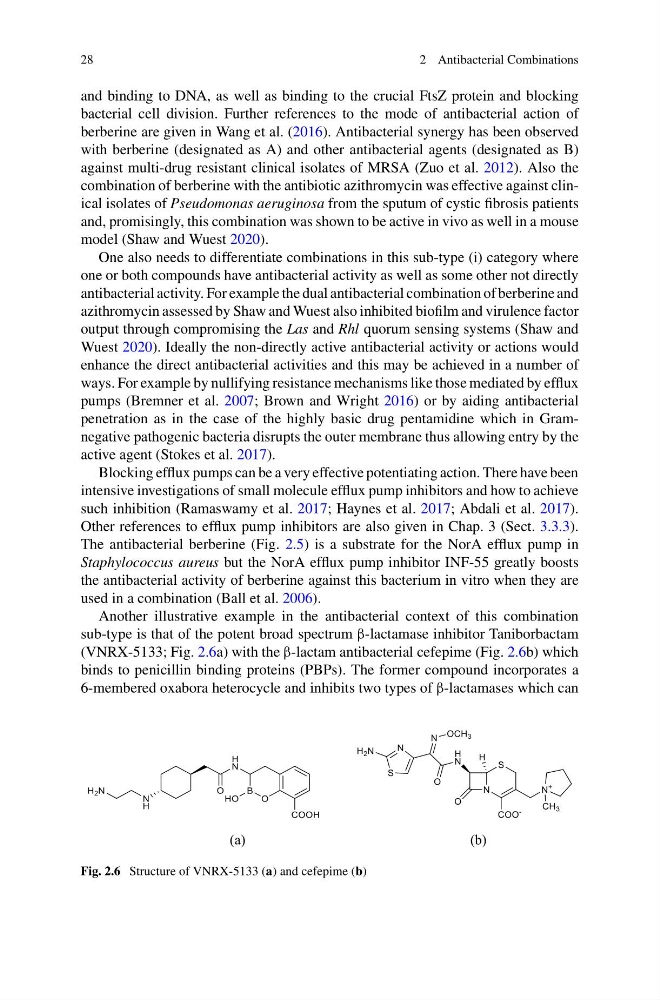
Another illustrative example in the antibacterial context of this combination
sub-type is that of the potent broad spectrum β-lactamase inhibitor Taniborbactam
(VNRX-5133; Fig. 2.6a) with the β-lactam antibacterial cefepime (Fig. 2.6b) which
binds to penicillin binding proteins (PBPs). The former compound incorporates a
6-membered oxabora heterocycle and inhibits two types of β-lactamases which can
(a)
(b)
Fig. 2.6 Structure of VNRX-5133 (a) and cefepime (b)
2 Antibacterial Combinations
and binding to DNA, as well as binding to the crucial FtsZ protein and blocking
bacterial cell division. Further references to the mode of antibacterial action of
berberine are given in Wang et al. (2016). Antibacterial synergy has been observed
with berberine (designated as A) and other antibacterial agents (designated as B)
against multi-drug resistant clinical isolates of MRSA (Zuo et al. 2012). Also the
combination of berberine with the antibiotic azithromycin was effective against clinical isolates of Pseudomonas aeruginosa from the sputum of cystic fibrosis patients
and, promisingly, this combination was shown to be active in vivo as well in a mouse
model (Shaw and Wuest 2020).
One also needs to differentiate combinations in this sub-type (i) category where
one or both compounds have antibacterial activity as well as some other not directly
antibacterial activity. For example the dual antibacterial combination of berberine and
azithromycin assessed by Shaw and Wuest also inhibited biofilm and virulence factor
output through compromising the Las and Rhl quorum sensing systems (Shaw and
Wuest 2020). Ideally the non-directly active antibacterial activity or actions would
enhance the direct antibacterial activities and this may be achieved in a number of
ways. For example by nullifying resistance mechanisms like those mediated by efflux
pumps (Bremner et al. 2007; Brown and Wright 2016) or by aiding antibacterial
penetration as in the case of the highly basic drug pentamidine which in Gramnegative pathogenic bacteria disrupts the outer membrane thus allowing entry by the
active agent (Stokes et al. 2017).
Blocking efflux pumps can be a very effective potentiating action. There have been
intensive investigations of small molecule efflux pump inhibitors and how to achieve
such inhibition (Ramaswamy et al. 2017; Haynes et al. 2017; Abdali et al. 2017).
Other references to efflux pump inhibitors are also given in Chap. 3 (Sect. 3.3.3).
The antibacterial berberine (Fig. 2.5) is a substrate for the NorA efflux pump in
Staphylococcus aureus but the NorA efflux pump inhibitor INF-55 greatly boosts
the antibacterial activity of berberine against this bacterium in vitro when they are
used in a combination (Ball et al. 2006).
Another illustrative example in the antibacterial context of this combination
sub-type is that of the potent broad spectrum β-lactamase inhibitor Taniborbactam
(VNRX-5133; Fig. 2.6a) with the β-lactam antibacterial cefepime (Fig. 2.6b) which
binds to penicillin binding proteins (PBPs). The former compound incorporates a
6-membered oxabora heterocycle and inhibits two types of β-lactamases which can
(a)
(b)
Fig. 2.6 Structure of VNRX-5133 (a) and cefepime (b)