

2.1 Introduction
27
(i) A + B where one component has two actions and the other one a single action
and where at least one of the actions is directly antibacterial for a triple action
outcome. This could be extended to a higher order of actions as well.
(ii) (A − B) + C where (A − B) represents a single molecule like a covalently linked dual action hybrid, or a produg which can release dual action
compounds in situ, derived from the pharmacophoric units A and B derived
from the separate drugs and C is another single or greater action component.
Again at least one of the actions from this combination would be directly
antibacterial.
(iii) (A − B) + (C − D) where (A − B) and (C − D) each represent a single
covalently linked dual action hybrid (or related produg) with dual actions
derived from the pharmacophoric units A and B or C and D. At least one of
the actions from this combination would be directly antibacterial.
(iv) (A − B − C) + D where (A − B − C) represents a possible triple action single
agent (refer to Chap. 3) or prodrug for such an agent (refer to Chap. 4) with
the embedded relevant target interaction moieties A, B and C, plus another
separate single or higher action compound (D). This is just one representation
and there could be a number of variations and extensions on this.
It should be pointed out, however, that some uncertainty can arise in allocating
a discussed example to one of these basic classifications if the modes of action are
not fully established. Also unrealised interactions may still occur and may influence
activity outcomes.
Some specific examples are also included which could potentially express triple
or higher activity profiles based on the assessment of other results on alternative
components.
2.1.2.1 Dual A Plus B Combination with Three or More Actions
A good example of this A + B group (sub-type i) involves the weak to moderately
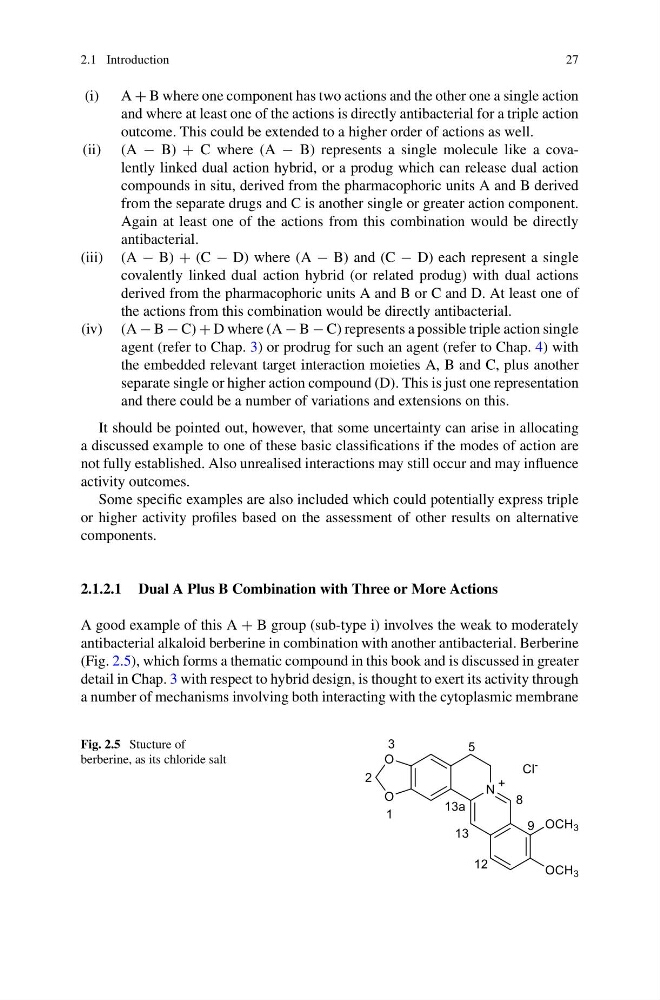
antibacterial alkaloid berberine in combination with another antibacterial. Berberine
(Fig. 2.5), which forms a thematic compound in this book and is discussed in greater
detail in Chap. 3 with respect to hybrid design, is thought to exert its activity through
a number of mechanisms involving both interacting with the cytoplasmic membrane
Fig. 2.5 Stucture of
berberine, as its chloride salt
27
(i) A + B where one component has two actions and the other one a single action
and where at least one of the actions is directly antibacterial for a triple action
outcome. This could be extended to a higher order of actions as well.
(ii) (A − B) + C where (A − B) represents a single molecule like a covalently linked dual action hybrid, or a produg which can release dual action
compounds in situ, derived from the pharmacophoric units A and B derived
from the separate drugs and C is another single or greater action component.
Again at least one of the actions from this combination would be directly
antibacterial.
(iii) (A − B) + (C − D) where (A − B) and (C − D) each represent a single
covalently linked dual action hybrid (or related produg) with dual actions
derived from the pharmacophoric units A and B or C and D. At least one of
the actions from this combination would be directly antibacterial.
(iv) (A − B − C) + D where (A − B − C) represents a possible triple action single
agent (refer to Chap. 3) or prodrug for such an agent (refer to Chap. 4) with
the embedded relevant target interaction moieties A, B and C, plus another
separate single or higher action compound (D). This is just one representation
and there could be a number of variations and extensions on this.
It should be pointed out, however, that some uncertainty can arise in allocating
a discussed example to one of these basic classifications if the modes of action are
not fully established. Also unrealised interactions may still occur and may influence
activity outcomes.
Some specific examples are also included which could potentially express triple
or higher activity profiles based on the assessment of other results on alternative
components.
2.1.2.1 Dual A Plus B Combination with Three or More Actions
A good example of this A + B group (sub-type i) involves the weak to moderately
antibacterial alkaloid berberine in combination with another antibacterial. Berberine
(Fig. 2.5), which forms a thematic compound in this book and is discussed in greater
detail in Chap. 3 with respect to hybrid design, is thought to exert its activity through
a number of mechanisms involving both interacting with the cytoplasmic membrane
Fig. 2.5 Stucture of
berberine, as its chloride salt