

4.3 Release Mechanisms and Prodrug Design
149
The effects of ultrasound waves (vibration frequencies higher than 20 kHz) on
liposomes and nanometal particles is also being actively investigated in the context
of the development of antibacterial treatments. Ultrasonic wave absorption can cause
an increase in temperature in tissue from local mechanical compression and decompression events which can disrupt cell membranes. Complicated non-thermal effects
of ultrasound can also occur which can result in mechanical stresses and increases
in temperature (Canavese et al. 2018). Developments in this area include the intensification or collection of low intensity ultrasound by a suitable molecule or nanoparticulate system concentrated selectively in bacteria and much of this work has
focussed on the use of gold nanoparticles. Nanoparticle-assisted ultrasound in cancer
therapy is also under active study (Canavese et al. 2018) and the results from this area
have ramifications for multi-active prodrug antibacterial design and ways to avoid
host cell damage while attacking pathogenic bacteria in vivo.
The effects of ultrasound directly on bacteria is also relevant as perhaps one can use
these effects to improve antibacterial outcomes (Monsen et al. 2009). An inhibitory
effect on Gram-negative bacteria, particularly on Escherichia coli, has been observed,
but Gram-positive bacteria were more resistant (Monsen et al. 2009). However, in
other work (Liao et al. 2018) both Escherichia coli and Staphylococcus aureus were
irreversibly affected, perhaps because of the different experimental conditions. Also
it has been shown that low-intensity and low-frequency ultrasound combined with
the antibiotic tobramycin on multidrug resistant Escherichia coli biofilms shows
promise in significantly decreasing bacterial viability of biofilms with the ultrasound
disruption aiding antibiotic penetration (Hou et al. 2019).
Other interesting possibilities present themselves in prodrug design if one ‘action’
is induced by a physical phenomenon. And in this context the bacterial mechanosensitive channels are of great interest. These channels, amongst other functions, are
vital for mitigating the effects of hypo-osmotic shock in bacteria (Booth 2014).
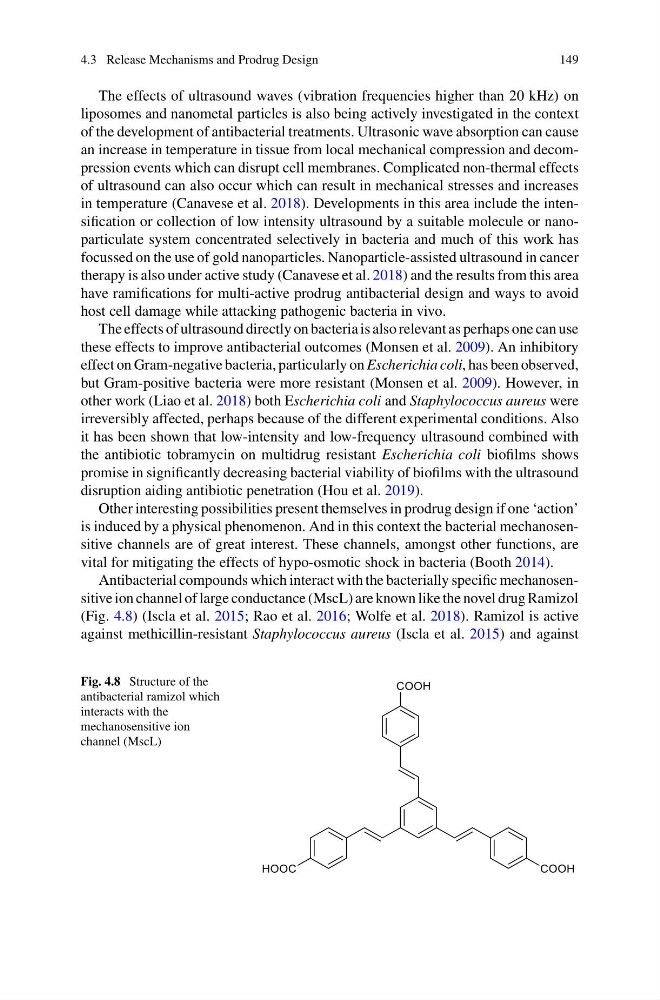
Antibacterial compounds which interact with the bacterially specific mechanosensitive ion channel of large conductance (MscL) are known like the novel drug Ramizol
(Fig. 4.8) (Iscla et al. 2015; Rao et al. 2016; Wolfe et al. 2018). Ramizol is active
against methicillin-resistant Staphylococcus aureus (Iscla et al. 2015) and against
Fig. 4.8 Structure of the
antibacterial ramizol which
interacts with the
mechanosensitive ion
channel (MscL)
149
The effects of ultrasound waves (vibration frequencies higher than 20 kHz) on
liposomes and nanometal particles is also being actively investigated in the context
of the development of antibacterial treatments. Ultrasonic wave absorption can cause
an increase in temperature in tissue from local mechanical compression and decompression events which can disrupt cell membranes. Complicated non-thermal effects
of ultrasound can also occur which can result in mechanical stresses and increases
in temperature (Canavese et al. 2018). Developments in this area include the intensification or collection of low intensity ultrasound by a suitable molecule or nanoparticulate system concentrated selectively in bacteria and much of this work has
focussed on the use of gold nanoparticles. Nanoparticle-assisted ultrasound in cancer
therapy is also under active study (Canavese et al. 2018) and the results from this area
have ramifications for multi-active prodrug antibacterial design and ways to avoid
host cell damage while attacking pathogenic bacteria in vivo.
The effects of ultrasound directly on bacteria is also relevant as perhaps one can use
these effects to improve antibacterial outcomes (Monsen et al. 2009). An inhibitory
effect on Gram-negative bacteria, particularly on Escherichia coli, has been observed,
but Gram-positive bacteria were more resistant (Monsen et al. 2009). However, in
other work (Liao et al. 2018) both Escherichia coli and Staphylococcus aureus were
irreversibly affected, perhaps because of the different experimental conditions. Also
it has been shown that low-intensity and low-frequency ultrasound combined with
the antibiotic tobramycin on multidrug resistant Escherichia coli biofilms shows
promise in significantly decreasing bacterial viability of biofilms with the ultrasound
disruption aiding antibiotic penetration (Hou et al. 2019).
Other interesting possibilities present themselves in prodrug design if one ‘action’
is induced by a physical phenomenon. And in this context the bacterial mechanosensitive channels are of great interest. These channels, amongst other functions, are
vital for mitigating the effects of hypo-osmotic shock in bacteria (Booth 2014).
Antibacterial compounds which interact with the bacterially specific mechanosensitive ion channel of large conductance (MscL) are known like the novel drug Ramizol
(Fig. 4.8) (Iscla et al. 2015; Rao et al. 2016; Wolfe et al. 2018). Ramizol is active
against methicillin-resistant Staphylococcus aureus (Iscla et al. 2015) and against
Fig. 4.8 Structure of the
antibacterial ramizol which
interacts with the
mechanosensitive ion
channel (MscL)