

150
4 Design Principles and Development of Prodrugs for Multiply …
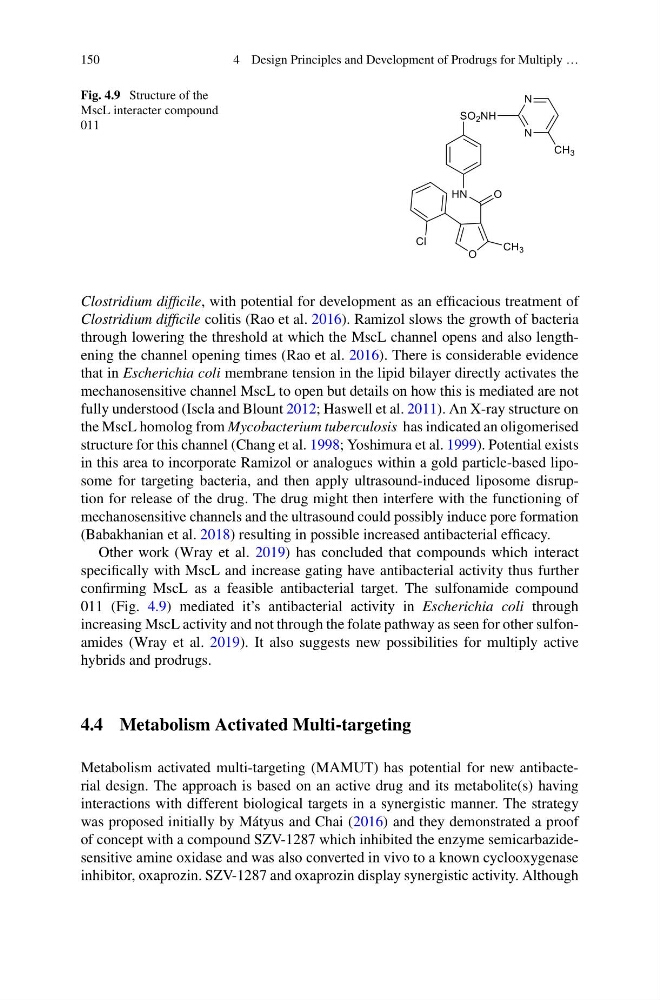
Fig. 4.9 Structure of the
MscL interacter compound
011
Clostridium difficile, with potential for development as an efficacious treatment of
Clostridium difficile colitis (Rao et al. 2016). Ramizol slows the growth of bacteria
through lowering the threshold at which the MscL channel opens and also lengthening the channel opening times (Rao et al. 2016). There is considerable evidence
that in Escherichia coli membrane tension in the lipid bilayer directly activates the
mechanosensitive channel MscL to open but details on how this is mediated are not
fully understood (Iscla and Blount 2012; Haswell et al. 2011). An X-ray structure on
the MscL homolog from Mycobacterium tuberculosis has indicated an oligomerised
structure for this channel (Chang et al. 1998; Yoshimura et al. 1999). Potential exists
in this area to incorporate Ramizol or analogues within a gold particle-based liposome for targeting bacteria, and then apply ultrasound-induced liposome disruption for release of the drug. The drug might then interfere with the functioning of
mechanosensitive channels and the ultrasound could possibly induce pore formation
(Babakhanian et al. 2018) resulting in possible increased antibacterial efficacy.
Other work (Wray et al. 2019) has concluded that compounds which interact
specifically with MscL and increase gating have antibacterial activity thus further
confirming MscL as a feasible antibacterial target. The sulfonamide compound
011 (Fig. 4.9) mediated it’s antibacterial activity in Escherichia coli through
increasing MscL activity and not through the folate pathway as seen for other sulfonamides (Wray et al. 2019). It also suggests new possibilities for multiply active
hybrids and prodrugs.
4.4 Metabolism Activated Multi-targeting
Metabolism activated multi-targeting (MAMUT) has potential for new antibacterial design. The approach is based on an active drug and its metabolite(s) having
interactions with different biological targets in a synergistic manner. The strategy
was proposed initially by Mátyus and Chai (2016) and they demonstrated a proof
of concept with a compound SZV-1287 which inhibited the enzyme semicarbazidesensitive amine oxidase and was also converted in vivo to a known cyclooxygenase
inhibitor, oxaprozin. SZV-1287 and oxaprozin display synergistic activity. Although
4 Design Principles and Development of Prodrugs for Multiply …
Fig. 4.9 Structure of the
MscL interacter compound
011
Clostridium difficile, with potential for development as an efficacious treatment of
Clostridium difficile colitis (Rao et al. 2016). Ramizol slows the growth of bacteria
through lowering the threshold at which the MscL channel opens and also lengthening the channel opening times (Rao et al. 2016). There is considerable evidence
that in Escherichia coli membrane tension in the lipid bilayer directly activates the
mechanosensitive channel MscL to open but details on how this is mediated are not
fully understood (Iscla and Blount 2012; Haswell et al. 2011). An X-ray structure on
the MscL homolog from Mycobacterium tuberculosis has indicated an oligomerised
structure for this channel (Chang et al. 1998; Yoshimura et al. 1999). Potential exists
in this area to incorporate Ramizol or analogues within a gold particle-based liposome for targeting bacteria, and then apply ultrasound-induced liposome disruption for release of the drug. The drug might then interfere with the functioning of
mechanosensitive channels and the ultrasound could possibly induce pore formation
(Babakhanian et al. 2018) resulting in possible increased antibacterial efficacy.
Other work (Wray et al. 2019) has concluded that compounds which interact
specifically with MscL and increase gating have antibacterial activity thus further
confirming MscL as a feasible antibacterial target. The sulfonamide compound
011 (Fig. 4.9) mediated it’s antibacterial activity in Escherichia coli through
increasing MscL activity and not through the folate pathway as seen for other sulfonamides (Wray et al. 2019). It also suggests new possibilities for multiply active
hybrids and prodrugs.
4.4 Metabolism Activated Multi-targeting
Metabolism activated multi-targeting (MAMUT) has potential for new antibacterial design. The approach is based on an active drug and its metabolite(s) having
interactions with different biological targets in a synergistic manner. The strategy
was proposed initially by Mátyus and Chai (2016) and they demonstrated a proof
of concept with a compound SZV-1287 which inhibited the enzyme semicarbazidesensitive amine oxidase and was also converted in vivo to a known cyclooxygenase
inhibitor, oxaprozin. SZV-1287 and oxaprozin display synergistic activity. Although