

148
4 Design Principles and Development of Prodrugs for Multiply …
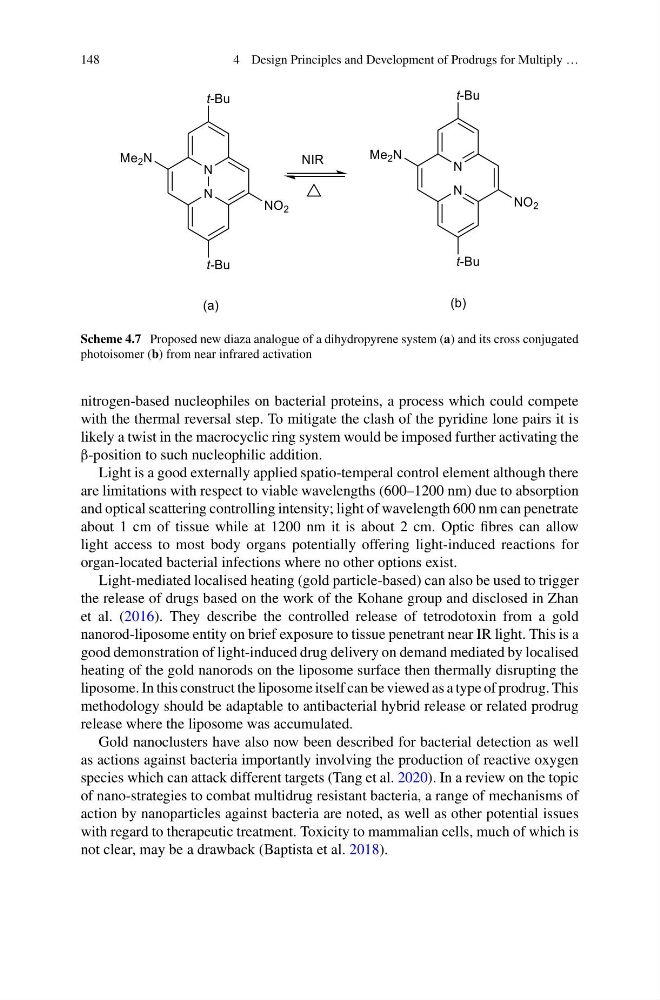
Scheme 4.7 Proposed new diaza analogue of a dihydropyrene system (a) and its cross conjugated
photoisomer (b) from near infrared activation
nitrogen-based nucleophiles on bacterial proteins, a process which could compete
with the thermal reversal step. To mitigate the clash of the pyridine lone pairs it is
likely a twist in the macrocyclic ring system would be imposed further activating the
β-position to such nucleophilic addition.
Light is a good externally applied spatio-temperal control element although there
are limitations with respect to viable wavelengths (600–1200 nm) due to absorption
and optical scattering controlling intensity; light of wavelength 600 nm can penetrate
about 1 cm of tissue while at 1200 nm it is about 2 cm. Optic fibres can allow
light access to most body organs potentially offering light-induced reactions for
organ-located bacterial infections where no other options exist.
Light-mediated localised heating (gold particle-based) can also be used to trigger
the release of drugs based on the work of the Kohane group and disclosed in Zhan
et al. (2016). They describe the controlled release of tetrodotoxin from a gold
nanorod-liposome entity on brief exposure to tissue penetrant near IR light. This is a
good demonstration of light-induced drug delivery on demand mediated by localised
heating of the gold nanorods on the liposome surface then thermally disrupting the
liposome. In this construct the liposome itself can be viewed as a type of prodrug. This
methodology should be adaptable to antibacterial hybrid release or related prodrug
release where the liposome was accumulated.
Gold nanoclusters have also now been described for bacterial detection as well
as actions against bacteria importantly involving the production of reactive oxygen
species which can attack different targets (Tang et al. 2020). In a review on the topic
of nano-strategies to combat multidrug resistant bacteria, a range of mechanisms of
action by nanoparticles against bacteria are noted, as well as other potential issues
with regard to therapeutic treatment. Toxicity to mammalian cells, much of which is
not clear, may be a drawback (Baptista et al. 2018).
4 Design Principles and Development of Prodrugs for Multiply …
Scheme 4.7 Proposed new diaza analogue of a dihydropyrene system (a) and its cross conjugated
photoisomer (b) from near infrared activation
nitrogen-based nucleophiles on bacterial proteins, a process which could compete
with the thermal reversal step. To mitigate the clash of the pyridine lone pairs it is
likely a twist in the macrocyclic ring system would be imposed further activating the
β-position to such nucleophilic addition.
Light is a good externally applied spatio-temperal control element although there
are limitations with respect to viable wavelengths (600–1200 nm) due to absorption
and optical scattering controlling intensity; light of wavelength 600 nm can penetrate
about 1 cm of tissue while at 1200 nm it is about 2 cm. Optic fibres can allow
light access to most body organs potentially offering light-induced reactions for
organ-located bacterial infections where no other options exist.
Light-mediated localised heating (gold particle-based) can also be used to trigger
the release of drugs based on the work of the Kohane group and disclosed in Zhan
et al. (2016). They describe the controlled release of tetrodotoxin from a gold
nanorod-liposome entity on brief exposure to tissue penetrant near IR light. This is a
good demonstration of light-induced drug delivery on demand mediated by localised
heating of the gold nanorods on the liposome surface then thermally disrupting the
liposome. In this construct the liposome itself can be viewed as a type of prodrug. This
methodology should be adaptable to antibacterial hybrid release or related prodrug
release where the liposome was accumulated.
Gold nanoclusters have also now been described for bacterial detection as well
as actions against bacteria importantly involving the production of reactive oxygen
species which can attack different targets (Tang et al. 2020). In a review on the topic
of nano-strategies to combat multidrug resistant bacteria, a range of mechanisms of
action by nanoparticles against bacteria are noted, as well as other potential issues
with regard to therapeutic treatment. Toxicity to mammalian cells, much of which is
not clear, may be a drawback (Baptista et al. 2018).